



|
Getting your Trinity Audio player ready...
|
Israel’s Athletes Shine Worldwide, Securing Medals and Historic Firsts in Ju-Jitsu, MMA, and Windsurfing
By: Jeff Gorman
As winter’s grand athletic pageant unfolds in Milan, the cadence of Israel’s sporting ascent has been sounding far beyond the Olympic venues, echoing across European arenas where blue-and-white uniforms have become emblems of persistence, prowess, and improbable triumph. This month, Israeli athletes have amassed medals in a constellation of international competitions, weaving together narratives of individual excellence and national affirmation at a time when the global spotlight remains fixed on Italy. In a report on Thursday, The Algemeiner, which has closely chronicled these achievements, has portrayed the moment as a rare convergence of disciplines—martial arts, windsurfing, and winter sport—each contributing to a mosaic of accomplishment that speaks to the breadth of Israel’s athletic renaissance.
In Genoa, amid the disciplined choreography of the JJIF Open Ju-Jitsu Grand Prix, Maya Day and Maya Behar ascended to the summit of their respective categories, each securing gold. The Algemeiner report noted that their victories were not isolated feats but rather the culmination of years of meticulous training in a sport that demands both physical acuity and mental composure. The image of two Israeli women standing atop the podium in Italy carried a resonance that transcended the medals themselves, signaling the maturation of a national program that has increasingly asserted itself within international ju-jitsu circuits. The Algemeiner report framed their triumph as emblematic of a generation of Israeli athletes for whom international competition is no longer an aspiration but an expectation.
Simultaneously, far from the Italian mainland, the Atlantic winds off Lanzarote bore witness to another Israeli ascent. At the iQFOiL International Games in Spain, Sharon Kantor, an Olympic medalist whose name has become synonymous with Israeli windsurfing, claimed silver, finishing second only to Britain’s Emma Wilson. Kantor’s performance reaffirmed her status as a perennial presence on the podium, a testament to a discipline that demands an almost symbiotic relationship with the elements. Her silver medal, earned amid shifting winds and exacting competition, was portrayed in The Algemeiner report as a reminder that consistency at the highest levels of sport is itself a form of excellence, one that often requires more resilience than the singular flash of gold.
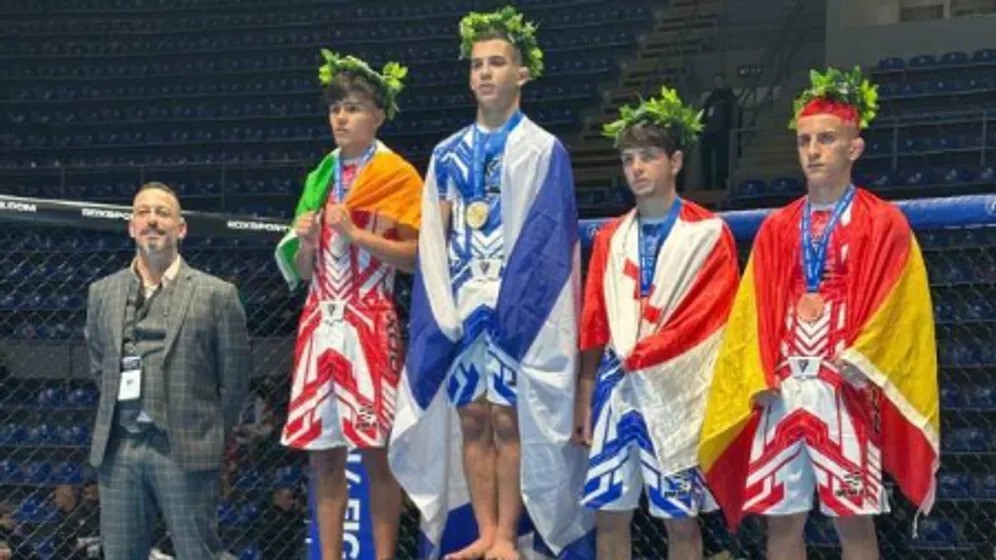
The narrative of Israeli achievement took on a particularly historic dimension in Belgrade, where the IMMAF European Championship unfolded under the auspices of the International Mixed Martial Arts Federation. There, two young Israelis, Guy Pariente and Alon Avital, etched their names into the annals of the sport. Pariente, just 15 years old, captured gold in the under-16 –62kg division, defeating an Irish opponent in the final. The Algemeiner report highlighted the singularity of this moment: Pariente became the first Israeli ever to win gold at the European MMA Championships in any age category. The ceremony that followed, in which his father Ido—president of the Israeli MMA Federation—presented the medal as “Hatikvah” was played for the first time in the competition’s history, was imbued with a symbolism that transcended sport. The Algemeiner report described the anthem’s debut in that arena as a moment of cultural affirmation, the resonance of a national melody underscoring a personal triumph.
v
View this post on Instagram
Avital’s victory in the under-18 –79kg category, secured against an Austrian opponent, further amplified the sense of a breakthrough. These wins were not anomalies but part of a broader surge: the Israeli delegation amassed a total of 17 medals at the Belgrade championships. Silver medals were claimed by Uriel Barak in the under-18 –70kg category and Yulia Schlesinger in the –57kg division, while Ori Zerbel and Tal Foris secured bronze in their respective age and weight classes. This collective haul positioned Israel as a rising force within European mixed martial arts, a sport whose competitive ecosystem has historically been dominated by nations with longer traditions in combat disciplines.
Even as these victories unfolded across Europe, Israeli athletes were carving their own narratives within the crucible of the Milan Olympics. Jared Firestone, competing in skeleton, entered a discipline as unforgiving as it is obscure, hurtling headlong down ice tracks at velocities that render split-second decisions existential. Firestone, who is also a practicing lawyer, stood 22nd after the second heat and was set to compete in the third leg of the competition. His presence in skeleton carries its own historical weight: he is only the second Israeli ever to compete in the sport at the Olympic level, following AJ Edelman, who this year pilots Israel’s bobsled team.
The Algemeiner report framed Firestone’s participation as emblematic of Israel’s expanding footprint in winter sports, arenas once considered peripheral to a nation more commonly associated with Mediterranean climates than alpine descents.
Barnabas Szollos, racing for Team Israel in alpine skiing, added another chapter to this unfolding story. Competing in the Super-G event, Szollos finished 33rd out of 42 participants, following an earlier downhill competition in which he placed 30th out of 36. These results with a tone of measured realism, acknowledging that Olympic participation itself constitutes a formidable achievement, particularly in disciplines where Israel’s institutional infrastructure is comparatively nascent. Szollos’s performances, while not medal-winning, were framed as incremental steps in the slow accretion of experience that defines a nation’s entry into elite winter sport.
Taken together, these disparate achievements compose a portrait of Israeli sport in a moment of expansive reach. The Algemeiner’s frequent references to competitions in Italy, Spain, and Serbia underscore the geographic breadth of this month’s successes, while the inclusion of Olympic participation in Milan situates these feats within the broader theater of global sport. What emerges is not a singular narrative of triumph but a polyphony of efforts, each athlete contributing to a collective presence that is increasingly visible on the world stage.
The resonance of these victories extends beyond medal counts. In disciplines as varied as ju-jitsu and MMA, where physical confrontation is mediated by rigorous codes of respect and discipline, Israeli athletes have demonstrated not only technical proficiency but a capacity to embody the ethos of their sports. Such performances serve as informal ambassadors, projecting images of Israeli youth defined by resilience and aspiration rather than by the reductive stereotypes that often dominate international discourse. In the arena of windsurfing,
Kantor’s silver medal reaffirmed a tradition of maritime excellence that aligns Israel’s sporting identity with its Mediterranean horizon. In skeleton and alpine skiing, Firestone and Szollos have begun to carve pathways into terrains that were once peripheral to Israeli athletic ambition.
As the Milan Olympics continue to unfold, and as competitions across Europe draw to a close, the month’s harvest of medals and milestones invites reflection on the evolving architecture of Israeli sport. The image of Ido Pariente placing the gold medal around his son’s neck while the national anthem reverberated through a European hall captures, in miniature, the intergenerational transmission of aspiration that underlies athletic success.
In the end, the blue-and-white banners that have fluttered above podiums this month tell a story of continuity and change. Israel’s athletes are no longer confined to a narrow band of disciplines or regional competitions; they are present, competitive, and increasingly consequential across a spectrum of global arenas. The Algemeiner’s chronicling of these moments invites readers to perceive in them not merely the accumulation of medals, but the articulation of a national sporting identity that is both plural and aspirational—one that, in the shadow of the Olympic flame, continues to assert itself with quiet, determined grace.
