



|
Getting your Trinity Audio player ready...
|
From Exodus to Economic War: Argentina’s Milei Invokes Ancient Liberties at Davos, Ties His Destiny to Trump’s Vision
By: Fern Sidman
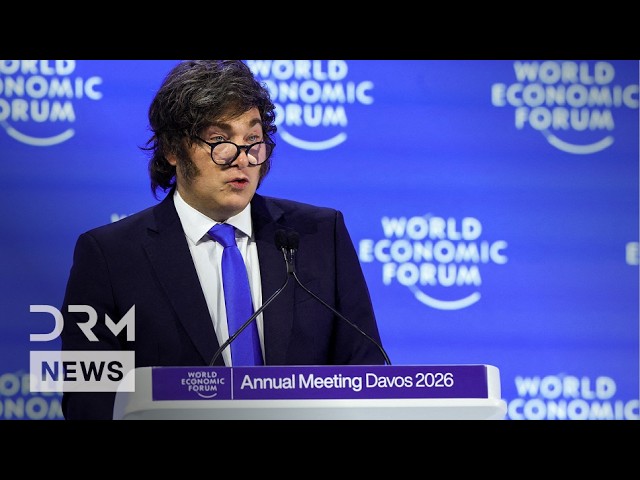
Argentinian President Javier Milei delivered a momentous address at the World Economic Forum (WEF) in Davos, Switzerland, on Wednesday, interweaving biblical allegory, staunch advocacy of free-market capitalism, and a pointed ideological endorsement of U.S. leadership—particularly that of President Donald Trump. The speech, reported on by World Israel News, marked a strategic moment in Milei’s ascending global profile and underscored his efforts to align Argentina with what he defines as the core values of Western civilization.
In a forum dominated by global elites, corporate executives, and international policymakers, Milei’s remarks stood out for their moral urgency and philosophical ambition. While delivered with more measured rhetoric than some of his prior outbursts, his address reiterated his core themes: liberty, economic deregulation, and a rejection of socialism and collectivism. More strikingly, Milei invoked the biblical story of Exodus—drawing a historical parallel that placed the modern West’s political trajectory within the larger narrative of liberation from tyranny.
Milei’s address came shortly after President Trump’s own speech at Davos—where Trump unveiled his controversial “Board of Peace,” a diplomatic initiative focused on Gaza and wider geopolitical stabilization efforts. Miles lauded the United States as “the beacon of light that reignites the whole of the West,” framing Washington’s leadership as central to a broader ideological renaissance.
For Milei, the ascent of the U.S. under Trump’s leadership signifies not only a rebuke to socialist governance, but a restoration of foundational civilizational principles. This rhetoric resonated throughout his speech: the West, in his telling, stands at a crossroads between freedom and decay, and the choices made today will determine whether it continues the historical arc toward liberty first envisioned by ancient traditions. Milei’s invocation of the United States was not mere praise; it was a declaration of shared destiny and ideological continuity.
Perhaps the most dramatic portion of Milei’s address came in the form of a theological-cultural analogy. Drawing upon Parashat Bo—the Torah portion that recounts Moses’ confrontation with Pharaoh and the plagues inflicted upon Egypt—Milei sought to illuminate his critique of modern governance.
“In Parashat Bo,” Milei explained, “Moses stands before Pharaoh as a voice of liberation against despotic authority. When Pharaoh refuses freedom, the plagues arrive—the plague of locusts signifying famine, the plague of darkness signifying loss of clarity, and finally the death of the firstborn, a dire outcome for those who deny liberty.”
This biblical parallel was more than literary flourish; it was a moral indictment. Milei drew an explicit line between Pharaoh’s stubbornness and what he perceives as the West’s growing embrace of authoritarian economic controls, regulatory expansion, and cultural narratives he believes undermine individual autonomy. The imagery of locusts, darkness, and death served as a stark cautionary tableau: societies that forsake freedom risk their own ruin.
Throughout his address, Milei afforded free-market economics a moral dimension. “Free-trade capitalism is the only fair system,” he declared, rejecting regulatory frameworks that, in his estimation, suppress performance and stifle human potential. Milei’s narrative was not purely economic; it was ethical and civilizational. He decried socialism as a system that “always ends badly, horrifically badly,” invoking Venezuela’s catastrophic descent as a cautionary exemplar.
Since assuming office in December 2023, Milei touted the implementation of “13,500 structural reforms,” praising ministries dedicated to deregulation and human capital. This rhetorical emphasis on the volume and depth of reform served to affirm his commitment to radical economic transformation—casting Argentina as a laboratory of liberty in a world he argues is increasingly susceptible to collectivist ideologies.
Milei’s remarks in Davos were not delivered in isolation. They build upon a broader ideological coalition that has been gaining traction among certain right-leaning governments and political movements worldwide. This coalition includes, notably, the U.S. under Trump’s leadership, which launched the aforementioned Board of Peace—an international initiative intended to oversee postwar reconstruction and governance reforms in Gaza and more broadly to rival or supplement existing global institutions.
While some nations have been wary of Trump’s board—citing concerns over its potential to supplant the United Nations or lack of multilateral coordination—the participation of Argentina under Milei demonstrates a strategic alignment among nations that share skepticism of traditional global governance models. Argentina’s inclusion in the Board signifies a diplomatic endorsement of U.S.-led frameworks, even as debates about the board’s structure and mandate continue.
Central to Milei’s critique was a categorical rejection of socialism and what he termed “populist and impoverishing ideas.” For Milei, the triumph of free-market capitalism is not merely an economic preference—it is a civilizational imperative. In his worldview, unfettered markets empower individuals and enable societal flourishing, while state-driven redistribution and regulation entrench dependency and diminish liberty.
This is where Milei’s use of biblical analogy gains its strategic depth: he frames the struggle between economic freedom and state control as not merely a political debate, but a moral confrontation reminiscent of the Hebrews’ deliverance from Egyptian oppression.
In doing so, Milei situates Argentina’s own reforms within a broader narrative of liberation—a historical continuum that begins in antiquity and extends to the ideological battles of the 21st century.
Milei’s speech was also an exercise in identity politics on a civilizational scale. By invoking Judeo-Christian symbolism, classical Western thought, and the foundational virtues of liberty, he sought to reassert a particular narrative of Western heritage—one rooted in individual autonomy, limited government, and economic liberty.
This is a critical moment, he argued, in which societies must choose between embracing the emancipatory legacy of the West or succumbing to the expanding reach of collectivist governance. Argentina, he posited, is on the side of history that champions freedom, and by extension, so too should the West.
Milei’s closing words—an emphatic declaration of liberty—echoed his well-known rallying cry ¡Viva la libertad, carajo! (Long live freedom, damn it!)—a phrase that has come to define both his political brand and his philosophical mission.
This defiant exit encapsulated the essence of his address: a call to arms—not in the martial sense, but as an appeal to ideological courage. Milei challenged his global audience to defend the principles he believes underpin Western civilization: liberty, free enterprise, and individual dignity.
In bringing together biblical narrative, economic theory, and geopolitical alignment with the United States, Milei’s address at Davos has reverberated far beyond the Alpine forum. As World Israel News reported, the speech signaled not only Argentina’s philosophical stance but also its geopolitical orientation—a clear statement of alignment with Washington’s vision of Western leadership under Trump.
For observers, the significance of this moment lies in its fusion of moral narrative with realpolitik. Whether one agrees with Milei’s prescriptions or not, his Davos address underscores the intensity of the ideological contest swirling around economic systems, national sovereignty, and the very future of Western identity.
As global leaders return from Davos to their capitals, the imagery of Moses confronting Pharaoh—a symbol of resistance, authority, and liberation—offers a powerful metaphor for the ideological battles ahead. Whether that metaphor will guide policy decisions or merely be a stirring rhetorical flourish remains to be seen. Yet in invoking the Exodus story, Milei has ensured that his vision of liberty will be heard not just in economic circles, but within the deeper cultural and historical narratives that continue to animate global politics.
