



|
Getting your Trinity Audio player ready...
|
By: Chaya Sora Jungreis-Gertzulin
This past Sunday brought a fierce winter storm across much of the U.S. We got hit with a whopper. An Arctic blast, frigid temperature, strong winds and a sizable snowfall, topped off with sleet and freezing rain.
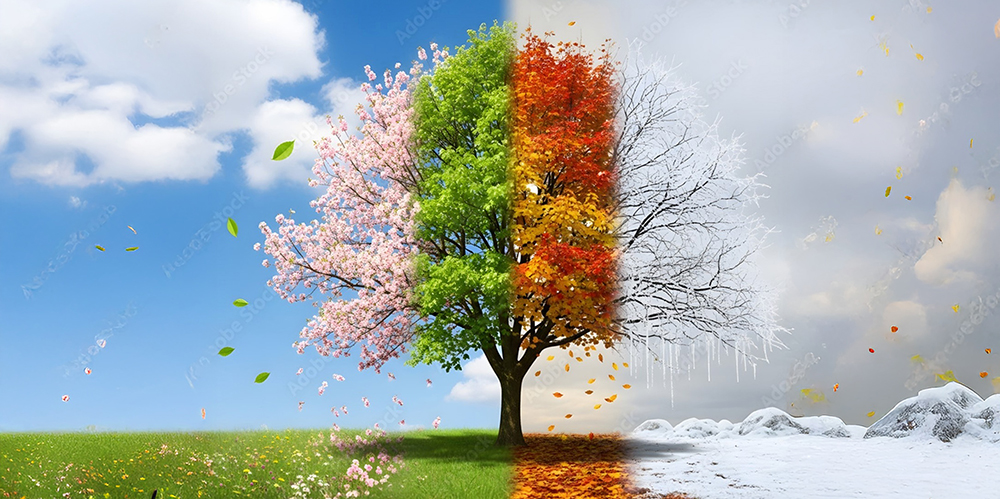
At the same time, it is Chodesh Shevat, the month we celebrate Tu B’Shevat, Rosh HaShana L’ilanos, the New Year for Trees. This leaves us with a question – why celebrate the rebirth of trees in midst of winter? Wouldn’t it be more appropriate in the springtime, when all is abloom?
The Talmud teaches that Tu B’Shevat is when the sap that lays beneath the ground starts to rise, entering the tree. It brings new life to the barren trees, giving them the ability to blossom and eventually produce fruit. We don’t see it happening, but it is real. Tu B’Shevat is a time to celebrate the process of renewal, the rebirth of the bare tree to one that is blessed with fruit. Tu B’Shevat teaches us to value unseen growth—spiritual and personal—even when the world looks frozen.
As Rabbi Samson Raphael Hirsch (1808-1888) so eloquently wrote, “Though still in the middle of the bleak embrace of winter, the gentle murmur of the awakening spring begins its hidden work. In the core and the atrial network of the trees, silently and softly hidden from view, the new sap flows, announcing the coming of spring.” Rabbi Hirsch highlights the contrast between the external, harsh reality of winter and the hidden, inner stirring of life that promises future growth, a metaphor for the resilience and spiritual potential of the Jewish people.
The Torah compares man’s life to that of a tree. “Ki Ha’adam eitz ha’sodeh…, For man is like a tree of the field…” (Devarim 20:19). In winter, the trees stand alone, their dry branches reaching upward. The ground is hard, cold, at times even frozen. Winds come, and the branches sway this way and that way. Yet, there is hope. There is rebirth. The tree will bear fruit once again.
Like a tree, at times we go through the harsh, cold winter of life. Like the withering branches that turn upward, we turn to HaShem and ask for His brachos. Just as the winds blow the tree, we have our “shaky” days, feeling vulnerable. We ask HaShem for the gift of new beginnings. That our “inner sap” will rise and give us strength. As Rabbi Hirsch writes, Tu B’Shevat teaches us that just as a tree holds life within its core during winter, the Jewish spirit remains alive and active even during the coldest, bleakest times of history.
Since October 7, this message has taken on extra meaning. As a nation, we have gone through a stormy winter. Like the empty, forlorn branches, we have been abandoned, standing alone amongst the nations. The winds of anti-Semitism have hit us hard. From the college campuses here at home to the tragic Chanukah massacre in Bondi Beach, to – just this week – the vile desecration of Jewish graves at a cemetery in Barcelona – and so many more. Yet, we hold onto the belief that “springtime” is on the way, the buds and blossoms will reappear, and we will even see the lush fruits of accomplishments and blessings.
Tu B’Shevat is a day to remember that each fruit is a creation of HaShem, each one a gift from Above.
A story is told of Rav Gamliel Rabinowitz who regularly learned together with his rebbi, Rav Zundel Kroizer zt”l, in his home. One day, as they sat down to learn, a bowl filled with fruits was brought to the table. An orange fell onto the table and rolled off to the floor. Rav Kroizer, who was well into his 80s, instinctively bent down – with much effort – to pick up the orange. Rav Rabinowitz (who was 25 years his junior) said that he would have picked it up, so why did his rebbi leap to retrieve the orange?
Rav Kroizer replied that an orange is a davar sheh’b’kedusha, a holy creation of HaShem. How could he not bend down and pick it up. Just think of the z’chus of picking up HaShem’s creation.
What a lesson. To look at each fruit as an object of kedusha. Let’s take it a step further. Man is compared to “the tree of the field”. If Rav Kroizer was able to see the holiness of an orange, imagine the sanctity within each and every man, for each of us is a creation of HaShem.
On Tu B’Shevat, many of the Chassidic rebbes have a custom to conduct a tisch, a Tu B’Shevat table, where the rebbe distributes fruits to those assembled. The tisch is not only a time to partake in fruits, but to hear words of Torah from the “Eitz Chaim”, the Tree of Life, our beloved Torah.
It is told about Rav Yitzchok Izak of Zidichov (1805-1873), that one year he had an unusually large crowd attending his Tu B’Shevat tisch. Unfortunately, there were insufficient fruits to distribute. The rebbe stood up and delivered a powerful message, more meaningful that any fruit.
“I will tell you where fruits are available. The Mishna teaches, ‘These are the mitzvos whose fruits a person enjoys in this world but whose principle remains intact for him in the World to Come’. The Mishna ends with ‘And the study of Torah is as great as all the others put together’. Go and study Torah, and you will find an abundance of fruit, besides the reward that awaits you in the World to Come.”
There are many beautiful Tu B’Shevat customs. One is to eat from the Shivas Ha’minim, the Seven Species that are mentioned in the Torah, as foods that Eretz Yisroel is praised for. Rav Aharon of Belz would begin his Tu B’Shevat seuda with bread made from wheat, then drink beer made from barley, wine from grapes, and then enjoy some figs, pomegranates, olives and dates. The Ben Ish Chai teaches that Tu B’Shevat is a propitious time to daven for the various agricultural items that are used for mitzvos – grapes for kiddush and havdala, esrog and lulav for arba minim, wheat for our Shabbos challa and Pesach matzah.
There is a story about a man in need of a major refuah who approached HaRav Shlomo Zalman Auerbach, zt”l, seeking advice on how to beseech HaShem to have mercy upon him.
“I will tell you what I would do in such a situation”, said Rav Shlomo Zalman. “I would strengthen myself in the reciting of brachos, making sure to enunciate each word carefully, clearly, and with proper concentration. If I were to succeed in that, that would be for me a great accomplishment.” (Meah Berachos K’Hilchasa)
My mother a”h would say that we eat healthy to nourish our body, but what do we do to nourish our soul? Say brachos with meaning. Each bracha brings a spark of light to our neshama.
This Tu B’Shevat, as we enjoy our fruits and say our brachos, let’s try to concentrate a little harder on the words, and really thank HaShem for His kindness.
Shabbat Shalom!
Chaya Sora
Chaya Sora can reached at [email protected]
This article was written L’zecher Nishmas / In Memory Of HaRav Meshulem ben HaRav Osher Anshil HaLevi, zt”l and Rebbetzin Esther bas HaRav Avraham HaLevi, zt’l