



|
Getting your Trinity Audio player ready...
|
By: Chaya Sora Jungreis-Gertzulin
Tu B’Shevat, the 15th day of Shevat, is known as Rosh HaShanah L’ilanos, the New Year for Trees. (This year, Tu B’Shevat occurs on Thursday, January 25.)
It is still winter, the sky is grey, the trees are bare, and there is a chill in the air. Yet, we celebrate HaShem’s blessing the fruit trees with the power of rejuvenation.
An inspiring story is related by Rabbi Yitzchok Zilberstein about the Spinka Rebbe, Rabbi Yitzchak Isaac Weiss (1875-1944). The Rebbe was having his annual Tu B’Shevat tish. The table was set royally, laden with beautiful platters of fresh fruits and fine wines. The chassidim surrounded the Rebbe, listening attentively, holding on to each and every one of the Rebbe’s words.
They may have been sitting in Spinka (then in Hungary, now Romania) but the Rebbe’s words transported the chassidim to the Holy Land, to Eretz Yisroel.
All eyes were on the Rebbe as he picked up a new fruit, ready to say the bracha of Shehecheyanu.
Suddenly, Bang… Bam… Crash. Shards of glass went flying all over the room. Local hoodlums hurled large rocks through the window, shattering the glass. Miraculously, no one was injured.
The incident was a cruel reminder to the chassidim that they were still in galus, in exile. That they were living amongst people who had no need for them. People who actually detested them, and the beautiful community they had built.
The Rebbe maintained his composure, held the fruit up high, ready to recite a bracha, ready to thank HaShem.
The chassidim looked at their leader in wonder. How can he just continue on at a time like this. The Rebbe observed their bewildered expressions, put down the fruit and explained. “For every mitzva there is a special time, when its inner meaning can be revealed. The day of Tu B’Shevat reminds us of the future geula, redemption. Even though we are now in exile, the redemption is very much a real thing. On Tu B’Shevat, a ray of light shines in the darkness. But if we would not be aware of the darkness of the exile, we would not see the light.”
The Rebbe’s words uplifted the chassidim, and together, with much simcha, they all said Shehecheyanu.
The power of the Rebbe. To give hope in times of darkness. The Rebbe didn’t allow the Tu B’Shevat celebration to be marred, but took the anti-Semitic incident as an opportunity to inspire the community.
One can wonder whether it would be timelier to celebrate “Tu B’Shvat” in the springtime – April or May – when the trees are in full bloom.
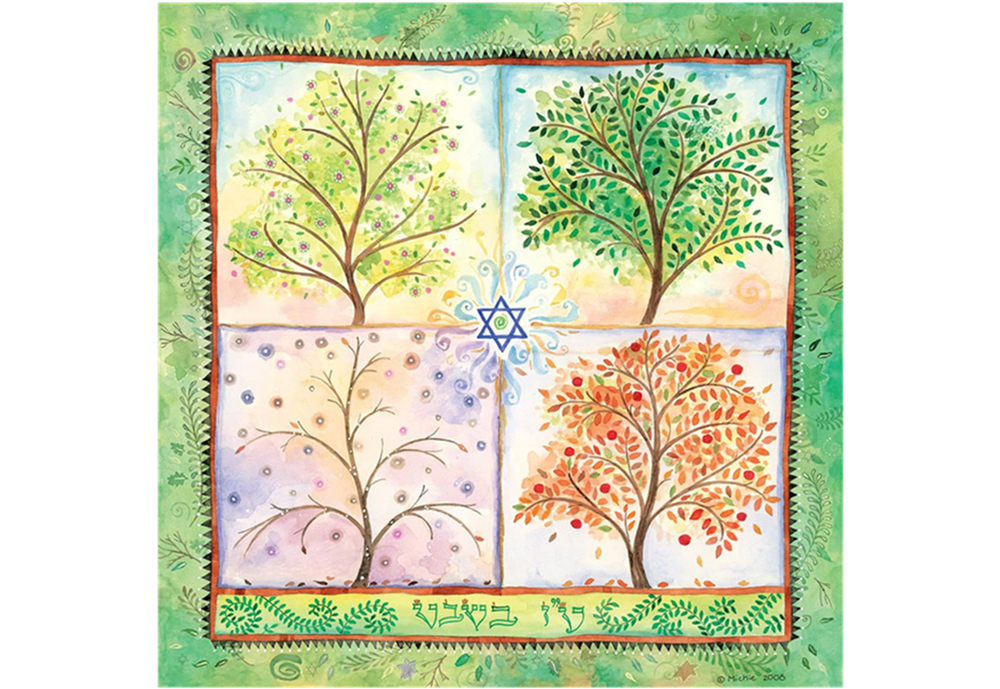
The answer is that the while the trees look dead, while it appears that they will never have another green leaf emerging from them, in reality it is at this time that the sap is beginning to run within them. The leaves and the fruits that the trees will produce in the spring and summer are all being prepared now, in the dead of winter. As Rabbi Samson Raphael Hirsch, zt”l wrote regarding Tu B’Shevat, “Behold, today they are celebrating the birthday of the coming of spring. Under the torn, dark, cold bark, fresh life pulsates.”
While all may seem dark to us, HaShem is preparing the trees to give forth fruit in the months ahead. On Tu B’Shevat, trees emerge from their winter sleep and begin a new fruit-bearing cycle.
Tu B’Shevat comes to remind us that the branches will be full of leaves once again. The fruit trees will bud and blossom. The grass will grow anew. Spring is on its way.
On Tu B’Shevat, there is a custom to make brachos and enjoy multiple fruits. Some even partake of fifteen different fruits in honor of the 15th of Shevat. Another custom is to taste from each of the shivas haminim – the seven species that Eretz Yisroel is praised for. “A land of wheat and barley, of grapevines, figs and pomegranates, a land of olive trees and honey from dates.” (Devarim 8:8)
A man in need of a major refuah, healing, approached HaRav Shlomo Zalman Auerbach, zt”l, seeking advice on how to beseech HaShem to have mercy upon him.
“I will tell you what I would do in such a situation”, said Rav Shlomo Zalman. “I would strengthen myself in the reciting of brachos, making sure to enunciate each word carefully and clearly and with the proper concentration. If I were to succeed in that, that would be for me a great accomplishment.” (Meah Berachos K’Hilchasa, Ner L’Elef Resources)
This Tu B’Shevat, as we say our brachos, let’s try to concentrate a little harder on the words, to really thank HaShem for His kindness, thereby nourishing ourselves both physically and spiritually.
Tu B’Shevat occurs around the time in which we read Parshas B’Shalach, story of the Exodus. What is the connection between Tu B’Shevat and the Exodus?
The sap enables the tree to grow, flourish and bear fruit. As the sap brings new life to the tree, so too, did the Exodus give new faith and hope to Am Yisroel. They were infused with a new spirit, to thrive and produce their own “personal trees” of mitzvos and good deeds.
This year it isn’t just the winter sky that looks grey and gloomy. We are a nation at war. We are crying for our people. For the lives lost, the families in pain, the communities devastated. For the hostages and for the injured. The bare trees give us a message. Even when something looks terribly bleak, and looks like it has no future, one should not give up. As we don’t give up on the trees, one should not give up on oneself when things look dark and hopeless.
Even though rocks came crashing upon the Rebbe’s tish, he did not allow the spirit of the moment to be destroyed. He used the incident to convey a life lesson. We may be in exile, he told his chassidim, but Tu B’Shevat teaches us that we can only appreciate light when we experience darkness. And with HaShem’s help, we have the emunah that the light will come soon.
The Hebrew month Shevat is spelled shin, beis, tes. It is an acronym for a message of hope. Shin – Shenishma, we should hear; Beis – Besuros, news; Tes – Tovos, that is good. The month of Shevat heralds good tidings. As winter becomes spring, blessing comes our way.
Let us take the Rebbe’s words to heart. While we are experiencing dark and difficult days, Tu B’Shevat’s message is that the sun will shine once again, the trees will bud and bear fruit, the flowers will blossom, ushering in a period of light, bringing this difficult exile to an end.
Chaya Sora can be reached at [email protected]
This article was written L’zecher Nishmas/In Memory Of HaRav Meshulem ben HaRav Osher Anshil HaLevi, zt”l and Rebbetzin Esther bas HaRav Avraham HaLevi, zt”l
