



|
Getting your Trinity Audio player ready...
|
By: Chaya Sora Jungreis-Gertzulin
It was Rosh HaShana night, and our family was enjoying sweet apples and honey. The conversation around the table turned to why apples from all the fruits. Though there are several explanations, my nine-year-old granddaughter, Tehila, shared her own original understanding.
“There are so many different kinds of apples. Red, green, yellow. Different sizes, shapes and tastes. But they are still all apples. It’s like the Jewish people. We are all different – but we are all one.”
How special from a young girl, and so true. I visualized the many varieties of apples. Cortland, Macs, Red Delicious, Golden Delicious, Granny Smith, Honeycrisp, Pink Lady, Gala, and it goes on.
And so it is with Am Yisroel. Diversified, yet all part of one people.
The theme of unity is intrinsic to this yom tov season. We build succahs and remember the Ananei HaKovod, Hashem’s Heavenly Clouds that surrounded Bnei Yisroel as they journeyed through the desert. A nation travelling together. All under the protection of HaShem’s clouds. A nation that stood at Sinai and accepted the Torah k’ish echad b’lev echad, as one man with one heart.
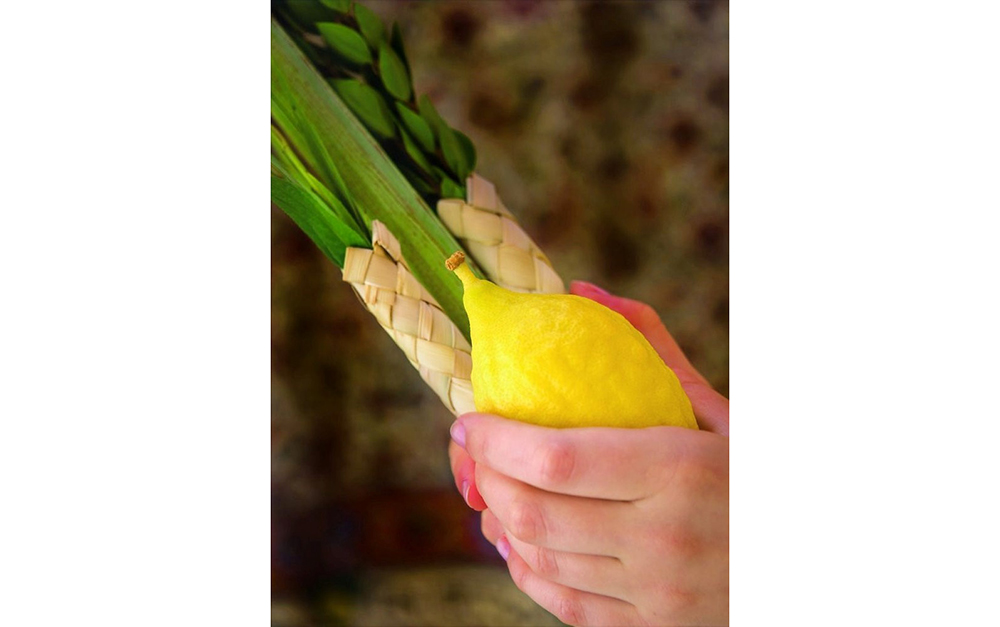
Besides building and dwelling in a succah, another mitzva of Succos is the Arba Minim, the four species, the term commonly referring to taking the lulav and esrog. “You shall take for yourself on the first day the fruit of a beautiful (esrog) tree, the branches of date palms, the twigs of a braided (myrtle) tree and willows by the brook.” (Vayikra 23:40)
The Rambam teaches that as we hold the lulav and esrog, we should think of Bnei Yisroel emerging from the desolate desert, an area of vast emptiness, and entering Eretz Yisroel, a land of beautiful fruits. On Succos we take the fruit and branches in our hand, we recite a bracha, and wave them in all directions. Like the walls of the succah that remind us that we are surrounded on all sides by HaShem’s presence, the waving of the Arba Minim reminds us that HaShem’s spirit can be found everywhere.
The Arba Minim have a deeper symbolic message. The message of unity, of our people being an am echad, one nation. Like the different apples, the four species are unalike, yet they are held together, close to our heart. Each one of the four is symbolic of different characteristics, with taste and fragrance alluding to Torah study and good deeds, respectively.
The esrog has both taste and fragrance, symbolic of one who possesses both Torah knowledge and good deeds. The lulav, a date palm, has taste but no fragrance, compared to one who has acquired Torah knowledge but is lacking in good deeds. The haddasim, myrtle branches, have fragrance but are devoid of taste, representative of one who performs good deeds but is deficient in Torah study. Finally, the arava, the willow, has neither taste nor fragrance, characterizing one who neither studies nor performs good deeds.
One would think that the esrog would be sufficient. After all, it has both taste and fragrance, Torah knowledge and good deeds. But we recite the bracha while holding all four species together, as one. A message to us all – every Jew is important. Each individual is an essential component of the entirety of klal Yisroel.
I saw a clip, where Rabbi Simon Jacobson was on a panel. It opened up to Q & A from the audience. A woman rose and asked, “When Moshiach comes, what will happen to people like me who aren’t observant and are lacking in Torah knowledge?”
There was a heavy silence in the room. It was filled with many others like her, waiting for the Rabbi’s response.
It took Rabbi Jacobson a minute to collect his thoughts. He told over a teaching of Rabbi Shneur Zalman of Liadi, known as the Baal HaTanya, the first Rebbe of the Chabad movement. If one doesn’t have an answer to a question, tell a story. If that doesn’t work, sing a song. With that, he broke the ice.
He then shared a story from the fifth Rebbe of Chabad, Rav Sholom Dov Ber.
One Simchas Torah, the Rebbe spoke about the beauty of the “poshute Yidden – simple Jews.” One of his chassidim became upset. He approached the Rebbe and asked, “Why only speak about the poshute Yid, why not about the tzaddikim and the learned ones?”
This chossid was a diamond dealer. The Rebbe asked him to go home and return with a bag of diamonds. While the chossid didn’t comprehend the reason for the Rebbe’s request, he did as instructed.
The chossid returned to the Rebbe with the diamonds. The Rebbe said that he will choose the most valuable stone and proceeded to pull out the largest diamond.
“I’m sorry Rebbe, but that one is not the most valuable. It may be the largest, but that doesn’t mean most valuable. You need a trained eye to see the true value of a diamond.”
“Aha”, said the Rebbe. “You need to be a diamond dealer to know a diamond. You need to be a ‘soul dealer’ to recognize the most precious soul.”
Rabbi Jacobson continued and explained that souls are measured by the journey, the challenges one undergoes. He added that he was taught that when Moshiach comes, those with the greatest challenges will lead the line. He only hopes to stand behind them.
After that story, there was no need for a song.
There is yet another understanding to the Arba Minim. The Sefer HaChinuch teaches that each one of the four alludes to a different body part. The heart-shaped esrog reminds us of a place of understanding, sensitivity and compassion. The lulav stands tall and straight, symbolizing the spine. To have backbone and stand up for what is right, true and just. The hadassim, are shaped like an eye. To have an ayin tov and see the good in others. Arovos are lip-shaped, cautioning us to be careful with our words. Speech is a G-d given gift. Use it well.
I think of my husband, who on erev Succos is busy weaving palm leaves to make rings that hold the lulav together. The lulav is then encircled by the hadassim and aravos, which together with the esrog will create the aguda achas, the one bundle of all four species.
The Talmud teaches (Menachos 27a) that just as it is required to hold all of the Arba Minim together in order to perform the mitzva, so too, when the Jewish people turn to HaShem, their tefillos are only answered in the merit of their being “bundled together”, united as one.
With everything our nation is experiencing, from the war in Gaza to increased anti-Semitism, more than ever we need HaShem to answer our tefillos. May we merit to stand together, united in heart and purpose and greet Moshiach, quickly in our days.
Wishing all my readers a Good Shabbos, Chag Sameach
And ah gutten kvittel.
Chaya Sora
Chaya Sora can be reached at csgertzulin@gmail. com
This article was written L’zecher Nishmas /In Memory Of HaRav Meshulem ben HaRav Osher Anshil HaLevi, zt”l and Rebbetzin Esther bas HaRav Avraham HaLevi, zt”l
