



|
Getting your Trinity Audio player ready...
|
By: Chaya Sora Jungreis-Gertzulin
I opened the door of my over-stuffed freezer, and a large roast came tumbling out, right onto my poor toes. OUCH!
No one was home, not a soul around to hear me, yet I cried out in pain. Broken toes hurt.
In a lecture entitled “Scream if it Hurts”, Rabbi Zechariah Wallerstein z”l, said that it is human, even instinctive, to cry out when in pain. While it doesn’t make the pain go away, nor does it alleviate the problem, we cry out. Why? Because it hurts.
Rabbi Wallerstein shared that so it is with spiritual and emotional pain. We must call out to HaShem, even if we don’t see an immediate fix. Cry, pray, call out to Him. Tefilla is the voice of the neshama, calling out, I’m in pain, it hurts. Help!
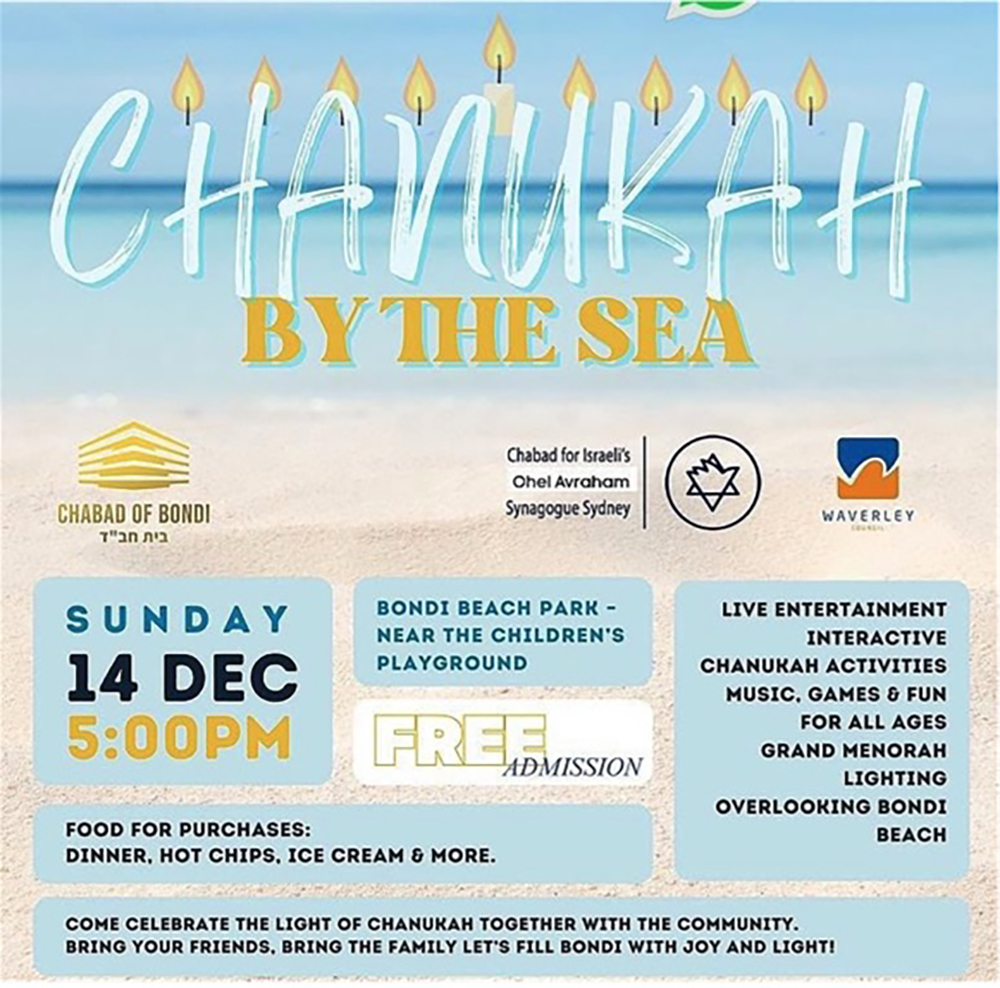
This past Sunday morning, I, like so many others, woke up to the most devastating news. A targeted terror attack at a Chanukah gathering at Bondi Beach. What was meant to be a time of light and celebration, became one of darkness and mourning. A living nightmare.
For Jews worldwide, it is a time to scream – it hurts so much. While the massacre was thousands of miles away, while we may not know the families of the victims, and we may not know the injured, they are part of us. The Jewish nation is family. We are all one. And when any part of us is in pain, we cry out.
When I began writing these words, 11 holy souls were lost. 29 painfully injured. The cruel results of vicious hatred and evil anti-Semitism. As the hours passed, the number of kedoshim and injured continued to rise. 15 korbonos, innocent lives sacrificed, and over 40 injured.
Al eileh ani bochia, for these I cry. Each life holy, each one precious. A heartbreak. An unimaginable tragedy. Amongst them, Rabbonim, a holocaust survivor, a survivor of October 7, mothers, fathers, and a beautiful 10-year old girl. Each life lost is a world lost.
As a nation, we are in pain. Shocked to our very core. I know I have written it before, but my mother’s voice is haunting me. “Chaya Sorale, I’m so frightened. I feel it happening once again. The hatred, the anti-Semitism, the violence.” Words not only spoken to me, but shared by the Rebbetzin a”h in so many lectures and classes.
“Kinderlach, my dear children”, my mother would say, “We are sleeping. We have to wake up and see the world around us. We are living in the challenging time of ikvesa d’Meshicha, the footsteps of moshiach. The final days – and I don’t know how many those days will be – preceding the arrival of moshiach. Our answer to the pain that surrounds us must be one of inner strength. To be fortified by turning to HaShem. Our ammunition is a life of Torah, avoda – prayer, and gemilas chassodim – acts of lovingkindness. To be the very best Jew we can.”
Words my mother voiced years ago. Words we are living today. As a nation, we are not safe anywhere. We have been targeted so many times. Each time, is a time too many.
As I am writing, so many brutal acts of anti-Semitic terror come to mind. Who can ever forget the cruel Munich Olympic attack. Mumbai, Barcelona, Rome, Paris, Montpellier, London, South Africa.
Each generation believes the danger belongs to another place, another time—until it doesn’t. There was a time we all felt safe and secure in the US. After all, we are living in a democracy, gifted with the right of religious freedom, a government that protects its citizens. We would think it’s over there, it can’t happen here. How wrong we were. What a foolish thought. Why would it be safer for Jews here than anywhere else. The attacks on the Poway Chabad shul, the Tree of Life Synagogue in Pittsburgh, the Jersey City Kosher Market, the Chanukah stabbings in Rabbi Rottenberg’s shul in Monsey. The list continues. Boulder, Colorado, the DC Holocaust Memorial Museum, and even on our college campuses. Memories we let fade and forget, allowing them to slip into the recesses of our mind.
As Jews, we are all connected to one another, going all the way back to our patriarchs. The stories of our ancestors are our stories. Ma’aseh avos, siman l’bonim. Chazal teach that the deeds of the fathers are a sign for the children. Our lives and their lives are intertwined, mirroring one another. The Ramban comments that the Torah teaches so many details about the lives of the avos, in order to teach us about the future. Their life occurrences are prophetic of what the future holds for us.
In his weekly Shabbos drasha, the rov of our shul, Rabbi Yosef Frankel, Shlita, applied the above thought to the time when Yaakov was about to confront the treacherous hand of Eisav. Yaakov understood that he couldn’t allow his entire family to be together as one group. The Torah tells us that “He divided the people with him… so that if Eisav comes to one camp and strikes it down, then the remaining camp shall survive.” (Bereishis 32:8-9)
Throughout history, this lesson has faced us time and time again. There have been – and will always be – times when a part of Bnei Yisroel, the descendants of Yaakov, will be confronted by danger in their homeland and be forced to pick themselves up and relocate to another country. During the Inquisition, many were forced to flee to Portugal, Turkey, Greece and other Mediterranean countries. Following the pogroms in Russia, many immigrated to countries in Western and Central Europe, the United States, Canada, South America and Australia. More recently, following the Holocaust, our people were forced to move once again. This time, to either the United States, South America, Canada or Israel.
Today, we are once again faced with vile anti-Semitism. But now, there are no safe havens. There are no guarantees. Bondi Beach was known as a serene, tranquil place. Until, for a group of Jewish people celebrating Chanukah, it wasn’t.
Rabbi Frankel told us that it must mean one thing. That we are getting closer and closer to the coming of Moshiach. A time when all of the Jewish nation will be ingathered to our final home.
This Shabbos is Shabbos Chanukah. Parshas Mikeitz is almost always read on this Shabbos. Mikeitz means the end. In this week’s parsha, for Yosef, it was the end of his imprisonment in Egypt. The end of his difficult, dark journey. It’s Chanukah, our time to celebrate the triumph of light over darkness. Not just physical light and darkness, but spiritual. As the Lubavitcher Rebbe taught, even a little bit of light dispels a great deal of darkness.
As we sit around our menorahs and celebrate with our family, let’s remember to cry out for those who are hurting, those in pain. May we soon see an end to our long journey of darkness. May we be zoche to merit illuminating the dark world through the light of Torah, avoda and gemilas chassodim. May HaShem bring a keitz, a final end, to this difficult and long exile.
Wishing all my readers
Shabbat Shalom and a lichtige Chanukah!
Chaya Sora
Chaya Sora can reached at [email protected]
This article was written L’zecher Nishmas / In Memory Of HaRav Meshulem ben HaRav Osher Anshil HaLevi, zt”l and Rebbetzin Esther bas HaRav Avraham HaLevi, zt’l