



|
Getting your Trinity Audio player ready...
|
By: Chaya Sora Jungreis-Gertzulin
On a recent Friday afternoon, my friend Chayale received a surprise gift package – a bottle of wine and a cake. She wasn’t expecting Shabbos guests. It wasn’t her birthday or anniversary. Her curiosity was piqued. Who could it be from?
Chayale opened the card.
“To my neighbor. I live in the building next door. My window faces yours. Every Friday evening, as the sun sets, I see your Shabbos candles burning brightly. I sit by my window and gaze at your light. It means so much to me. I want to get to know you, and learn about Shabbos. – Svetlana”
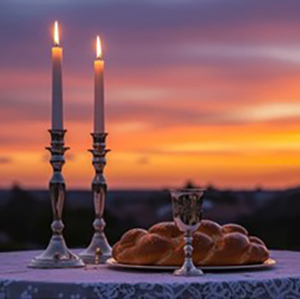
A heartfelt message. The power of Shabbos candles. Candles that burn so bright, they can kindle a soul. Spiritual flames, touching the Yiddishe neshama.
Svetlana included her number, and Chayale reached out and called her. They made up to meet on a future date. But the story doesn’t end there.
That was in Miami. The following week, Chayale flew to New York. With errands to run, and an available taxi nowhere in sight, Chayale took the subway. The train was beyond packed. As more people piled in, one really felt the crush. Chayale turned to the woman standing next to her, and apologized in advance, just in case she bumped into her when the train comes to a stop.
The two began conversing and discovered that they both flew into New York from Miami. They started playing geography, exchanging addresses. Chayale’s newfound friend on the train was none other than the woman watching the Shabbos lights from her window – Svetlana.
What are the chances of that happening? Of the millions of people she could have possibly bumped into on a crowded train, Chayale and Svetlana ended up standing next to each other.
Everything is bashert. If HaShem wants people to cross paths, it happens – at times, in the most unexpected ways.
When Chayale shared the story with me, it took her back in time to when she spent her first Shabbos, and experienced her first candle lighting. Chayale was invited to a home in Boro Park. After the men and boys left to shul, the women – her hostess together with her married daughters – went to the dining room to light candles. Just watching mother and daughters lighting together, standing over the candles, each silently engrossed in their own thoughts, their own tefillos, touched Chayale in a way she never felt before. All of a sudden, she was overwhelmed with a sense of longing for something she never had, and started to cry.
Tears from the neshama. A neshama that yearns for Shabbos.
The power of Shabbos candles. Candles that speak to the soul.
This Shabbos, we read Parshas Chayei Sara, the Life of Sara. Yet, the parsha speaks of Sara’s death. The Torah is imparting to us an important message. The life of Sara Imeinu, our mother Sara, lives on in each and every one of us. We are Sara’s daughters. We carry her spiritual DNA. We can emulate Sara’s life and follow in her ways.
Rashi cites a Midrash that Sara’s tent was known for three constant miracles:
Ner daluk –A light that stayed lit from one Shabbos to the next. Symbolic of the kedusha, the holiness that was intrinsically part of Sara’s being.
Bracha m’tzuya ba’eesa, a blessing would be found in the dough. Sara’s challa remained fresh from week to week, and was sufficient for all her guests. This alludes to the way Sara looked at everything in her life. It was all “fresh”. Her Torah, her mitzvos, never became stale, but was something she always looked forward to. Bread is also symbolic of the material in life. Sara was sameach b’chelka, happy with what she had. It was all good. It was never “out with the old, in with the new”. Her “things” never grew stale.
Anan koshur al ha’ohel, a Divine cloud that was “tied” to her tent, always hovering above it, signifying the kedusha within.
Three phenomena that also reflect the miracles that took place in the Mishkan, and later in the Beis HaMikdash. A ner tamid, a fire that was always burning, a reminder of HaShem’s constant presence. The lechem hapanim, the twelve special breads, symbolic of HaShem’s blessing of sustenance. And just as the Divine cloud hovered over Sara’s tent, so too, was there a cloud over the Mishkan, and the Shechina, the Divine presence, rested in the Beis Hamikdash.
Today, we no longer have a Beis HaMikdash, but we can strive to make our home a mikdash me’at, a sanctuary in miniature. A place of kedusha. We can follow in Sara’s footsteps, and bring the light of Shabbos into our home.
When we light our Shabbos candles, cherish the moment. We are all busy, with lots to do – especially during the short winter Fridays. But be sure to make time, not just to recite the bracha, but to linger before the lights, to really daven, to turn to HaShem with words of gratitude for the blessings in our life. Make it a “Thank You HaShem” moment. And also, use those special moments to ask for the needs in your life. To daven for those who need refuos, shidduchim, parnassa, children. To daven for Am Yisroel and Eretz Yisroel.
In our times, pain and uncertainty continue to shadow the world. Though the hostages have returned, Eretz Yisroel is still in danger, surrounded by enemies who continue to proclaim “From the River to the Sea”. And it isn’t just in Eretz Yisroel. The chant of “Globalize the Intifada” is spreading. A chant inferring that October 7 was okay. To globalize it. And here at home, the recent elections have instilled fear and uncertainty in many. But when we light candles and recite Kiddush, we are proclaiming that HaShem created the world. HaShem is in control.
On Shabbos we put everything on hold, the ultimate show of emuna. A belief that is comforting, especially during these difficult and unpredictable times. Emuna doesn’t mean that everything will turn out exactly the way we want it, but it does mean that we know HaShem has a plan, and ultimately it works out. A calming thought.
Licht bentschen, candle lighting, is HaShem’s gift to us. In Bereishis, we are told of the time before Creation. A time when the world was sohu, vo’vohu, a place of emptiness and disorder. A world of choshech, darkness. But HaShem proclaimed, “Yehi ohr, Let there be light”. Light to fill the world. Each week, come Shabbos, HaShem gives us the opportunity to be a partner in creation, to bring light into our home, into the world. With our Shabbos candles, we can rise above the darkness and bring true ohr, spiritual light to the world. Like Chayale, a neighbor across the street might notice our Shabbos candles, and we could have the merit of lighting the spark of Yiddishkeit that is embedded in every Jew.
The power of candles. The gift of Shabbos.
Shabbat Shalom!
Chaya Sora
Chaya Sora can be reached at [email protected]
This article was written L’zecher Nishmas / In Memory Of HaRav Meshulem ben HaRav Osher Anshil HaLevi, zt”l and Rebbetzin Esther bas HaRav Avraham HaLevi, zt”l