



|
Getting your Trinity Audio player ready...
|
By: Chaya Sora Jungreis-Gertzulin
Rabbi Yisrael Meir Lau, a former Chief Rabbi of Israel, is a most inspiring speaker, with a special knack for telling great stories. I had the good fortune of hearing Rabbi Lau speak, and share some of his amazing life experiences.
One of the stories Rabbi Lau related took place shortly after the fall of the Soviet Union. With the opening of the Iron Curtain, restrictions on religious expression and gatherings were eased, and Rabbi Lau seized the opportunity to travel to Moscow. He felt it was his duty to offer words of chizuk, strength and hope, to the community whose Jewish identity, religion and beliefs, had been stifled for so many decades.
For several nights in a row, Rabbi Lau spoke at the same shul. At each of the speeches, he noticed a tired-looking, elderly man in the same back-row seat. After each talk, the man would linger, watching as Rabbi Lau spoke to individuals who approached him. People seeking advice, asking for brachos, or just wanting to connect to the rov.
And then, the elderly man would silently walk to the exit.
It was the last day of Rabbi Lau’s visit. Once again, after his talk, people stood on line, waiting to speak to him. This time, the elderly man waited until everyone had their turn, and then made his way forward to Rabbi Lau. He sighed and “oy’d”, and sighed some more. It was hard for him to get the words out.
“It’s late”, Rabbi Lau said. “I’m leaving early tomorrow morning. Let’s walk together to the hotel, and we will talk.”
As they walked, the brokenhearted elderly man opened up. “Oy… If only I could see Eretz Yisroel. Oy… Just to stand before the Kosel… To daven at Kever Rochel.”
“Come with me”, Rabbi Lau offered. “I will help you settle in. With HaShem’s help, it will be good.”
“I wish… I wish.” With tears streaming down his face, the man spoke of his only daughter who married a non-Jew. “They live in St. Petersburg, and have two little boys. Two boys who are the love of my life. Two boys that are Yidden. Every Sunday, I make the trip to St. Petersburg. I go to my daughter, I pick up the boys, I hug them, I kiss them. I put one on one knee, the other on my second knee. I tell them stories of our people. Stories of Avraham, Yitzchok and Yaakov. Of Moshe, Dovid and Shlomo. Stories of Rabbi Akiva and Hillel.”
With his voice breaking, the man turned to Rabbi Lau and said, “If I don’t tell them, who will? How can I leave?”
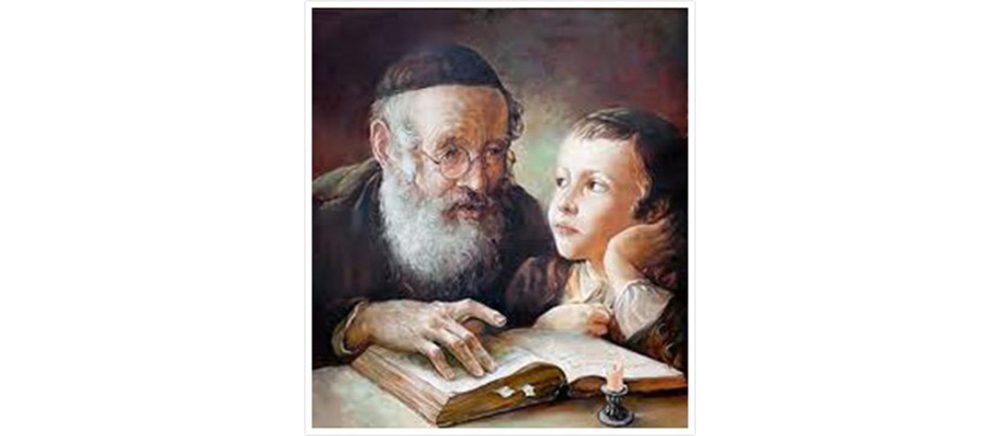
The love of a zeide. An elderly man, ready to travel hours, to see his grandchildren. To shower them with love, and give them a connection to their ancestors, to their heritage, to their people. A zeide who wanted to create a bond between his grandchildren and their past, to keep the spark of the pintele Yid burning within them. A zeide who realized that the strength and resilience of our nation is in knowing who we are, and where we come from. A zeide who yearned to give his grandchildren a sense of identity that defines where they are going to.
“Zechor yemos olam, binu shenos dor-v’dor, Remember the days of old, understand the years of generation after generation, Sh’al avicha v’yagedcha, z’kainecha v’yomru loch, Ask your father and he will relate to you, your elders and they will tell you.” (Devarim 32:7)
We are a nation that builds on our past. That understands that our ancestors’ lives and struggles, their deeds and actions, their accomplishments and triumphs, are all powerful life lessons.
In the book Sparks of Mussar, by Rabbi Ephraim Zaitchik, the Ramchal is quoted saying that a person should always ask himself what was it about our ancestors that caused HaShem to choose them. So too, we should ask ourselves, what did Moshe do, what did Dovid do? To contemplate upon the answer and internalize it within our personal lives.
This week’s parsha, Bo, stresses the importance of telling the story of our people, of teaching the next generation. “L’ma’an tesaper b’oznei vincha u’ven vincha…, In order that you shall relate it to your son and your son’s son. (Shemos 10:2)
“V’heeggadeta l’vincha bayom hahu leimor…, And you shall tell your son on that day…” (Shemos 13:8). To tell the story of our nation’s enslavement in Mitzrayim. Years of pain and torture. Times when they thought that they will never get out.
Mitzayim was the superpower of the time. Other nations looked towards Egypt with a mix of respect and fear. And then, when Bnei Yisroel couldn’t take it any longer, the unbelievable happened. Plagues that came with reversals of nature. A miraculous exodus of epic proportions. A story to tell our children. Yes, miracles, large and small, do happen.
The word Mitzrayim is from the root “tzaar”, narrow, locked in, restricted. There are times in life when we feel “locked in”, thinking how will we ever get out of this mess. Will the pain ever end? Will it ever work out? Will life ever return to normal? We tell the story of Yetzias Mitzrayim, the Exodus from Egypt, with all its miracles, to give our children, and ourselves, hope. We just need to really believe, to live our lives with emuna, that with HaShem’s help, there is a light at the end of the tunnel.
The mentioning of Yetzias Mitzrayim is unique in that it is recited numerous times in our daily prayers, as well as in our Shabbos Kiddush. It is also included in the Sheish Zechiros, the Six Remembrances. This is to reinforce within us that HaShem is the ultimate source of our freedom, and to remember that HaShem runs the world through both hidden and open miracles.
A story is told of the Chofetz Chaim, who in midst of speaking to his talmidim said that he learned Torah from the Vilna Gaon. How could it be, his students wondered. The Vilna Gaon lived many, many years before Chofetz Chaim.
The Chofetz Chaim explained, that he learned Torah from his father, who learned from Reb Chaim of Volozhin, who learned from the Vilna Gaon. Words of Torah passed down from generation to generation.
What stories are we telling, and to whom? When we tell the story to our children, and they in turn tell it to theirs, the links in the chain grow and grow. We not only learn from the previous generation, but connect to them, heart and soul. Their stories become our stories.
Shabbat Shalom!
Chaya Sora
Chaya Sora can reached at [email protected]
This article was written L’zecher Nishmas / In Memory Of HaRav Meshulem ben HaRav Osher Anshil HaLevi, zt”l and Rebbetzin Esther bas HaRav Avraham HaLevi, zt’l