



|
Getting your Trinity Audio player ready...
|
By: Chaya Sora Jungreis-Gertzulin
In this week’s parsha, we meet Balak, king of Moav. Though he was a king, the Chumash introduces him as Balak, son of Tzipor – sans the title melech, king. Ramban explains that Balak was an ordinary man, who upon seeing the encampments of Bnei Yisroel, became filled with feelings of fear, hatred and disgust. Strong, powerful emotions, that Balak exploited to incite the Moavites against the Jewish nation. He successfully built up a strong following, and ultimately became their king.
Balak saw in Bnei Yisroel a nation that grew and flourished, despite enduring the most difficult conditions in Egypt. A nation who even though were weakened by their seemingly endless travel through the desert, were able to defeat those who dared to confront and challenge them.
Balak realized that Bnei Yisroel’s strength and survival were a divine gift. They were HaShem’s people, led by Moshe, a spiritual leader, not a warrior. Balak decided that the only way to fight them was with spiritual power, and sought out the services of Bilaam, a sorcerer and practitioner of black magic. Balak’s hatred was so all-encompassing, that he offered to compensate Bilaam, both financially and with great honor. All Bilaam had to do was curse Bnei Yisroel.
“Moav became very frightened of the people… ki rav hu… because they were many, and Moav was disgusted because of Bnei Yisroel…” (Bamidbar 22:2-3)
Ki rav hu, because they were many. It is now over three thousand years later, but the anti-Semitism, the feelings of “they are many” still exists. Our nation is a minority, yet the majority of the world sees us as “many”. The chants of “from the river to the sea” doesn’t tolerate the existence of the Jewish nation. Even one minuscule strip of land is considered too much.
Even though it was more than a half-century ago, I can still visualize the picture in my mind. It was during the Yom Kippur War. A political cartoon appeared in one of the papers. It portrayed Arab leaders standing on the map of Israel, with one of them kicking an Israeli towards the sea.
Ki rav hu, because they are many. How often have we heard that the Jews control Wall Street, the Jews control Hollywood, the Jews control the media, the Jews control Washington. Ki rav hu, because they are many. For some, even one Jew is a Jew too many.
Balak recognized that our existence was beyond natural – it was a miracle, and it bothered him to no end. A miracle that has continued throughout the ages. What other nation has faced so many enemies, yet has survived and is here to prove it. B’chol dor vador, in every generation, there are those who try to destroy us, to knock us down, to do us in. Babylonians, Greeks, Romans, Crusaders, The Inquisition, pogroms, the Holocaust. And today’s merciless enemies, Hamas, Hezbollah, Iran, Houthis, and the terrorists they inspire throughout the world – even at our own doorstep.
But the miracle of our existence endures. Am Yisroel Chai. Our people are here. We are a nation of survivors.
What is our secret? In Tehillim we say, “Eileh va’rechev, v’eileh va’susim, some by chariot, and some by horse, va’anachnu b’shem HaShem Elokeinu nazkir, but we call out in the name of HaShem, our G-d.” To live one’s life being part of HaShem’s nation. To live life knowing that we are a miracle. That there is a HaShem above who watches over us. To really believe that although we may not always understand His ways, there is a reason for everything.
HaShem appeared to Bilaam, telling him not to heed King Balak’s request, yet Bilaam couldn’t resist. But, the King of kings had other plans.
“There came upon him a Ruach Elokim, a spirit of G-d” (Bamidbar 24:2). Rashi cites a Midrash which says that despite Bilaam’s malevolent intentions, a spirit entered his heart, warning him not to curse Bnei Yisroel. Thereupon, Bilaam’s words became words of blessing.
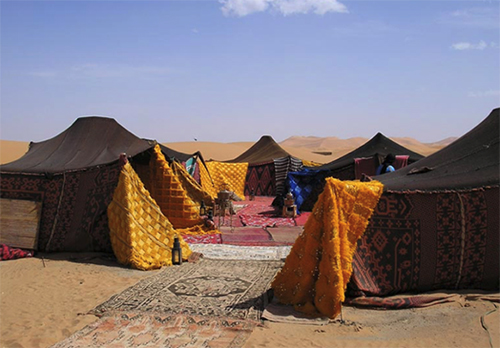
“Mah tovu ohalecha Yaakov, How goodly are your tents, (children of) Jacob, mish’ke’nosecha Yisroel, your dwelling places, (children of) Israel”. (Bamidbar 24:5) Words said by Bilaam – a curse turned into blessing. A bracha so eloquent, so meaningful, so intrinsic to our faith, that we begin Shacharis prayers with these very words.
Rashi explains that Bilaam was referring to the beautiful way Bnei Yisroel built their tents. No two openings faced one another. Each family respected the privacy of their neighbor, never looking in, or even taking a peek. Man is by nature a curious creature. Just think of all the traffic backups caused by rubbernecking – people just having the urge to see what’s going on.
A powerful lesson to internalize. To not only respect our neighbor’s privacy, but to honor our family’s privacy, and even our own. Not everything has to be out there.
Mah tovu ohalecha, how goodly are your tents. When I think of tents, two “tents” come to mind. The tent of Avraham Avinu, and the tent of Yaakov Avinu. Avrohom was known for his tent of chesed. His tent stood alone in the desert, and was built with openings on all four sides, making it accessible to people approaching it from all directions. A tent of true hachnossas orchim.
Yaakov was known as an “ish taam, yosheiv ohalim, a complete, pure man, who sat in his tents. “Ohalim”, tents. Our sages have many explanations regarding the tents of Yaakov. One explanation is this alludes to the two tents housing the study halls of Shem and Ever. Another understanding is that one was a tent for learning, and a second for prayer. A third teaching is that one tent was for study and the other symbolized the tent of “real life” – Yaakov taking the lessons home and living them.
My mother would always say in her classes that one can see references to current events in the weekly parsha. We are all so grateful to HaShem at the success of Operation Am KeLavi Yakum, meaning a people who arise like a lion. How uncanny it is that amongst the many phrases expressed by Bilaam in this week’s parshas Balak, is the verse “Hen am kelavie yakum, Behold, the people arise like a lion.” (Bamidbar 23:24) Each of us can take a cue from these powerful words. Each of us has opportunities to rise like a lion. To build our own tents of Torah, chesed, emunah, and proper midos. To stand tall and proud in our faith, and to be relentless in defending our values and way of life.
Shabbat Shalom!
Chaya Sora
Chaya Sora can be reached at [email protected]
This article was written L’zecher Nishmas /In Memory Of HaRav Meshulem ben HaRav Osher Anshil HaLevi, zt”l and Rebbetzin Esther bas HaRav Avraham HaLevi, zt”l
