



|
Getting your Trinity Audio player ready...
|
By: Rikki Zagelbaum
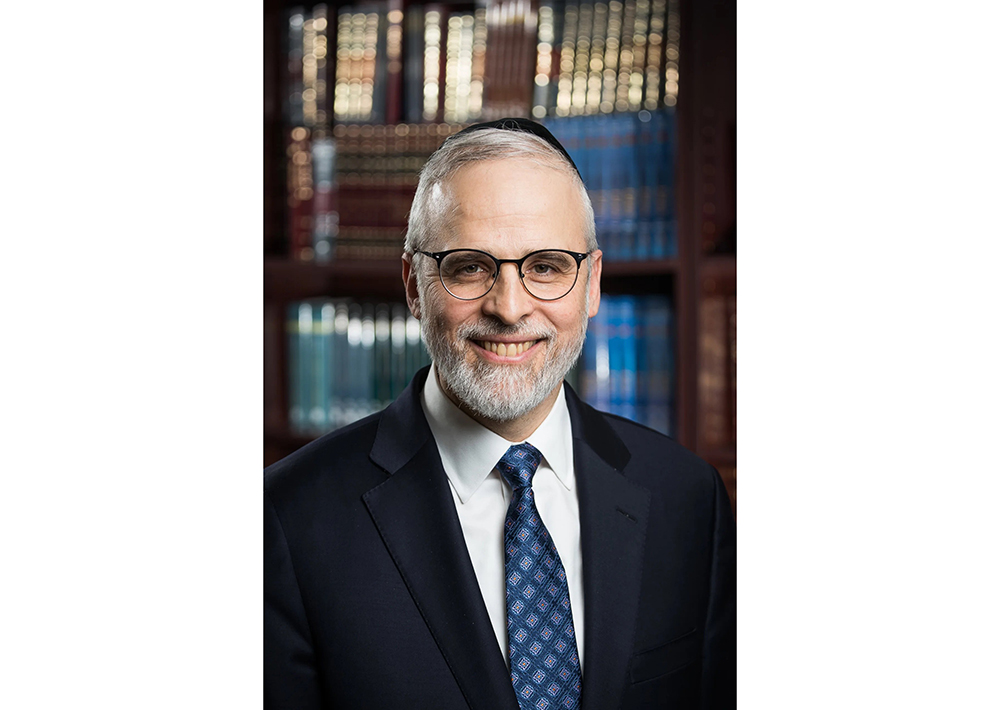
President Donald Trump and Israeli Prime Minister Benjamin Netanyahu were among the leaders who offered condolences upon the death of Rabbi Moshe Hauer, 60, executive vice president of the Orthodox Union, on Oct. 11.
Trump referred to the rabbi’s “remarkable legacy” and said he was a “fierce advocate for the Jewish people.” Netanyahu stated that Hauer was “a towering leader of faith and unity,” whose “voice carried the strength of Torah, his heart the love of the people of Israel” and whose “legacy will live on in every soul he touched.”
Sen. Josh Hawley (R-Mo.) told JNS that he met Hauer at a small dinner with Jewish community leaders during the early wave of antisemitic incidents on college campuses.
“He asked me about my family, told me about his, and we just became fast friends,” the senator said. “I loved him from the moment we started talking.”
Over the years, Hauer, whom Hawley described as “a man of faith and integrity, who embodied everything he believed,” would often text the senator to ask about his family, remembering birthdays, milestones and even trips that Hawley mentioned with his 4-year-old daughter.
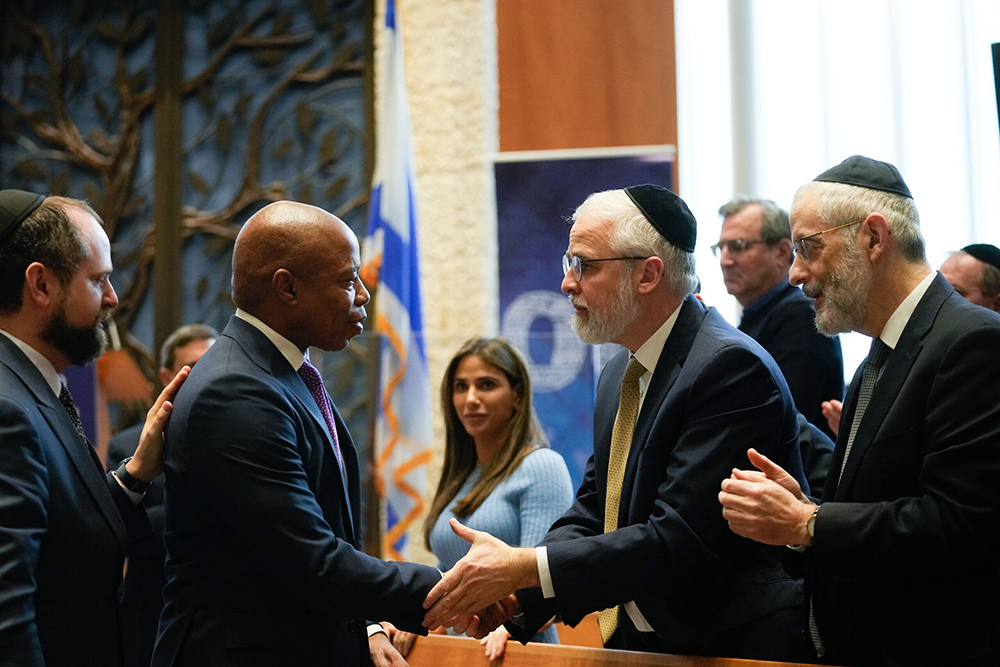
“When I’d say I was taking my daughter somewhere, he’d text me later and ask, ‘How did it go? What did she say? Did she like the gift you gave her?’” Hawley told JNS. “You think for a guy who had so much to do, whose responsibilities were mammoth, who met so many people every day, if he had a relationship with a senator, it would be focused on policy.”
Hauer was “very substantive, but the depth of his personal friendship and his commitment to people was remarkable,” Hawley said.
The Christian senator described the late rabbi as “pastoral.”
“You could tell he was a shepherd of others,” he told JNS. “I was just so touched that he would take that kind of interest in me and invite me into his life in that way.”
The two would also compare notes often on faith. “I remember once I inadvertently quoted from the book of Esther, and he caught it immediately. He said, ‘Oh, you’re quoting the Old Testament,’” Hawley said. He added with a laugh that he told Hauer, “I do know a little of it.”
“There was just this wonderful shared foundation of faith—the faith of the Bible,” he said. “I loved that about him. I learned so much from him. When we talked about faith, I learned even about my own, just from listening to him—his historical perspective, his way of thinking.”
“It’s one of the reasons I’m going to miss him so much,” the senator told JNS. “I can’t tell you how shocked I was to learn of his passing. I’m going to miss him dearly.”
‘Sorry, I have to call my mother’
Rabbi Josh Joseph joined the OU as executive vice president and chief operating officer in fall 2020, a few months after Hauer—who was the rabbi of Bnai Jacob Shaarei Zion, an Orthodox synagogue in Baltimore, for 26 years—came to the nonprofit.
Both shared roots in Montreal, where their fathers were rabbis in neighboring communities—Joseph’s in Snowdon and Hauer’s in Hampstead. Their first scheduled meeting was to be held at Yeshiva University, where Joseph was then a senior vice president. But then Yeshiva learned it had a confirmed case of COVID—one of the nation’s first—so the meeting was rescheduled.
Months later, they met at a park halfway between Baltimore and Lawrence, N.Y., sitting 20 feet apart in masks and gloves, Joseph told JNS.
“Even with all of that, within five, 10 minutes, we understood that we were connected, neshama-linked,” he said, using the Hebrew word for “soul.”
“There are people whom you meet right away and you realize that you were meant for each other,” Joseph said.
At the OU, Hauer and Joseph called each other “brother from another mother,” Joseph told JNS. He said that Hauer’s deep sense of loyalty and family extended into every aspect of his life.
“He had this thing. He called his mother every single day at three o’clock if he could,” Joseph said. “You could be in the middle of a meeting with a government official or a chief rabbi, and at 2:59 and 37 seconds, he’d say, ‘I’m sorry, I have to call my mother.’”
When Isaac Herzog called Hauer’s mother to offer condolences during the shiva in Israel, the Israeli president interrupted as Joseph brought the phone to her.
“I was going on about her, and he asked, ‘So what’s her name?’” Joseph told JNS. “And I don’t know if the name escaped me, or if it was instinct, but I said, ‘It’s Ima,’” using the Hebrew word for “mother.”
“Because that’s what Rabbi Hauer always called her,” he said. “We really were connected in that kind of way, as soul brothers.”
At a memorial service for Hauer, which the OU held on Oct. 20, Joseph said that the Jewish nation had “lost its voice” with the rabbi’s passing. He told JNS that he meant that in two ways.
“There are no words, because he is not here to say them,” Joseph said of Hauer. He added that the latter’s absence leaves a spiritual void.
“Even though he was soft-spoken, he was a man of conviction who expressed ideas—Torah ideas, Torah framings, as we call them—in ways that connected with people in unique kinds of ways,” he said. “I feel like we’ve lost that voice that could translate these incredible Torah ideas.”
‘More to do’
Hawley told JNS that in recent months, Hauer wanted to connect with Christian faith leaders.
“He wanted to build personal ties. Not just meet at conferences or seminars but really get to know them personally,” the senator said. “He told me, ‘People of faith need to be personally engaged.’ Of course, on the scourge of antisemitism in our nation, but also on other issues that matter to families and faith communities.”
Zevy Wolman, OU secretary and a student of Hauer’s, felt a strong personal connection to the rabbi, whom he first met at Hauer’s home in Baltimore at a weekly Torah study group that he held for young professionals.
“Rabbi Hauer encouraged us to take our communal responsibilities seriously,” Wolman told JNS. “He pushed us to think about how we could help others not just through learning Torah, but through action.”
Wolman moved his family next to Hauer’s synagogue. “We just wanted to be close to him,” he told JNS.
As an educator, Hauer “walked this really fine line,” Wolman said. He described his mentor as warm, humble and unrelentingly driven to help others. “He had incredibly high expectations for us. Not in a harsh way, but because he saw what we were capable of. Whatever we did, he’d say, ‘That’s great, and I’m proud of you. Now we’re going to do more.’”
Joseph thinks that Hauer would share that lesson—that there is more to do—about the bodies of the hostages that remain in Gaza, even as he celebrated those whom Israel has liberated.
“I think Rabbi Hauer would say that the job isn’t done. The mission is not fully accomplished, and we have work to do and we have unfinished business,” he told JNS. “That there’s the opportunity for everybody, and maybe the mandate, for everybody to keep going and keep moving forward.”
“Not to say that what happened wasn’t miraculous and amazing and fantastic, but that there’s more to do,” Joseph said.
‘Exquisitely sensitive’
Among Hauer’s passions was helping those whom society often overlooks: single people, those who are divorced, widows and the elderly, according to Wolman.
Wolman told JNS that Hauer created a year-round program that offered divorced women remote access to rabbinic guidance. The idea came from Shabbat gatherings of the Sister to Sister program, which works with Jewish divorced women.
“It was inconceivable to him that these women could only speak to a rabbi once a year,” Wolman said. “He pushed until we made it happen. That’s who he was: exquisitely sensitive, always thinking about who was being left out.”
No matter whom he was meeting, Hauer was true to himself, according to Wolman. “He was exactly the same person with presidents and prime ministers as he was with his family,” Wolman said. “Humble, self-effacing and kind.”
“He had such a gravitas to him that it was just magnificent to see him in all of these different milieus, because he wasn’t any different,” he said. “He was exactly the same in every single one.”
Losing Hauer is “like losing a father” to Wolman.
“He was a father figure to me and to so many others,” he told JNS. “The loss is immeasurable.”
Joseph agreed. “I feel like a body part is missing,” he said. “I feel like I’m missing a piece of who I am.”
Hawley told JNS that he lost a “dear friend.”
“It’s the loss of a true lover of God,” the senator said. “It’s the loss of a man of faith and integrity.”
“What really strikes me about Rabbi Hauer is that if you spent even five minutes with him, probably even 30 seconds, you knew this was a man who embodied what he believed,” Hawley said. “He believed in God, in family, in the way of life set down in the scriptures.”
“He didn’t just say those things, though he said them eloquently. He lived them,” the senator said. “His life was an attractive witness to everything he believed and stood for. That was his most profound and powerful witness. You look at the lives he touched. He just embodied everything he said he believed.”
“He’s irreplaceable,” the senator added. “He was one of a kind, and the loss is profound.”
(JNS.org)
