




|
Getting your Trinity Audio player ready...
|
When Estonia’s Chief Rabbi Shmuel Kot first proposed a new synagogue, members asked why it was needed. They pointed out the aging population and wondered who would fill it.
By: David Isaac
The new Israeli embassy in Tallinn has brought Estonia onto the radar of the Israeli public, sparking curiosity about the country, its people and its Jewish community.
As to the latter, its footprint—with its synagogue, Jewish Community Center, and school in a compound adjoining one another—mirrors its character: small, close-knit, and united.
The Jewish population of Estonia only numbers 3,000. Eighty percent live in the capital of Tallinn. The rest are found in the cities of Pärnu, Tartu, Narva and Kohtla-Järve.
Until the 1820s, there were no Jews at all in Estonia. During that decade, cantonists, Jews forced into service in the Russian army, were allowed to settle in Tallinn. They brought Jewish women from nearby Belarus to start families. More Jews came in the 1860s after reforms by Czar Alexander II loosened restrictions on where Jews could settle. A Great Synagogue, orthodox, was built in 1844. It was destroyed in WWII.
In 1918, after World War I and the collapse of tsarist Russia, Estonia declared independence. In 1926, it became the first country to grant autonomy to its Jewish population, meaning Jews would be left to run their cultural and religious affairs. In that period, such declarations were common among newer states looking for acceptance among the nations. To Estonia’s credit, it was the only country in eastern Europe faithful to its pledge throughout its short history, until 1940, when the Soviets invaded.
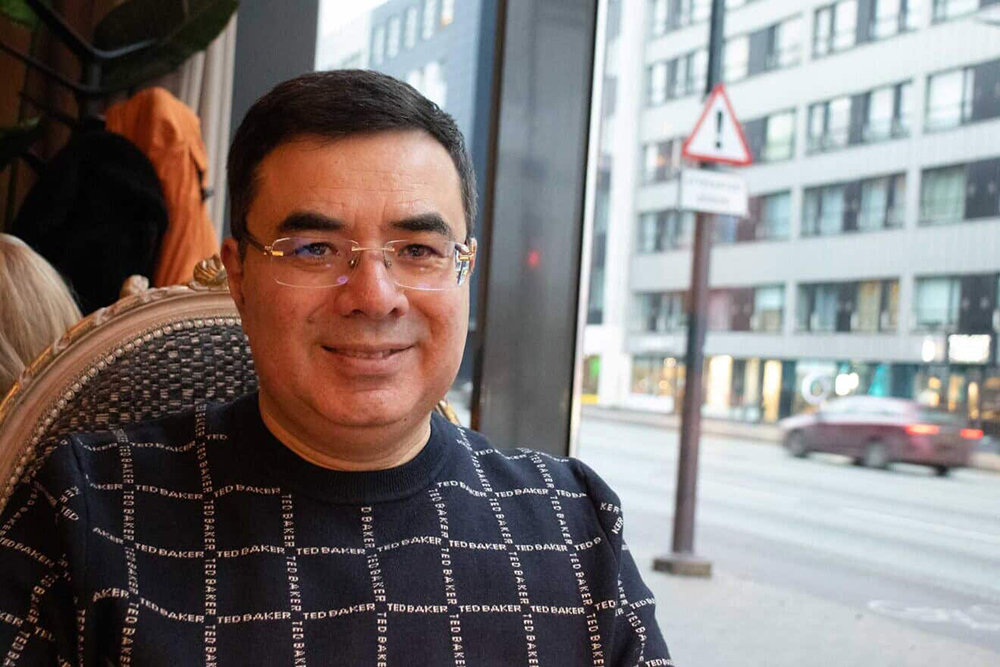
About one-third of Estonia’s Jews can trace their beginnings back that far. Ron Luvištšuk, 54, a financial consultant who grew up in Estonia, comes from one such family. His ancestors arrived in the 1860s.
Two Jewish communities
The other two-thirds of Estonian Jewry are Russian-speaking and came during the Soviet period or after.
Luvištšuk said there are two Jewish communities in Estonia: religious and secular. The religious group defines a Jew according to halacha, or Jewish law, while the secular operates by looser criteria.
The division has not led to conflict. The two communities are extremely friendly, he said, “We’re two parts of the same family.”
He described the first night of Chanukah when “all the kids took part in the religious activities. There was a real feeling of community. We’re very lucky with Rabbi Kot.”
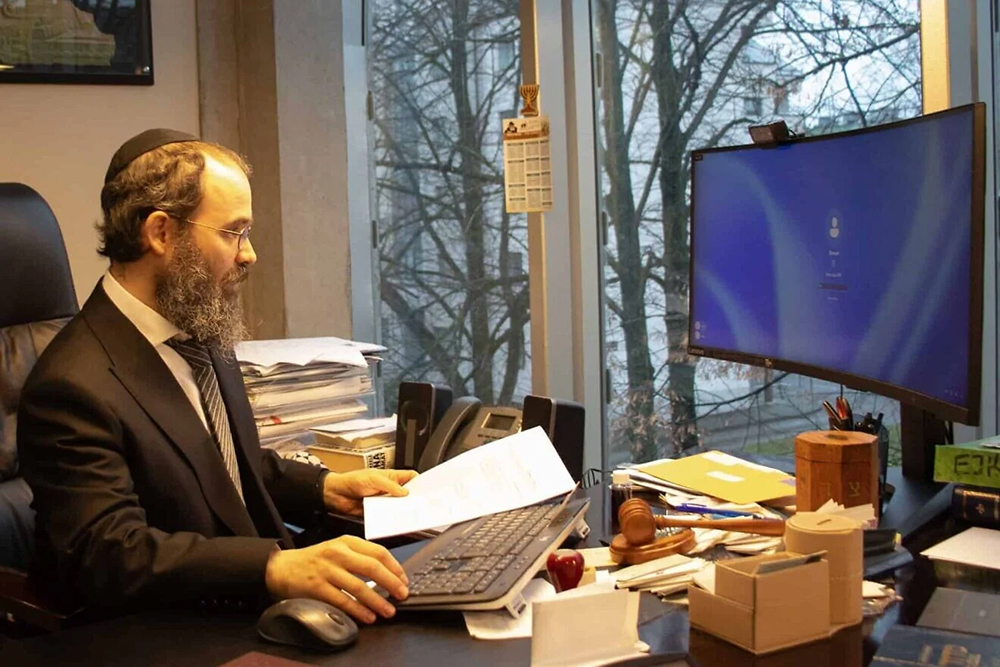
Chief Rabbi Shmuel Kot, whom JNS met in his offices at the Tallinn New Synagogue, deals with the issue of who is a Jew with sensitivity.
“We’re trying to give everyone the feeling that they’re welcome, to manage in a way that no one feels pushed away. If they have Jewish roots, they come. And they can come with family members, even if they are not Jewish,” Kot said.
“Still, I’m a rabbi and I’m keeping the halacha, so we can’t call up to the Torah someone who isn’t Jewish,” he told JNS.
Kot, 48, a Chabad rabbi, arrived in Estonia 25 years ago with his wife, Chana, and first child, then 31 days old (He now has 12 children).
“A great miracle happened here,” he said, referencing a Hebrew phrase connected to the letters of the Israeli dreidel. That “miracle” is the revival of spiritual Jewish life in Estonia, a place where it had virtually been extinguished.
The biggest challenge when he arrived was the level of Jewish knowledge. Kot, the country’s first chief rabbi since 1941, the year the Nazis invaded, found himself having to start with the basics, such as explaining concepts such as a Bar Mitzvah.
Before Kot came, the lack of Jewish infrastructure had been the main obstacle to the community’s search for a rabbi. “They reached out to several Jewish institutions, saying, ‘Please send us a rabbi,’” Kot said. “No one wanted to come. There was no mikveh, no kosher food. This was before Estonia joined the E.U. so it was difficult to get kosher food.”
(At the start, Kot had to travel 4 ½ hours each way to Riga, Latvia to use its mikveh, which is a pool for ritual bathing.)
Communal transformation
The community has since transformed. It boasts an attractive synagogue (winner of an architecture prize), a Jewish Community Center and a school, which covers first through 12th grades. Seventy percent of the student body is Jewish.
The place bustles with activity. Visiting the JCC, at which a birthday party for a senior member was in progress, JCC director Irina Shlick told JNS there were 17 activities for seniors planned for that week alone.
The rabbi spoke to JNS between a Talmud class and a trip to Kohtla-Järve, a distance of 100 miles, to lead a Menorah-lighting ceremony.
When Kot first proposed the building of a new synagogue, members asked why it was needed. They pointed out the aging population and wondered who would fill it. “You can see it is full today. It is full of children,” he said.
Completed in 2007, the synagogue attracts about 70 congregants for Shabbat morning services and hosts concerts, a women’s club, children’s events, boasts a mikveh and a kosher kitchen (kosher food is now heavily in demand, the rabbi says). “We have so many activities in the synagogue today; [the space is] not enough.”
The future of Estonian Jewry
The community is financially self-sustaining. Unlike Latvia and Lithuania, whose Jewish communities receive millions in compensation from their governments for communal property confiscated by the Nazis, the Estonian Jewish community does not, having owned little communal property before World War II.
The pre-World War II communities of those Baltic states were nearly entirely wiped out. More than 90% of Lithuania’s Jews (250,000), and Latvia’s Jews (100,000) were murdered.
The far smaller Estonian Jewish community, numbering then only 4,500, fared better for several reasons. About half fled when the Soviets occupied the country in June 1940.
Another 400-500 were deported by the Soviets, part of a general deportation of 10,000 Estonians. While many died due to the inhumane conditions, the deportation saved some, including Luvištšuk’s grandparents on both sides.
His grandparents on his mother’s side were a doctor, a fact which saved his grandfather from the front during the Battle of Stalingrad, and a bookkeeper with Russian language skills. His grandfather on his father’s side studied in Switzerland and knew perfect German, making him useful to Soviet intelligence. “Their education saved them,” Luvištšuk said.
Another factor is that Estonian Jews had more time to flee. When Nazi Germany launched Operation Barbarossa in June 1941, it occupied Lithuania in a week and Latvia in 18 days. Nazi troops didn’t take Tallinn until the end of August, giving Estonia’s Jews time to escape into the Soviet Union.
Even so, 1,000 Estonian Jews decided to stay. They were all murdered. And Estonia had its share of collaborators. Estonia became the first country to be declared Judenfrei—“Jew free” by the Nazis.
Among the 1,000 killed were two of Luvištšuk’s relatives. His great aunt urged them to flee, but they recalled the German occupation of Estonia in World War I. “‘We speak German. The Germans are nice,’ they told her,” Luvištšuk said. Their names, Samuel and Etta Aisikovitš, appear among others on a series of memorial plaques in a hallway facing the Jewish museum in Tallinn’s JCC.
Today, relations with official Estonia are excellent. “We have great connections with all parties,” Kot said, noting that on Dec. 9, Tallinn elected a new mayor and five days later, “he was already lighting the first Chanukah candle with us.”
In November, Israel opened an embassy in Tallinn. Israeli Foreign Minister Gideon Sa’ar visited for the inauguration. On the whole, though, Estonians aren’t really thinking about Israel, Luvištšuk said. “It’s just not an issue for them.” As for the local Jewish population, Estonians view them positively. “I think Estonians accept Jews as allies,” he said.
Yet, in a sad commentary on the worldwide situation, even though Estonia is very safe for Jews, the community feels obliged to take precautions. While certain events, such as a large Menorah lighting in Tallinn’s Rotermann Quarter, can’t help but be publicized, and security was present, the community keeps a low profile for most of its events. A Dec. 20 Chanukah gathering at the synagogue for Israelis visiting Estonia was only advertised via a WhatsApp group.
While Estonia does not have a large Muslim immigration, due to its less attractive welfare benefits compared to other European countries, a fact that makes overt antisemitism non-existent, Luvištšuk noted that Tallinn is only a ferry ride from Finland, where the situation has deteriorated and there is a reported rise in antisemitic incidents.
Estonia is also not immune from the pro-Palestinian sentiment afflicting higher education elsewhere. Luvištšuk showed pictures of pro-Palestinian posters at Tallinn University.
“Covid started in China and spread all over the globe. If you think that antisemitism is only in France or Australia, you’re making a mistake. Antisemitism can be here in a day. It can come to Estonia as well. So we have to worry, but not panic. We have good connections. We try our best,” the chief rabbi said.
Luvištšuk gives high marks to Estonia’s authorities. He said the internal security service understands the issues and the Jewish community meets with them periodically.
(JNS.org)