



|
Getting your Trinity Audio player ready...
|
Menachem Wecker
(JNS) Some 10 minutes into a conversation with JNS, Mark Goldfeder, director of the nonprofit National Jewish Advocacy Center, offered a tip on how to title this article.
“I like to describe this story as how the Rivash stopped the terrorist attack in 2025,” said the lawyer and rabbi, who directs the Antisemitism Law Clinic at Touro University, where he is an assistant clinical law professor. “That’s my headline for it.”
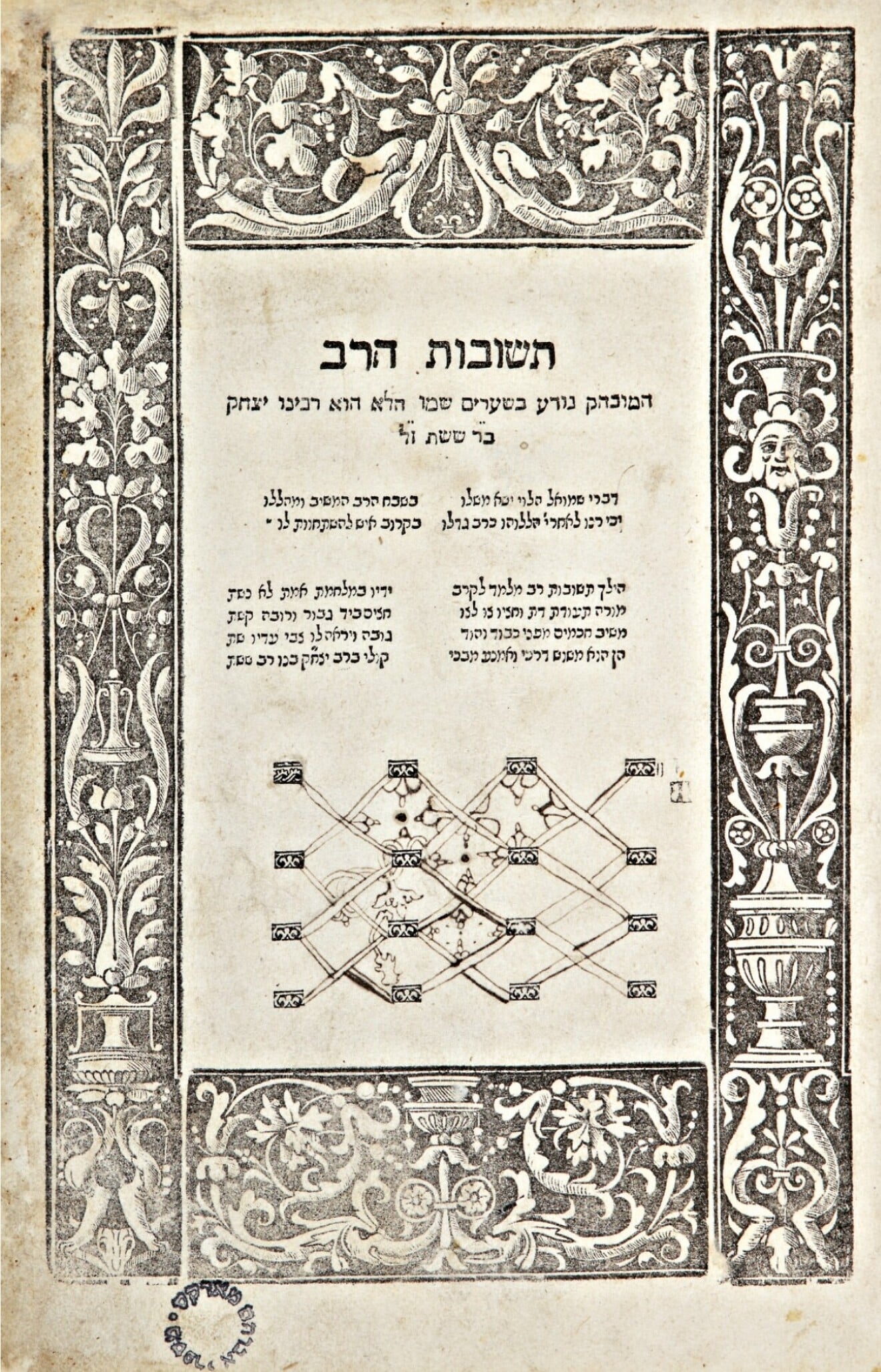
The acronym refers to the Spanish rabbi Isaac ben Sheshet Perfet (1326-1408), who led the community in Saragossa. Some 625 years ago, the Rivash wrote in responsum No. 387—of 518 he penned—that Jewish settlement in Israel “isn’t only a mitzvah for the moment, but rather a commandment that applies forever and for all Jews.”
Goldfeder and colleagues cited that remark in a footnote in a July 24, 2024, complaint filed against Codpink, Palestine Youth Movement and Wespac Foundation in the U.S. District Court for the Central District of California. The month prior, protesters attacked Jews outside Adas Torah, an Orthodox synagogue in Los Angeles.
“Bear-sprayed worshippers. Jews assaulted, intimidated and threatened. Bloodied members of the Jewish community, whose only transgressions were to attend synagogue,” Goldfeder and colleagues alleged. “The images that emerged from the antisemitic riot outside Adas Torah synagogue on June 23, 2024, are outrageous.”
He and Ben Schlager, both of the nonprofit, and Jason Torchinsky, Edward Wenger, Erielle Davidson and John Cycon, of Holtzman Vogel Baran Torchinsky and Josefiak, wrote that “deplorably, those images also are no longer surprising,” and that “they are emblematic of an increasingly common occurrence: organized riots that violently target the American Jewish community.”
The defendants, they alleged, “prevented congregants from attending an event” that “not only involved prayer but also sought to educate Jewish congregants about housing opportunities in Israel that would fulfill the religious commandment to ‘make aliyah,’ or immigrate to Israel.”
They cited the 1994 Freedom of Access to Clinic Entrances Act, a federal law known for its acronym FACE, which “ensures that worshippers may practice their respective religions free from persecution, interference and intimidation.”
On Page 14, the plaintiffs quote the Babylonian Talmud and Sifrei, part of the midrash, which state that living in Israel “is equivalent to all of the other commandments in the Torah.” They add, citing the Rivash, that “the preparations to make aliyah, including educating oneself about the options for doing so and then buying a home, are also considered at least a partial fulfillment of the commandment.”
Goldfeder told JNS that after the “pogrom” outside Adas Torah, “everyone said the right things, from the mayor to the president, but no one did anything.”
So he and colleagues brought the FACE Act case. “It’s an abortion clinic act. There’s a paragraph two, which nobody reads,” he told JNS. “This is probably the biggest professional accomplishment I’ll ever have, which is the whole goal of NJAC—literally to expand the toolbox of available options.”
After Oct. 7, Goldfeder realized that cases brought under Title VI of the 1964 Civil Rights Act, which bars “national origin” discrimination, didn’t work.
“Literally nobody has ever lost their funding because of Title VI. Even the cases you’re reading now in the Trump administration, they’re not actually Title VI cases,” he said. “Trump is very clear in all the briefs. This is not Title VI, because they don’t want Title VI. It doesn’t work.”
“Our biggest accomplishment to date probably in terms of practicality is now when Park East happens, everyone from the Department of Justice to every major Jewish organization says, ‘This is obviously a FACE Act thing,’” he said. “We made that up.”
On Jan. 8, protesters blocked Jews from entering a pro-Israel event at Park East Synagogue, an Orthodox congregation on Manhattan’s Upper East Side. A spokeswoman for Zohran Mamdani, the New York City mayor, said that synagogues shouldn’t host events that violate international law.
Goldfeder told JNS that good rabbis and effective legal briefs make very new things sound very old and vice versa. “You want to make it clear that this is absolutely precedential even if it’s a case of first impression,” he said.
When Democrats sought to pass the FACE Act in the 1990s, they wanted to get Republicans to sign on, so they allowed a sentence that said that protesters can’t obstruct houses of worship, in addition to abortion clinics.
The law bars “intentionally injuring, intimidating or interfering with, or attempting to injure, intimidate or interfere, any person by force, threat of force or physical obstruction exercising or seeking to exercise the First Amendment right of religious freedom at a place of religious worship.” It also bans “intentionally damaging or destroying the property of a place of religious worship.”
After protesters disrupted a church service in Minnesota, the state attorney general, Keith Ellison, told former CNN host Don Lemon—who currently faces federal charges in connection with the protest—that it wasn’t a violation of the FACE Act.
“The FACE Act, by the way, is designed to protect the rights of people seeking their reproductive rights to be protected, and so that people, for a religious reason, you know, cannot just use religion to break into women’s reproductive health centers,” he said. “So how they are stretching either of these laws to apply to people who protested in a church over the behavior, or the perceived behavior, of a religious leader is beyond me. But they don’t mind stretching these days.”
Goldfeder told JNS that the protest was “an unbelievably clear FACE Act violation.” Ellison “hasn’t read the fine print,” he said. “That’s how unknown this part of the bill was until very recently.”
The event at Adas Torah in Los Angeles was about aliyah, moving to Israel.
“So they responded and said, ‘This is not a religious event. This is a real estate event where they’re selling real estate. Nothing religious here,’” Goldfeder said.
He told the court that the Talmud considers aliyah a religious commandment that is shakul k’neged kulam, equal to all other commandments in the Torah, and “according to these many early commentators, including Rivash section 387, hechsher aliyah, preparing to make aliyah, is also considered a partial fulfillment,” he said.
Goldfeder told JNS that he had remembered a relevant discussion in the Talmud that, in certain circumstances, one can sign documents to buy land in Israel on the Sabbath, but not that the commentator was Rivash. He looked up the sources on the website of either the Bar-Ilan Responsa Project or Sefaria.
“The judge basically said, ‘I don’t want to touch this with a 10-foot pole. That’s where the law and religion training melded with the rabbinic training,” he told JNS. “This is clearly not a made-up thing, and courts aren’t allowed to say, ‘I do’ or ‘do not think this is a good religious belief.’”
Courts are allowed to test sincerity. “If I could string cite 15 rishonim,” early rabbinic commentators, “it’s a sincere belief,” he said. “We’re not making it up.”
Esther Panitch, the only Jewish member of the Georgia state legislature, told JNS that “every community has its unsung heroes—the people who don’t wait for applause, who don’t chase headlines, who simply put their heads down and do the work.”
“For the Jewish community, that person is Mark Goldfeder. I have had the privilege of working alongside Mark as his partner in passing Georgia’s antisemitism definition bill and as a board member of the National Jewish Advocacy Center he built from the ground up,” she said. “I have watched him answer the call at every hour, for every Jewish student afraid to walk across campus, for every family targeted for loving Israel, for every community that felt abandoned.”
The Jewish Democrat added that “he never says no. He never walks away.”
“Mark fights for us in the courtrooms, in the halls of Congress, state capitols and in the quiet moments no one ever sees,” she said. “He is the person Jewish families call on their worst day, and he shows up—every single time. There are people who talk about combating antisemitism, and there are people who actually do it. Mark Goldfeder does it.”
“He is a hero of our community, and it is long past time the world knows his name,” she said.
‘A line of rabbis’
Goldfeder grew up in a Modern Orthodox home in Brooklyn, N.Y., and moved with his family, when he was 10, to Monsey in nearby Rockland County, N.Y. His parents sent him to schools to the right of Modern Orthodoxy, which he thinks was a good idea.
“My parents’ philosophy and now my parenting philosophy honestly is that the immersion is incredibly helpful, and so I have, thank God, a very deep familiarity with text and comfortability reading fine print and analytical thought,” he told JNS. “There were periods of my life post-high school where I was studying literally 15 to 16 hours a day talmudically, and I think that that helps.”
People often ask Goldfeder, who comes from a “line of rabbis” on his mother’s side, if Talmudic training really helps for law school. He says the answer—in Talmudic fashion—is yes and no.
There are instances, like the Talmudic discussion about the circumstances under which homeowners can kill burglars in self-defense, that differ from American law. But, he adds, “my rabbinic training comes in incredibly handy.”
Growing up, any of his peers would have predicted that Goldfeder—captain of his college’s debate team—would be a lawyer, he said. He also sees himself as a “black sheep” of his family, since he is the only non-technical one among computer-science scholars. He figured that the standard Jewish jobs are rabbi, lawyer and doctor. “Fantastic, I’ll do all three,” he said. (He holds a doctorate in law and religion.)
“I’m trained as an academic,” he told JNS. “We’re trying to see around corners and trying to see what the next thing that’s going to come up.”
That rhymes with studying the Talmud, where there is never a wrong answer, according to Goldfeder.
“There’s an answer that’s 70% right and 30% wrong, and one that’s 30% right, and so you go with the 70% one,” he said. “But you’re always aware, too, that it might shift and then that 30% becomes the standard.”
The Talmud also goes through all the wrong answers (hava aminahs) before arriving at the correct one. “By the time you get to the bottom, you’ve explored every other option,” which is also how his legal practice works, Goldfeder said.
“I was a rabbi before I became a lawyer, which informs a lot of my worldview, and I also worked in the beit din,” religious court, “system as a rabbinic judge for a little while, so I spent a lot of time studying inside the Jewish world then also outside the Jewish world,” he told JNS.

His doctorate focused on religious liberty, and in the first part of his career, he worked on First Amendment free-speech issues. In the last decade, more and more people came to him with their antisemitism problems. He was teaching at Emory University School of Law in Atlanta, where he ran the religious liberty clinic.
“I got a lot of hands-on training teaching the next generation, and all of these would be pieces that would later come into play when I started doing more communal work back in 2016,” he said. “I was asked to help draft some of the anti-BDS bills around the country, and I did because I’d been developing a secondary specialty in international law.”
Joe Sabag, then at the Israeli-American Coalition for Action and now working for Goldfeder, did the asking, and Eugene Kontorovich, a professor at George Mason University Scalia Law School and executive director of its Middle East and international law center, was also involved.
In 2018, Goldfeder penned what became the model for state bills nationwide recognizing the International Holocaust Remembrance Alliance’s working definition of Jew-hatred. He wrote on the subject in “Defining Antisemitism” in Seton Hall Law Review in 2021, and after the bill passed, he went to seven states and talked to legislators about it. He said he wrote down every question they asked him about the bill, which became the basis of his 2023 Penn State Law Review article “Codifying Antisemitism.”
The bill has now passed “in some form or fashion in over 35 states,” he told JNS. “That was the beginning of NJAC.”
‘Ahead of the game’
So how does a judge assess Hebrew and Aramaic citations in footnotes of complaints to make sure that—to use a biblical phrase—no one is putting a stumbling block before a blind person?
Goldfeder told JNS that clerks check such references. “I can always tell, and I’m sure many people can always tell when the judge actually has a Jewish law clerk,” he said.
The late Supreme Court associate justice Antonin Scalia had Jewish law clerks, which is how he came to cite the Talmud saying, about the Torah, “turn it over and turn it over, for all is therein,” adding that “Divinely inspired text may contain the answers to all earthly questions, but the Due Process Clause most assuredly does not.”
“He didn’t put that line in,” Goldfeder told JNS. “There’s a kid who was doing that first.”
The lawyer is optimistic about the future, even as he says antisemitic competition is putting up more of a fight.
Goldfeder told JNS that there is now a second generation of lawyers on the other side. “The first generation was horrible—just really, really bad at the game,” he said. “Motivated by hate, it would seem like. Nowadays, I’m not saying they’re not motivated by hate, but they do a much better job of thinking strategically.”
“I always say this, and it’s always true that the nice part about useful idiots is that they’re still idiots, and they make idiot mistakes. Like in the FACE Act case. They advertised, ‘Let’s go block a synagogue,’ and then they said, ‘Hey, look, we’re blocking a synagogue,’” he said. “Then they bragged about blocking a synagogue.”
Protesters who hand out pro-Hamas literature can’t help themselves, according to Goldfeder. “The first generation of lawyers was more along those lines,” he said. “This generation is better, and they’ve done things that I have to admire from an artistic point of view.”
One innovation is the “entire invention of the category of anti-Palestinian racism.” -->>
-->>
In the wake of a 300% spike in Jew-hatred after Oct. 7, antisemitic organizers identified what they called a 600% increase in Islamophobia.
“Have you ever seen an anti-Islamic encampment? I haven’t, because they don’t exist. So what did they do? I think it’s evil, but I have to say that it wasn’t a bad strategic move. They basically told all of their followers, ‘Look. Every time someone complains about antisemitism, that itself is Islamophobic and also anti-Palestinian racism,’” he said. “Literally overnight, a 300% increase in antisemitism became a 600% increase, to the point that they got that to the White House level, where people were quoting that made-up number.”
Not only did lawyers on the other side create numbers wholecloth, according to Goldfeder, but they started filing “sister briefs” to everything he and his colleagues did.
The nonprofit would file a complaint with the U.S. Education Department’s civil-rights office about widespread Jew-hatred on campus.
“They would respond by filing a copy of that brief with the terms inverted,” he said. The National Jewish Advocacy Center would identify an antisemitic encampment, and the other side would admit that there was an encampment, but would say that complaining about it was Islamophobic.
The Education Department, under the former administration, didn’t act and “basically threw up their hands and said, ‘Oh, well. You know, both sides.’ And they allowed them to muddy the waters,” Goldfeder said. “That muddying of the waters is a brilliant legal tactic. If you can muddy the waters enough to let it slide, then you’ve essentially won the game. They’ve ceded the ground.”
The second generation of lawyers targeting Jews and Zionists is more talented, but Goldfeder told JNS that “I believe, thank God, we’re still ahead of the game.”
“I don’t know if I should say out loud, but this litigation is kind of our national sport as a Jewish people,” he said. “Thank God, we have a lot of good people working really hard.”
One of the nonprofit’s victories was in a ruling, in which a judge ruled that attacking a Jew for any aspect of the person’s faith, including wearing an Israeli flag, is antisemitic and antithetical to U.S. values.
“I think people are starting to see that it was never really about the Jews. It was never even really about Israel,” Goldfeder said. “It’s a wedge issue for people who are trying to destroy a way of life, an entire Western democracy.” He added that he tells people who go to events, “don’t bring an Israeli flag, bring an American flag, and make that distinction as clear as possible.”
There is a re-emergence of Nazism, however. A few years ago, when Goldfeder testified in Congress, a Democratic member asked him if antisemitism was worse on the right or the left. Goldfeder told the congressman that both are bad, but that the left was more dangerous.
“You can’t in polite society say, ‘I’m a Nazi, and I hate Jews,’ but you can in polite society say, ‘I support Hamas, and I hate Zionists,’” he said at the time. “Turns out I was wrong. You can now say in polite society, ‘I’m a Nazi.’”
That’s why Goldfeder was one of the first to leave the Heritage Foundation, after the head of the conservative think tank defended former Fox News host Tucker Carlson, who has repeatedly made antisemitic and anti-Israel comments.
“I think you need to draw lines,” Goldfeder said. “I am heartened by the fact that there seems to be, at least on the right, an actual attempt at drawing some lines by some people, whereas on the left I didn’t see anything like that.”
The law won’t change antisemitic hearts and minds, but Goldfeder thinks that at encampments, some 90% of participants don’t know which river and which sea are referenced in the slogan “from the river to the sea,” and are just there for the pizza.
“Many of them have been genuinely misled into thinking that they are on the right side of history,” he said. “That 10% you’re never going to change. But the 90% of our future congressmen, senators, presidents, citizens, our kids’ classmates—whatever it might be—you might save them if you get a court to explain to them that you don’t realize this, you’ve been in bed with Hamas.”
Maybe some of that 90% walks away, “and that kind of thing, I think, could save our country,” he said. “We’re never winning in all of these cases. You have to calibrate what winning looks like. It’s not like ‘Law & Order,’ and it’s not neat, and it’s not quick, but there are real steps along the way that I think can have demonstrably important effects on our entire community broadly.”
That doesn’t mean that he thinks that things will ever get back to the way they were before Oct. 7, “but I’m confident we can get back to a point where people are comfortable walking in public wearing a yarmulke, which they’re not always now, even in New York City,” he said.
“I think that we are addressing head-on this lie that we’ve allowed to fester for too long, that you can attack a Jewish person because of a real or perceived connection to the State of Israel and just claim that it was politics,” he added.
When he meets with legislators, he asks them if it would be ethnic discrimination to attack a Chinese person over the country’s trade policies or a Russian person because its president, Vladimir Putin, attacked Ukraine. The lawmakers say, “of course.”
“If I attack a Jew, because I hate Netanyahu or because I hate Israel, is that?” he asks. “No. That’s politics,” he is told.
“One guy actually said to me that he doesn’t think a swastika should be antisemitic. He said, ‘Young man, show me where in the Torah of the Talmud it says anything about a swastika. You shouldn’t be so sensitive,’” Goldfeder told JNS. “I said, ‘I’ll give you 6 million reasons why, and a million-and-a-half were children.’ Then he called me ‘condescending.’”
“The person who says to me, ‘No, that’s politics,’ I’m not getting their vote. Doesn’t make a difference what I say to them. Logic plays no part here,” he said. “Let me focus on the people I might be able to talk to and help.”
