



|
Getting your Trinity Audio player ready...
|
By: Tzirel Rosenblatt
In the vast architecture of twentieth-century history, moments of moral clarity often appear fleeting, almost imperceptible amid the thunder of mass movements and totalitarian pageantry. Yet it is precisely such moments, enacted by ordinary individuals in extraordinary circumstances, that illuminate the human capacity for conscience when conscience is most imperiled.
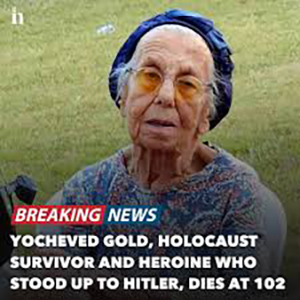
The death of Yocheved Gold at the age of 102, as reported by VIN News on Thursday, brings into focus one such moment: the quiet, resolute refusal of a thirteen-year-old Jewish girl to present flowers to Adolf Hitler at the opening ceremony of the 1936 Olympic Games in Berlin. In that instant, framed by the spectacle of Nazi grandeur, Gold’s refusal constituted a small but searing act of defiance against a regime that had already begun the systematic exclusion and degradation of Jews from German society.
The VIN News report recounted that Gold, born in 1923 in the central German town of Halberstadt, managed to enter Berlin’s Olympic Stadium in August 1936 to witness the opening ceremony. Outwardly appearing “German,” she was approached to join a procession of children offering bouquets to Hitler, who had been appointed chancellor three years earlier and who by that time had consolidated the apparatus of a totalitarian state. “I saw him face to face and was a little afraid,” Gold would later recall. “That I, a Jewish girl, should give Hitler flowers? I refused.” The refusal was neither dramatic nor public in the way later acts of resistance would become; it was a private assertion of dignity in a setting designed to obliterate individual conscience beneath a choreography of loyalty.
The setting itself was saturated with contradiction. The 1936 Olympics were orchestrated by the Nazi regime to present an image of cultural modernity and international legitimacy, even as the machinery of exclusion and persecution tightened its grip on Jewish life. By that time Germany under Hitler had implemented a broad system of legal discrimination that effectively banished Jews from public life. The Nuremberg Laws of 1935 had stripped Jews of German citizenship, barred them from most professions, and subjected them to a regime of social and economic isolation. Gold’s presence in the stadium was therefore already an anomaly, her refusal to participate in the ritualized homage to Hitler an implicit rebuke of a state that sought to render Jews invisible.
Gold’s upbringing placed her at the intersection of German Jewish tradition and rabbinic scholarship. Her father, Dr. Aharon Neuwirth, was an esteemed rabbi and halachic authority who served communities in Mainz, Halberstadt, Berlin, and Amsterdam. Her mother, Sarah Chaya, anchored a family whose spiritual commitments would later become a lifeline amid the chaos of war and persecution. Gold’s early years were shaped by this milieu of learning and faith, a foundation that likely informed her instinctive refusal to bestow symbolic legitimacy upon a man whose regime had already branded her people as pariahs.
The trajectory of Gold’s life after that Olympic moment traces the broader arc of Jewish displacement and survival in the shadow of the Holocaust. In 1938, as antisemitic violence erupted in the pogroms of Kristallnacht, she witnessed the destruction of synagogues—a visceral prelude to the cataclysm that would follow. At sixteen, she fled to Haifa in Mandatory Palestine, leaving her parents behind in Europe. VIN News reported that she maintained correspondence with them until the final year of the war, when their letters abruptly ceased. “I was sure they had been killed,” she later said. In an almost unimaginable turn of fate, her parents survived both the war and the Holocaust, spared through a series of extraordinary and, to the family, providential events.
Among the accounts preserved in family testimony and in the halachic work Shemirat Shabbat Kehilchatah, authored by her brother Rabbi Yehoshua Neuwirth, is an episode that has acquired a near-parabolic resonance within the family narrative. Gold’s father once went to a pharmacy for treatment but, because it was Shabbat, refrained from taking the medication that night. The substance later proved to be rat poison. The story, retold in religious and familial memory, underscores the precariousness of survival in a world where the line between life and death could hinge on the most prosaic of circumstances.
Gold’s siblings, too, would leave indelible marks on the religious landscape. Her brother Rabbi Yehoshua Yeshaya Neuwirth, head of Yeshivat Chochmat Shlomo, became widely known for Shemirat Shabbat Kehilchatah, a seminal guide to the laws of Shabbat and festivals that addresses the complexities of modern life. He passed away in 2013. Another brother, Rabbi Reuven Yosef Raphael Neuwirth, who ran one of the most prominent free-loan funds in the Haredi world, died at 94 about nine months ago, according to the VIN News report. The constellation of rabbinic leadership within the family situates Gold’s life within a broader continuum of Jewish scholarship and communal service.
After fleeing Europe, Gold built her life in the nascent Jewish society of Palestine and, later, the State of Israel. VIN News reported that she was among the founding members of Kibbutz Sa’ad, near the Gaza border, a community that would become emblematic of the pioneering ethos of early Israeli settlement. In 1942, she married Shmuel Gold, one of the kibbutz founders, whose death in 1961 at the age of forty left her a widow in midlife. Yet Gold’s commitment to communal life did not waver.
She worked on the kibbutz for decades, occupying various organizational and administrative roles before being appointed the kibbutz nurse—a position she held for approximately forty years despite having no formal medical training. The appointment speaks to the ethos of mutual reliance that characterized kibbutz life, where necessity often outpaced credentialism and communal trust substituted for formal certification.
Gold’s personal narrative became inseparable from the tumultuous history of the state she helped to build. Remarkably, she survived all of Israel’s wars since the state’s founding, including the War of Independence and the most recent conflict in Gaza. On October 7, 2023, she spent thirty hours in a safe room with her son as violence engulfed communities near the border.
VIN News reported that she was later evacuated to a hotel near the Dead Sea, a displacement that echoed, in attenuated form, the forced movements of her youth. Yet even at the age of one hundred, Gold’s attachment to place proved unyielding. “I’m not prepared to die in a hotel,” she told her family. “Take me home. If I die, I’ll die there.” She returned to Sa’ad, insisting on anchoring her final years in the community that had defined her adult life.
The insistence on returning home resonates as more than stubbornness; it reflects a lifelong refusal to be uprooted by forces beyond one’s control. VIN News’s account of Gold’s final years speaks volumes about the continuity between her teenage refusal in Berlin and her centenarian determination in Sa’ad. In both instances, she asserted agency against circumstances that sought to dictate the terms of her existence. That she survived to see children, grandchildren, great-grandchildren, and even great-great-grandchildren is itself a testament to a life that outlived the regime that sought her erasure.
Gold’s death invites reflection not only on her singular gesture at the 1936 Olympics but on the broader moral economy of remembrance. In a century marked by mass violence and ideological absolutism, the power of individual refusal often appears negligible. Yet as VIN News has documented, it is precisely such refusals—quiet, unadorned, and rooted in personal conscience—that puncture the totalitarian fantasy of unanimous consent. Gold did not stop Hitler. She did not alter the course of history. But she preserved, within herself, the integrity that regimes of hatred seek to extinguish. That integrity, transmitted through story and memory, becomes a resource for subsequent generations navigating their own moral tests.
The narrative of her parents’ survival, too, complicates the historiography of the Holocaust, reminding us that survival often hinged on contingencies so improbable as to defy rational explanation. VIN News’s recounting of these episodes resists both fatalism and facile triumphalism. Gold’s life was not a linear ascent from victimhood to redemption; it was a sustained negotiation with loss, displacement, and rebuilding. Her decades of service as a kibbutz nurse, her endurance through successive wars, and her final insistence on returning home all speak to a conception of resilience grounded in communal responsibility rather than solitary heroism.
In the end, Yocheved Gold’s story is not reducible to a single act of defiance, however luminous that act may appear in retrospect. It is the story of a woman whose life traversed the central catastrophes and creations of the Jewish twentieth century: the destruction of European Jewry, the flight to Palestine, the building of Israeli society, and the ongoing vulnerability of border communities.
