



|
Getting your Trinity Audio player ready...
|
By: Fern Sidman
The contemporary American Jewish community finds itself in the throes of a searching and, at times, bruising debate over the most elemental question of communal strategy: how best to confront a resurgent antisemitism without allowing the struggle against hatred to eclipse the deeper work of cultivating Jewish life, identity and resilience. The dispute, which has simmered for years beneath the surface of institutional politics, has erupted into open view in recent weeks, as leading voices have publicly questioned not merely the tactics but the very raison d’être of organizations long regarded as pillars of Jewish civil rights advocacy.
At the center of this widening fault line stands the Anti-Defamation League, an institution founded more than a century ago to combat anti-Jewish hatred and defend the civil liberties of Jews and other minorities. As The Jewish Insider reported on Monday, the ADL has rarely been compelled to justify its continued existence to fellow Jews in such stark terms. Yet that is precisely the position in which it now finds itself, following an unusually caustic critique from Bret Stephens, a prominent columnist for The New York Times, whose annual State of World Jewry address at Manhattan’s 92NY became the unlikely catalyst for a communal reckoning.
Stephens’ speech, as recounted by The Jewish Insider, was not a casual provocation but a carefully constructed indictment of what he characterized as a misallocation of Jewish philanthropic energy. He argued that the enormous sums devoted each year to combating antisemitism — tens of millions of dollars across the organized Jewish sector — have yielded meager returns, while inadvertently fostering a culture of defensive anxiety that risks reducing Jewishness to a posture of perpetual alarm. In his formulation, the resources marshaled to track, denounce and litigate against antisemitism might be more productively invested in strengthening Jewish identity, education and communal life, thereby fortifying Jews from within rather than perpetually reacting to hostility from without.
The implications of Stephens’ critique were stark. He suggested that institutions such as the ADL should be dismantled, their budgets redirected toward projects that cultivate Jewish pride, learning and continuity. It was a call not merely for strategic recalibration but for institutional rupture — an argument that reverberated across Jewish organizational circles with the force of heresy. The shockwaves that rippled through the communal ecosystem, where even those sympathetic to aspects of Stephens’ diagnosis recoiled at the severity of his prescription.
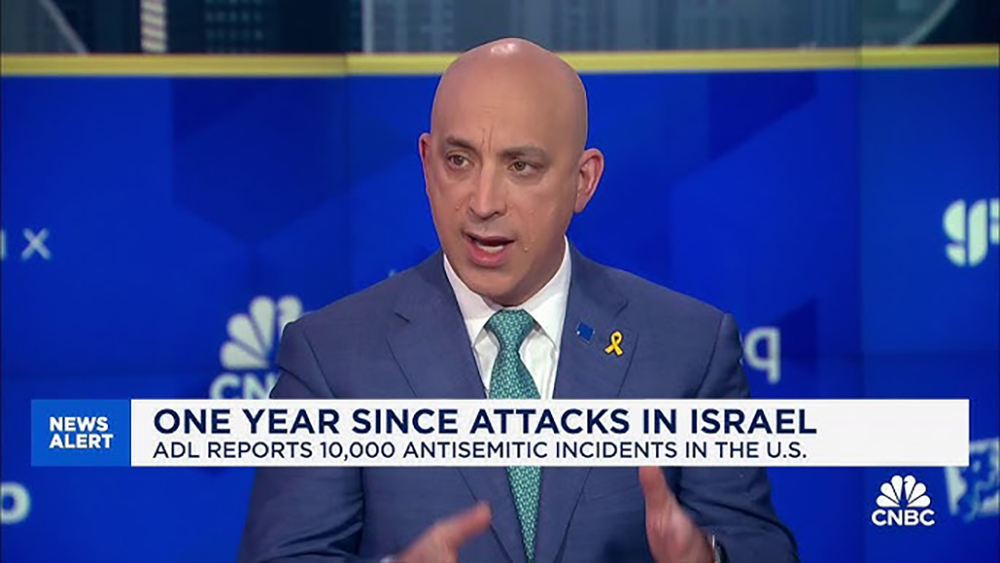
Jonathan Greenblatt, the ADL’s chief executive, responded with a forceful rebuttal in an opinion essay published in eJewishPhilanthropy. His intervention sought to reframe the debate away from what he portrayed as a false dichotomy between security and identity. Greenblatt acknowledged that Stephens had identified a genuine “pathology” within Jewish communal life: the danger that defining Jewishness primarily in opposition to antisemitism can reduce a rich, multifaceted civilization to a defensive crouch. Yet he rejected the notion that this pathology could be cured by dismantling the institutions designed to combat hatred.
For Greenblatt, the struggle against antisemitism and the cultivation of Jewish life are not competing priorities but mutually reinforcing imperatives. Security, he argued, is a precondition for flourishing, just as flourishing imbues security with meaning. To shutter organizations like the ADL, he warned, would constitute a form of “unilateral disarmament,” leaving Jews exposed at a moment when antisemitism has surged with alarming velocity, often entwined with virulent anti-Israel sentiment in the wake of Hamas’ Oct. 7, 2023, terror attacks. The Jewish Insider report underscored that Greenblatt’s defense was not merely institutional self-preservation but an attempt to articulate a holistic vision of Jewish communal strategy, one that resists the temptation to frame identity and security as a zero-sum contest.
The intensity of this exchange reflects a broader anxiety roiling Jewish communal life. As The Jewish Insider has reported, Jewish organizations have found themselves under fire from multiple directions in recent years. The ADL, in particular, has been criticized by voices on the left for its engagement with law enforcement and its stances on campus activism, and by voices on the right for what some perceive as politicized definitions of extremism. Yet rarely has the critique cut so close to the bone as in Stephens’ challenge, which emanated from within the pro-Israel, center-right intellectual milieu that has often aligned with the ADL’s core mission.
This moment of institutional introspection has unfolded against a backdrop of unprecedented strain. The post–Oct. 7 environment has witnessed a dramatic escalation in antisemitic incidents across the United States, much of it emanating from political discourse surrounding Israel and Gaza. Jewish students have reported harassment on campuses; synagogues and community centers have heightened security; online spaces have become saturated with rhetoric that blurs the line between criticism of Israeli policy and demonization of Jews. The Jewish Insider has documented how these developments have sharpened disagreements over whether the primary task of Jewish organizations should be to confront external hostility or to double down on internal communal renewal.
The debate has not been confined to policy papers and op-eds. It has spilled into the realm of mass culture and public messaging, most notably through the controversy surrounding a high-profile Super Bowl advertisement sponsored by the Blue Square Alliance Against Hate, an advocacy organization founded by New England Patriots owner Robert Kraft. As The Jewish Insider reported, the 30-second commercial depicted a Jewish high school student humiliated by bullies who affixed a “dirty Jew” note to his backpack, only to be comforted by a Black classmate who symbolically covered the slur with a blue square. The ad was designed to reach a broad, largely unengaged audience, evoking empathy and encouraging bystander intervention in the face of antisemitism.
Yet the ad quickly became a lightning rod for criticism. Detractors, many of them Jews, argued that its framing portrayed Jews as passive victims in need of rescue by benevolent outsiders, reinforcing a narrative of vulnerability that some believe is counterproductive in an era when Jews seek to project confidence and agency. Others faulted the commercial for sidestepping the contemporary realities of antisemitism, which often manifest not as crude slurs in school hallways but as sophisticated ideological campaigns entwined with anti-Zionist activism. The Jewish Insider report noted that the backlash echoed Stephens’ broader critique: that public-facing efforts to combat antisemitism risk oversimplifying the problem and misdirecting communal energy.
Greenblatt, for his part, publicly praised the Blue Square Alliance ad, framing it as a “simple yet moving depiction of resilience in the face of discrimination” and emphasizing that combating antisemitism requires the engagement of allies beyond the Jewish community. His endorsement, as The Jewish Insider report observed, functioned as a tacit reaffirmation of his organization’s core philosophy: that public education and coalition-building remain indispensable tools in the fight against hatred, even if such efforts are inevitably imperfect.
What emerges from this confluence of debates is a portrait of a community wrestling with its own self-understanding. On one side are those who fear that an excessive focus on antisemitism risks entrenching a siege mentality, defining Jewish identity primarily through the lens of victimhood and opposition. On the other are those who warn that to deprioritize the fight against antisemitism at a moment of rising hostility is to misread the perilousness of the current moment. The Jewish Insider report captured how these tensions have exposed generational divides, ideological fissures and differing assessments of the external environment in which Jews now navigate.
The challenge, as many communal leaders privately concede, is to resist the allure of false choices. The Jewish tradition, with its layered history of vulnerability and resilience, offers a vocabulary for holding multiple truths at once: that Jews must fortify their institutions against hatred even as they invest in the positive work of cultural, religious and civic renewal. The current debate, sharpened by Stephens’ provocation and Greenblatt’s rebuttal, may ultimately prove salutary if it compels Jewish organizations to articulate more clearly the philosophical foundations of their work and the metrics by which they assess success.
As The Jewish Insider report emphasized, the stakes of this conversation extend beyond institutional turf wars. They touch on the deeper question of how a minority community sustains itself in an open society that oscillates between tolerance and hostility, between inclusion and exclusion. Whether the Jewish community can navigate this moment without succumbing to either defensive paralysis or naïve complacency will shape not only the future of organizations like the ADL but the broader contours of Jewish life in America for years to come.
