



|
Getting your Trinity Audio player ready...
|
By: Fern Sidman
Jerusalem, a city where every stone and shard whispers fragments of ancient history, has once again yielded an extraordinary treasure from beneath its soil. In an announcement that reverberated across the archaeological world, the Israel Antiquities Authority confirmed the discovery of an exceedingly rare gold coin bearing the likeness of Queen Berenice II of Egypt, unearthed in the City of David’s Givati Parking Lot excavation.
The small quarter-drachma coin, made of nearly pure gold (99.3%), dates from between 246 and 221 BCE, corresponding to the reign of Ptolemy III, husband of Queen Berenice II. What renders this discovery so singular is not merely the coin’s rarity — with only about twenty known examples worldwide — but the context: it is the first specimen ever found in a controlled archaeological excavation, offering invaluable evidence about Jerusalem’s status under Ptolemaic rule in the Hellenistic period.
As VIN News emphasized in its report on Wednesday, the find is “a once-in-a-generation discovery,” a moment when archaeology, numismatics, and history converge to rewrite longstanding assumptions about the city’s trajectory in the centuries following the destruction of the First Temple.
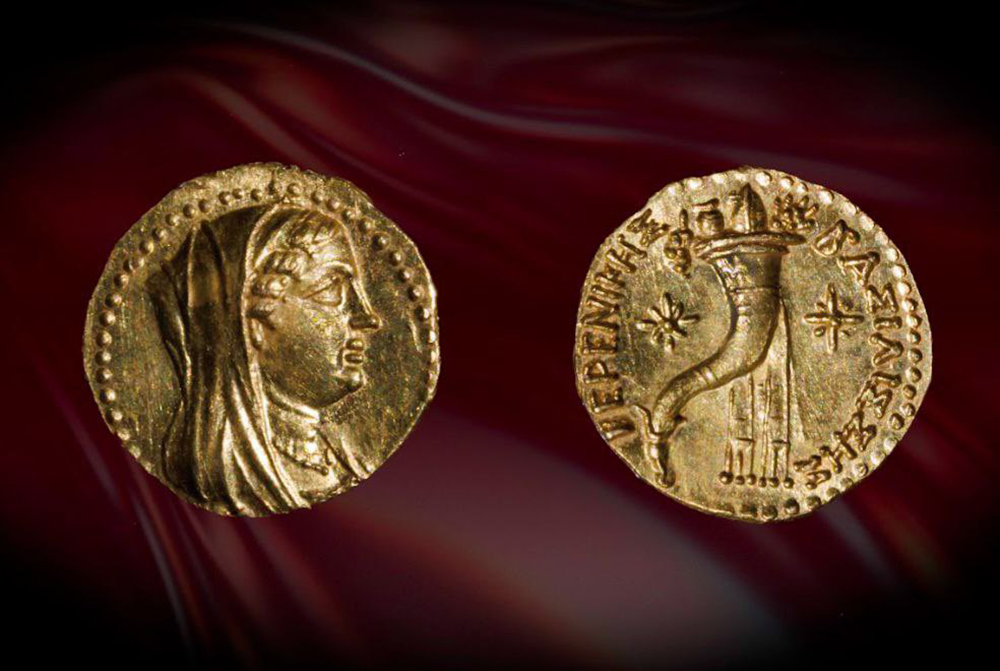
The obverse of the coin features the portrait of Queen Berenice II, her visage rendered with the regal elegance typical of Hellenistic art. Adorned with a crown and veil, a necklace resting around her neck, the queen is depicted not simply as consort to a king, but as a sovereign figure in her own right.
On the reverse, a cornucopia — symbol of prosperity and fertility — flanked by two stars, is accompanied by the rare Greek inscription “ΒΑΣΙΛΙΣΣΗΣ” (“Of Queen Berenice”). Scholars note that such inscriptions are uncommon for this period, particularly when applied to women. As VIN News reported, this coin represents “one of the earliest known instances of a Ptolemaic queen portrayed with titular authority during her lifetime.”
Dr. Robert Kool, Head of the Coin Department at the Israel Antiquities Authority, and Dr. Haim Gitler, Chief Curator of Archaeology at the Israel Museum, stressed the exceptional nature of this detail. “This is not simply a portrait of a royal spouse,” they explained. “The inscription and imagery position Berenice as a ruler in her own right, underscoring her unusual degree of independence and political clout in the Ptolemaic dynasty.”
This nuance is critical. While later queens such as Cleopatra VII would dominate historical memory, Berenice’s appearance on coinage centuries earlier indicates a precedent for female prominence within the dynastic iconography of Egypt.
The coin was discovered not in the act of excavation but during the sifting of soil removed from the site. Rebecca Langeler, an archaeologist working at the Givati dig, recounted her moment of astonishment.
“I was sifting through the soil when I suddenly saw something shiny,” Langeler recalled. “I picked it up and saw it was a gold coin. At first, I couldn’t believe what I was seeing, but within seconds I started running excitedly through the excavation. I’ve been digging in the City of David for two years, and this is the first time I’ve found gold!”
Her discovery, highlighted in the VIN News report as a “career-defining moment,” illustrates the serendipity that often underpins archaeological breakthroughs. One second of recognition turned an ordinary day of fieldwork into a contribution that may reshape scholarly understanding of Hellenistic Jerusalem.
