



|
Getting your Trinity Audio player ready...
|
Keynote speaker at Conference of Chabad-Lubavitch Women Emissaries works to make lives better
By: Faygie Levy Holt
Miriam Moskovitz can still remember the call that changed everything. Almost a year ago exactly, on Feb. 24, 2022, she was awakened at 5 a.m. in her home in Kharkov, Ukraine, by the sound of the phone ringing. She picked up, it was a local Jewish community member.
“I asked him, ‘Is everything OK?’” Moskovitz recalls. “He said ‘No! They’re bombing Kharkov!’”
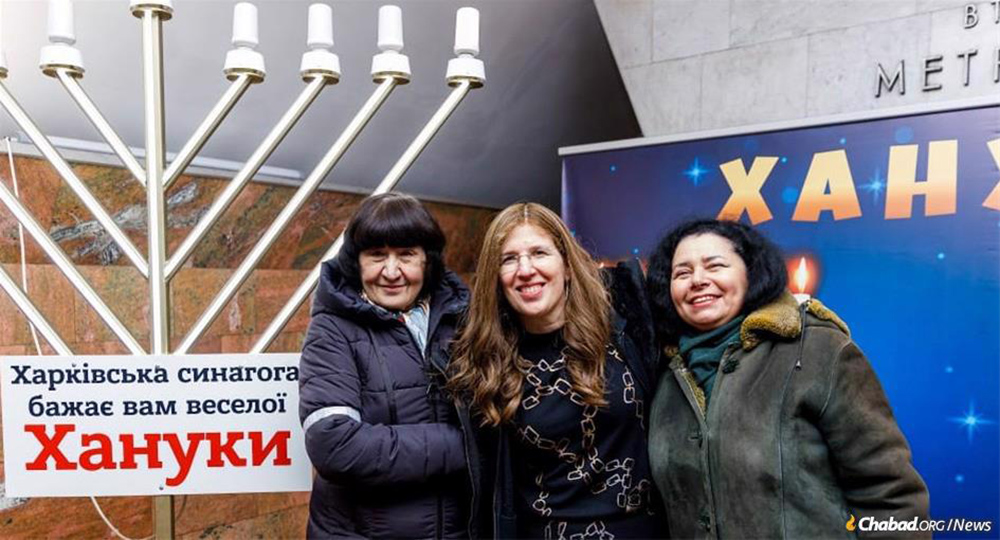
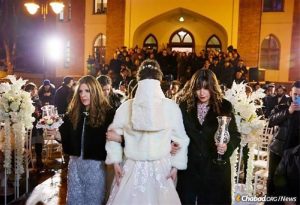
Moskovitz and her husband, Rabbi Moshe Moskovitz, have served as directors of Chabad-Lubavitch of Kharkov, the far-eastern Ukrainian city, since 1990. It was from there that they experienced the disintegration of the Soviet Union and birth of an independent Ukraine. It was there that they’d met and helped countless Soviet-born Jews reconnect to their Judaism, before watching them leave for the United States or Israel. Even after the massive waves of emigration, however, the Moskovitzes knew their place was in Kharkov, to which they were sent by the Rebbe, Rabbi Menachem M. Schneerson, of righteous memory, and whose many remaining Jews would be their focus to the present day. They’d restored the city’s old Choral synagogue, built a Jewish school, a yeshiva and a girls’ school—everything a Jewish community needed. Indeed, only weeks earlier the Moskovitzes had celebrated their daughter’s wedding in their hometown.
Now when Miriam opened her window, it was the sounds of exploding artillery and the acrid smell of burning that wafted in. She’d experienced a lot in her three decades in Ukraine, but not war, especially not like this one—unfolding on the internet and on her doorstep in real-time. Still, she knew, the work she and her husband had been sent by the Rebbe to do in Ukraine—together with her Chabad emissary colleagues throughout the embattled country—must go on.
Now, almost a year since that phone call, Miriam Moskovitz is on her way to New York to deliver the keynote address at the International Conference of Chabad-Lubavitch Women Emissaries (Kinus Hashluchos) on Sunday night, Feb. 12.
The trip is reminding her of another one she once took nearly four decades ago from her then-hometown of Sydney, Australia. Back in 1984 a 14-year-old Miriam Amzalak was crowned the Australian winner of the International World Bible Quiz and given a round-the-world airline ticket to Israel. That was exciting enough, but it was the stopover in New York that excited her even more. Accompanied by her mother, she traveled to Brooklyn where she received a blessing from the Rebbe.
That meeting with Rebbe, she recalls, was a transformative experience that solidified her vision of a future helping others on some distant corner of the earth. Decades later she’s doing just that but in ways she could never have imagined. Each day she’s preoccupied with the welfare of thousands of Kharkov Jews devastated by war—whether as refugees in Europe or Israel, or as beleaguered residents struggling through the harsh winter at home. Yet the goal is always the same: to reach out and assist every single Jewish person they can, and serve as a “light unto the nations” for everyone around them.
“The Rebbe is the inspiration for what we do,” Moskovitz says. “This is what the Rebbe wanted: For people to help others and make the world a better place.”
Heading to the Soviet Union
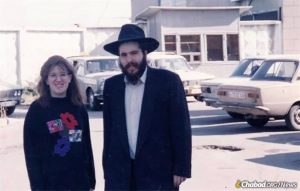
In the late 1980s, following high school in Sydney, Miriam Amzalak moved to Brooklyn to study at Bais Rivka Seminary, a post-high school Jewish learning program for young women in Crown Heights. Soon after graduation, she met and married Moshe Moskovitz, a young Torah scholar from Venezuela.
“When I was a teenager growing up in the ’80s, my friends constantly talked about shlichut, being an emissary of the Rebbe,” she tells Chabad.org. “We talked about what a tremendous honor it would be to help others—to go to a city, no matter how far away or how different it was from home.”
Since her new husband was a native Spanish speaker, Miriam assumed that they would be relocating to a country in South America and helping a Jewish community there, so she began learning Spanish. Then came the news that would change the trajectory of her life, her family’s life and the lives of thousands of Jews in Ukraine.
“My husband came home from kollel one day and said ‘Guess what, they are opening options for shlichut in the Soviet Union,’” she remembers. “I actually thought it was extremely amazing that people would be able to do that. It wasn’t something that I thought we could do since we already had a baby, and other people with children were told that shlichut in the Soviet Union wasn’t an option for them at that time. But then a couple with a child was given permission to go, so we decided to ask for permission and see if we would be lucky enough to be chosen for this new frontier.”
Which, of course, they were.
“The Soviet Union was still behind the Iron Curtain at the time, we had no idea what it looked like. We knew nothing about Kharkov and had no idea where it was, but we got things together as quickly as we could and off we went,” she says.
Not everyone was initially on board with the young couple’s decision. “Our parents were a bit shell-shocked when they heard,” acknowledged Moskovitz. “They knew I wanted to go on shlichut. Originally, it was going to be just for one year, then we would see. I think they thought, OK, for one year, they’ll have this experience … .”
Thousands Turn Out to Welcome a Young Couple
The Moskovitzes and their infant son, Mendel, arrived in Kharkov on the last day of August in 1990, the ninth day of Elul, on the Jewish calendar. The synagogue, which had just been returned to the Jewish community of Kharkov, had been a Soviet sports complex for 70 years. It was where people went to play soccer.
There was nothing inside of the building that spoke to its prior life and the vibrant community of Jews who once studied Torah and prayed to G‑d there. Nothing, save for a Star of David on the outside of the building.
That didn’t deter the young couple. They held a kabbalat panim, a “welcome” event, the first Friday night they were in town. They were astonished when 1,000 people turned out to see them. Two days later, on Sunday morning, Miriam Moskovitz started a Hebrew school, and on Monday, her husband began a yeshivah.
“We quickly put up a makeshift ark, curtains to serve as a separation during prayer services, benches, chairs and tables, and immediately began hosting davening,” she recalls. “Everyone knew the building as a sports complex, but people were happy to come back and use it for what it was intended.”
The Moskovitzes didn’t speak Russian, the predominant language in Kharkov, and while “the language was a barrier, the excitement of the people that we were there definitely made up for the challenges,” Moskovitz recalls. “It was a totally different way of life, not just a different country that was miles away. It was worlds away from where we had come from.
“Jewish-wise, this was a country where for 70 years under communism anything that looked Jewish was suppressed. And here we were, opening the shul, making Rosh Hashanah, making programs, with people who would just a few months earlier were embarrassed or frightened to say they were Jewish were now coming out of the woodwork; coming to shul, coming to programs signing up their kids for Sunday school … it was a chance for them to learn something about the Judaism they knew nothing about.”
While they got their programs off the ground, the couple’s home life was a challenge. They were living in a hotel room and had only a single burner on which to warm food.
Not that they had much of that, either, as there was also no kosher food to be had in Kharkov at that time. The couple relied on fresh fruits and vegetables, eggs, canned goods they had brought with them, fresh fish on occasion, and bread they were able to make themselves.