



|
Getting your Trinity Audio player ready...
|
Louisiana, about 90 miles north of St. Louis, is known for its Victorian streetscape and for 10 buildings on the National Register of Historic Places. It has another noteworthy distinction: its Jewish history.
By: Bill Motchan
The fall High Holiday season is a time of reflection and renewal and when many Jews visit the graves of loved ones. A secluded Jewish cemetery in Louisiana, Mo., is a special place for descendants of dozens of Jewish residents who made the town their home more than a century ago.
Louisiana, some 90 miles north of St. Louis, has a population of a little more than 3,000. The 200-year-old river town is known for its Victorian streetscape and for 10 buildings on the National Register of Historic Places. Louisiana has another noteworthy distinction: its Jewish history.
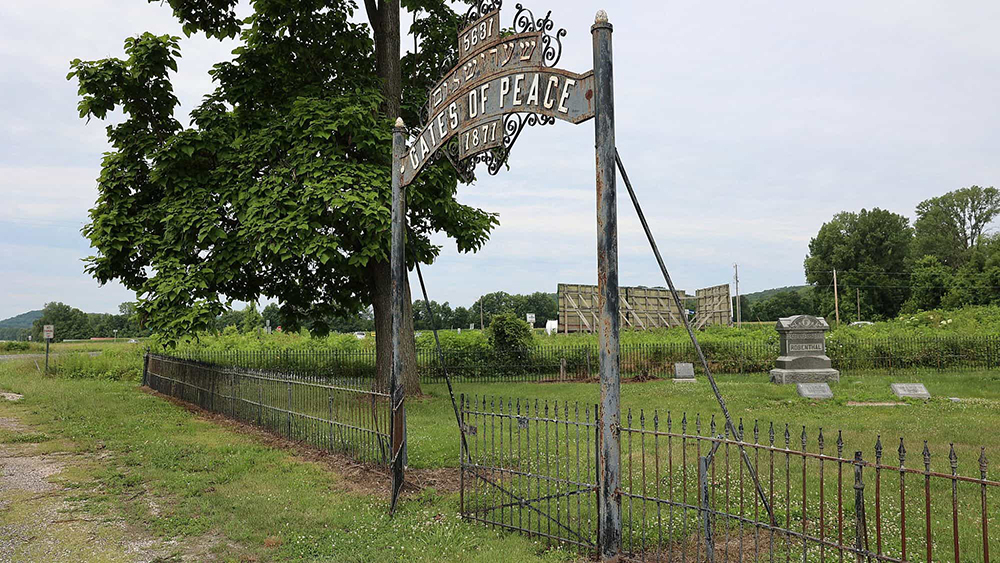
The most poignant reminder of a once-vibrant Jewish community in Louisiana is located just west of town on state road NN. That’s where the Gates of Peace Jewish Cemetery sits. The iron gate entrance reads:
5631
שערי שלום (Rodef Shalom)
GATES OF PEACE
1871
Gates of Peace is the resting place of 105 Jewish Louisianans. Most were members of families who ran successful dry-goods stores. In the late 1800s, more than a dozen large Jewish families made Louisiana their home and became part of the town’s fabric. They served as Jewish deputies, city councilmen, a county collector and a constable. The town had no synagogue, but residents routinely celebrated Jewish holidays and maintained a Jewish lifestyle.
It wasn’t unusual for Jewish immigrants to move from town to town, seeking opportunities to earn a living. As their businesses prospered, Jewish Louisianans decided to make the town their permanent home. It wasn’t practical to build a synagogue for such a small population, but they saw a real need to create a burial ground. The first burial at Gates of Peace was in 1871. Kate Fishell died there nine days after her first birthday.
Gates of Peace sits on a one-acre tract of land, adjacent to a fire station today. On June 11, 1871, a group of 26 Jewish men (including Ferdinand Fishell, Kate Fishell’s father) gathered in the town library to officially organize the Hebrew Cemetery Association of Louisiana.
Jewish migration to the Midwest
A steady influx of Jewish immigrants from Europe migrated to America in the 19th century. The Jewish population grew rapidly in the United States—from 3,000 in 1820 to 300,000 in 1880. Frequently, they came from Central Europe. The main attraction was the ability to build a better life for their families. America represented the land of opportunity. Many of the new arrivals were German-speaking Jews who settled in small Midwestern towns.
“River traffic was the main mode of transportation before the railroads were established, so the cities along the Mississippi River were developed as river towns,” said Jewish author and historian Cynthia Gensheimer. “They settled in every small town along the Mississippi.”
Their career path often took shape in the clothing and dry-goods business. That choice paid off because they were hard-working and motivated to succeed, Gensheimer said.
“Many of them began by being peddlers,” she said. “There are Horatio Alger stories that begin with a Jewish settler starting with a pack on his back. Then he gets a cart, then he’d become a clerk or set up a little store of his own. In the case of the Younker family, one brother would be at a store and another would be peddling. They had one prosperous store, then they’d set up a satellite store in a neighboring city. They were dealing in different commodities. Hides and furs were a big part of the business.”
Benjamin Younker, who settled in Louisiana, was the eldest of eight brothers. Some of them were in Louisiana as early as 1856. They started with nothing, and initially, one brother would be tending the store while another would be peddling. They moved around but stayed very close. Several brothers were headquartered in Keokuk, Iowa, in the mid-1870s when they decided to set up a branch in Des Moines. They correctly predicted that the railroads would make that city prosperous. The Younker Brothers Department store eventually expanded to 150 stores in the Midwest.
Growth of the Jewish community
Brothers Simon and Marx Lesem helped establish organized Jewish life in Louisiana. They had relatives in Quincy who were leaders there. In 1868, one of the Lesem brothers reported four Jewish families in Louisiana, and in 1870, they started the Hebrew Benevolent Society. The Lesems eventually got fed up with the lack of interest in Judaism displayed by the Jews in Louisiana and returned to their native Germany.
In addition to the Younker’s Louisiana’s Jewish residents included the Genzbergers, Michaels, Morrises, Zuzaks and Walds.
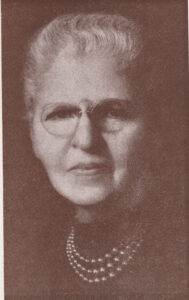
The Wald Brothers Department store was operated by brothers David and Adam Wald. They were also next-door neighbors who lived a half block from their store. Although Louisiana had a Jewish community, finding a suitable spouse was challenging for young Jewish men in town. So Adam ventured to Chicago where he met and courted Sara Liebenstein Hart. They settled in Louisiana, and Sara taught religious school to Jewish children. She also headed up the Louisiana chapter of the National Council of Jewish Women (NCJW).
Competitors and innovators in business
In the 1890s, the retail business in Louisiana was fiercely competitive. Two Jewish store owners—the Walds and Michaels—had stores on Georgia Street, the town’s main thoroughfare. Abraham Wald and Isador Michael were the patriarchs of the two families and their rivalry in business often spilled over to life outside the stores. Every Friday morning in preparation for Shabbat dinner, Jewish families would head to the local fish market. In her autobiography about life in Louisiana, The Pleasure Is Mine, Sara Hart described a weekly occurrence.
“The elder Mr. Michael and the elder Mr. Wald raced to market to buy fish. My father-in-law [Abraham Wald] had the advantage because he lived a block closer. Mr. Michael limped. Each made his way rapidly down the street intent upon getting there first.”
Although they were rivals in business, the Jewish merchants in Louisiana came together to worship. There was no official congregation, but Shabbat services were held on Friday evenings and during the Jewish holidays at the Masonic Temple on Georgia Street. Records show the congregation had 34 members. Isador Michael led services and Isaac Younker was president-secretary-treasurer. Younker doubled as president of Gates of Peace Cemetery.
Merchandising mavens
The Younkers flagship store in Des Moines was known for its tea room restaurant, and in 1939, it boasted Iowa’s first escalator, known as the “electric stairs.” The Zuzaks were also savvy innovators. Family members operated a sundries store in Boonville, Mo., called the Zuzak Wonder Store. Jerry Krueger, a Zuzak descendant now living in Akron, Ohio, offered a bit of family lore about the store.
“Depending on what source you read, the Zuzaks were either the first store to come up with Santa Claus coming to the store the day after Thanksgiving or the first one west of the Mississippi,” Krueger said. “But, yeah, the great irony is that the Jewish merchant is the one who figured out how to extend the Christmas shopping season.”
Two Zuzak sisters, Helen and Amy, eventually took ownership of the store and were successful businesswomen in their own right. They also contributed generously to the neighboring Kemper Military Academy. Bob Bondi, a Zuzak descendant now living in Galesburg, often visited the sisters when he was growing up.
“I remember them quite vividly, and they were always so kind to us,” said Bondi, 72. “In the ’50s and ’60s, we’d visit them every couple of months. I also went to their burials in Louisiana. Amy didn’t marry probably because she had diabetes and went blind very early in life when Helen took care of her.”
The Walds, Younkers and Zuzaks weren’t the only Jewish merchandising mavens in Louisiana. Elias Michael emigrated from Kolmar, Prussia, in 1856. He settled in Quincy, Ill., and in 1867 moved 45 miles south to Louisiana and opened a one-room store. It eventually grew to become one of the best-stocked dry goods stores in northeast Missouri. In 1929, he sold it to J.C. Penney.
Marcus Morris represents another rags-to-riches story—literally. Morris was a rag salesman. He eventually had his own department store. He later branched out into real estate, owning 127 business houses. His net worth was $200,000 when he died at age 59 in 1907. Adjusted for inflation, that’s equivalent to $6.2 million in 2023.
(JNS.org)