



|
Getting your Trinity Audio player ready...
|
By: Fern Sidman
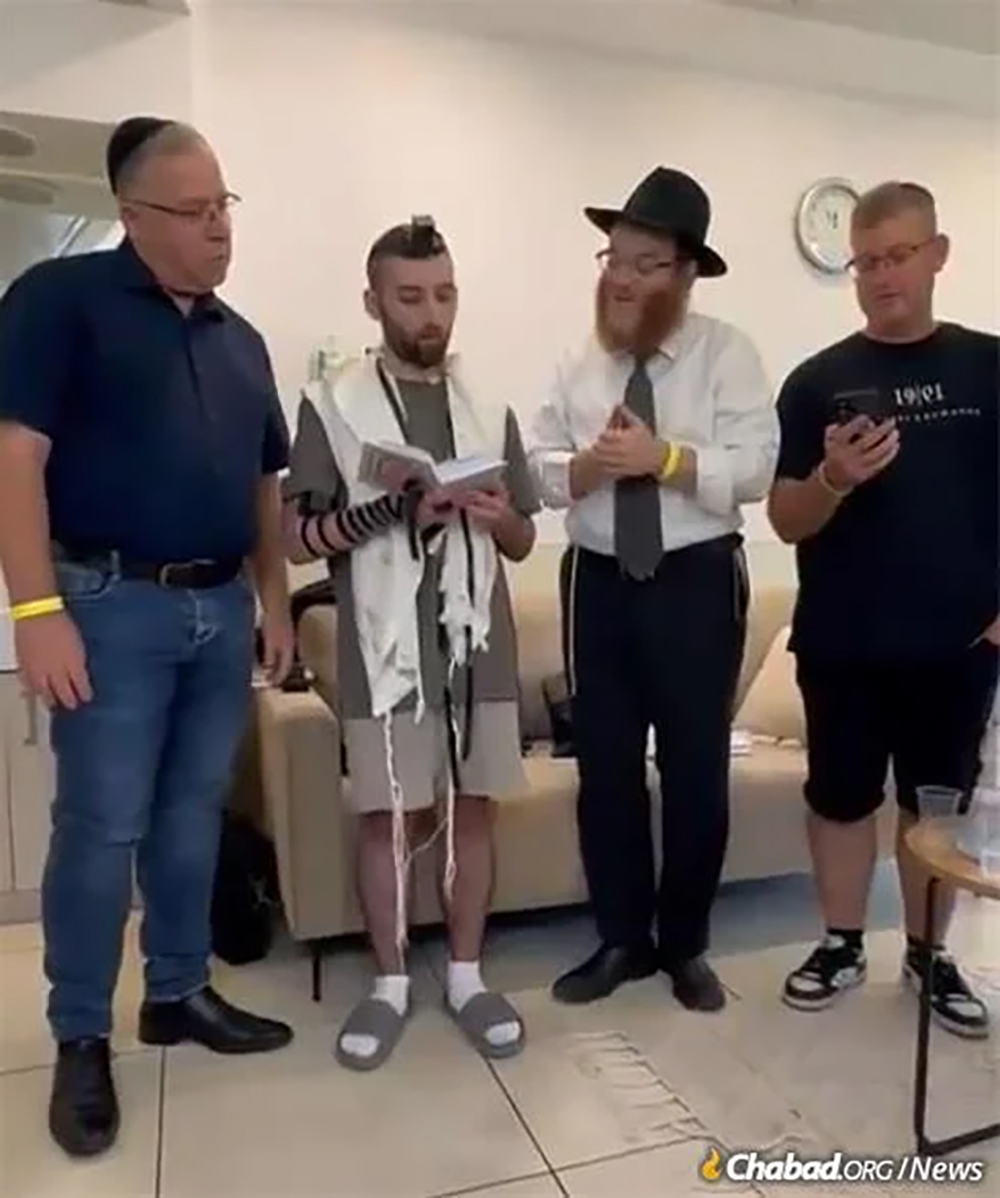
In a moment that has resonated deeply throughout Israel, freed hostage Matan Angrest, who famously put on tefillin while held captive in Hamas tunnels, once again wrapped the sacred leather straps around his arm and head on Friday morning, joining his father in prayer and thanksgiving. The intimate act, captured and shared across Israeli media outlets has become a symbol of faith restored — an affirmation of spiritual endurance in the aftermath of unimaginable darkness.
Standing beside his father in their home, Matan recited Mizmor LeTodah — the Psalm of Thanksgiving — the ancient prayer that Jews have recited for centuries to express gratitude for deliverance. His voice was steady but filled with emotion as he spoke the words, “Hariu l’Hashem kol ha’aretz” (“Shout for joy to the Lord, all the earth”).
After more than 700 days in Hamas captivity, enduring near-total darkness, hunger, and physical and psychological torment, Matan’s return to prayer has moved a nation still reckoning with the trauma of the October 7, 2023, attacks. As Channel 12 News reported, his choice to begin his morning by putting on tefillin — the very act he performed clandestinely underground — was not merely a personal ritual but a quiet declaration of triumph: faith had survived where so much else had been stripped away.
According to Ynet, Matan’s father, who stood beside him during the morning prayer, described the moment as one of “overwhelming gratitude to Hashem for the miracles that have carried us through these two years.” He told reporters that the family had waited for this morning since the day their son was taken from them. “We prayed every single day that he would live to wrap tefillin again, not in the tunnels, not in fear — but in freedom, under the light of the sun.”
The family’s living room was transformed into a makeshift synagogue. Relatives, neighbors, and friends gathered quietly around Matan, joining him in the ancient Psalm of thanks. Some wept as he began, others held prayer books, their voices rising softly with his.
When the prayer ended, Matan reportedly whispered to his father, “We said it down there, and now we can say it up here.”
Reports emphasized that the tefillin themselves carried profound symbolic weight: they were a pair gifted to Matan during his IDF service, rescued from his belongings after the October 7 massacre, and safeguarded by his family in the hope of his return. The sight of those same tefillin — once a fragile tether to faith in captivity, now a symbol of survival — has deeply moved Israelis across the political and religious spectrum.
During his captivity, Matan Angrest reportedly performed the mitzvah of tefillin in secret, according to testimonies shared with N12 and Israel National News. Fellow hostages who were freed earlier this year told investigators and journalists that Matan had fashioned a makeshift prayer corner in the tunnels beneath Khan Younis, whispering the morning blessings while his guards slept.
“He would say Modeh Ani every morning,” one former hostage told a media outlet, referring to the short prayer of gratitude traditionally recited upon waking. “He told us, ‘As long as I can say thank you, I am still free inside.’”
Religious leaders across Israel have cited Matan’s story in sermons and study circles as an emblem of Jewish perseverance. “The Nazis forbade prayer; the Soviets forbade faith. Hamas forbade light, but they could not forbid God,” Rabbi Yitzhak Levy told Channel 14 News. “Matan’s tefillin are our generation’s reminder that even in the tunnels of Gaza, the soul of Israel cannot be extinguished.”
In his first public remarks since returning home, Matan told Israeli media outlets that his spiritual routine — the act of prayer, even without tallit or siddur — helped him preserve a sense of purpose. “There were nights when the bombs shook the tunnels,” he said. “I didn’t know if we’d live till morning. But I would close my eyes and say Shema Yisrael. It was the one thing that was mine, that they couldn’t take.”
The Jerusalem Post, citing IDF sources, reported that Matan’s faith under captivity inspired others held with him, some of whom began to repeat fragments of Hebrew prayers they remembered from their childhoods. One guard reportedly mocked the hostages for their “silly rituals,” but Matan continued — quietly, defiantly.
When asked if he was ever afraid of being caught praying, he answered, “Of course. But the fear of not praying was worse.”
Matan was freed under the most recent stage of the U.S.-brokered ceasefire agreement, which secured the release of the remaining 20 living hostages in exchange for humanitarian concessions. His return, covered extensively by Israel National News, was marked by both jubilation and mourning, as many hostages’ families continue to await the return of their loved ones’ remains.
As Arutz Sheva (INN) reported, Matan’s mother, Leah, greeted her son with the words, “Baruch Hashem — we never stopped believing.” The family’s home in the coastal city of Rishon LeZion has since become a place of pilgrimage for neighbors and well-wishers, many of whom come simply to shake Matan’s hand or whisper “todah” — thank you.
For Matan, however, the celebration has been measured with humility. “We came back,” he said to Channel 12, “but others did not. Every morning when I put on tefillin, I think of them. It’s not just my miracle — it’s for all of us.”
Matan’s quiet act of faith has stirred something profound within Israeli society, still struggling with the scars of the Hamas massacre and the prolonged hostage crisis that followed. In synagogues across the country, from Tel Aviv to Be’er Sheva, rabbis referenced his Mizmor LeTodah during Shabbat sermons as a moment of collective healing.
Media reports described the prayer scene as “a small window of grace in a season of grief.” Even secular commentators acknowledged its emotional impact: “There was no politics in that moment,” wrote a columnist for Maariv. “Only a man, his father, and a simple prayer of thanks that all of Israel could understand.”
The Chief Rabbi of Israel, David Lau, issued a statement praising Matan’s steadfastness: “To put on tefillin in the shadow of Hamas is to declare that Am Yisrael Chai — the people of Israel live. Matan’s courage reminds us that faith is not a luxury of peace; it is the strength that sustains us in war.”
The words of Mizmor LeTodah — Psalm 100 — have taken on new resonance in Israel since Matan’s return. Ynet reported that recordings of his morning prayer have been played in synagogues, schools, and army bases. Soldiers stationed along the Gaza border reportedly joined together on Friday afternoon to sing Mizmor LeTodah in his honor, reciting the same lines he spoke underground in captivity: “Know that the Lord is God; it is He who made us, and we are His.”
“It’s not just gratitude for one man’s freedom,” said a rabbi interviewed by Israel National News. “It’s gratitude for the endurance of our people — for light that survives even in the tunnels.”
As Israel continues to grapple with the trauma of October 7 and the ongoing struggle for national security, the story of Matan Angrest — a soldier who never let go of his faith — has become a living parable.
In the words of Israel Hayom, “His tefillin are more than straps of leather; they are the link between heaven and earth, between fear and freedom, between the silence of Gaza’s tunnels and the song of a nation reborn.”
On that quiet Friday morning, as Matan stood once again in the sunlight beside his father, reciting Mizmor LeTodah, Israel witnessed something beyond survival. It saw renewal — the rebirth of spirit after two years in darkness.
And as one commentator for Israel National News wrote: “When Matan Angrest wrapped his tefillin, he wrapped the entire people of Israel in hope. His prayer was not his alone — it was ours.”
