



|
Getting your Trinity Audio player ready...
|
By: Tzirel Rosenblatt
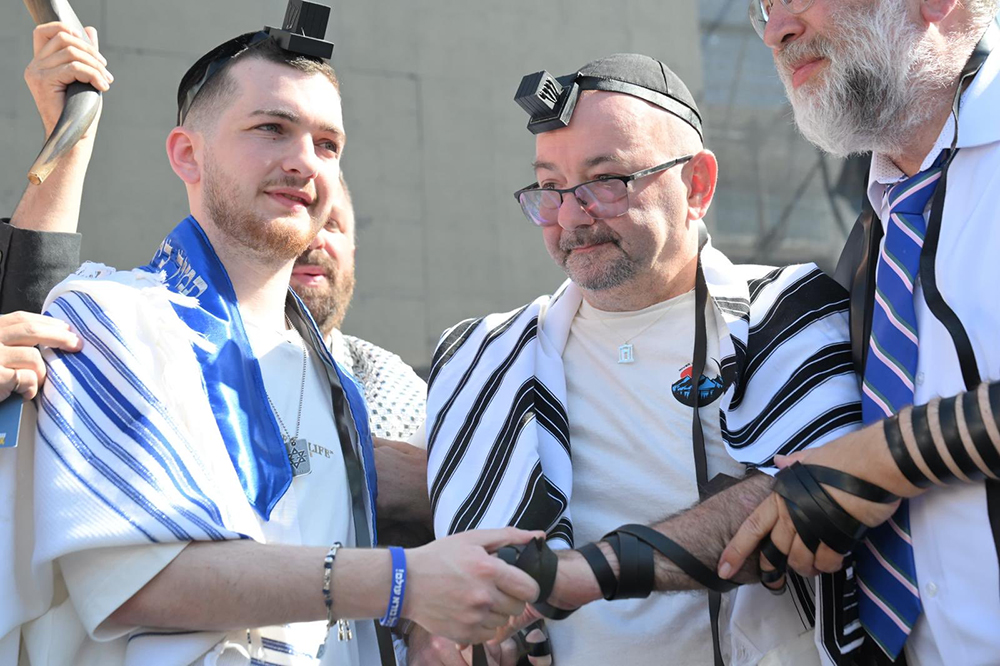
In a moment that fused faith, grief, and unyielding national solidarity, freed Israeli hostage Bar Kuperstein stood before hundreds of participants at Tel Aviv’s Hostage Square on Friday, leading a deeply emotional mass Tefillin event dedicated to the memory and return of Israel’s remaining hostages. The gathering, described by VIN News in a report on Friday as one of the most spiritually charged public displays since the Hamas war began, was organized by Kuperstein himself — a man whose survival and renewed devotion have come to symbolize Israel’s endurance through suffering.
Kuperstein, who was abducted by Hamas on October 7, 2023, shared chilling details from his time in captivity in Gaza. He described how, surrounded by the enemy’s prayers in Arabic, he resolved that his only weapon — his only hope — would be prayer itself. “I realized then that I would have to pray with more fervor than them to be released,” he told the crowd.
According to the information provided in the VIN News report, Kuperstein’s words resonated across Hostage Square — the very site where Israelis have gathered for months to demand the return of their loved ones. This time, however, the tone was different. Rather than anger or despair, there was faith.
Kuperstein recounted how, during the first days of his abduction, he was forbidden by his Hamas captors to speak in Hebrew. “I prayed silently — in my heart, in the deepest recesses of my soul,” he said. Only later, when he was permitted to speak, could he pray aloud — and even then, he did so quietly, in unison with fellow hostages who found in whispered prayers their last link to home.
The VIN News report noted that Kuperstein’s ordeal is emblematic of the spiritual resistance many Israeli hostages have described since their release. Prayer, for them, was both defiance and survival — a lifeline between captivity and the Divine.
Bar’s mother, Julie Kuperstein, who became religious in recent years, had been instrumental in organizing nationwide campaigns encouraging Jews around the world to don Tefillin in her son’s merit. According to the report at VIN News, her initiative had spread through synagogues, schools, and army bases, uniting religious and secular Jews in a shared act of faith.
When Bar learned of his mother’s efforts after his release, he decided to do the same — but publicly, and in the heart of Tel Aviv. “This event,” he said, “is not just for me. It’s for every soul still waiting to come home — alive or not. And it’s for every Jew who believes that faith can move Heaven and Earth.”
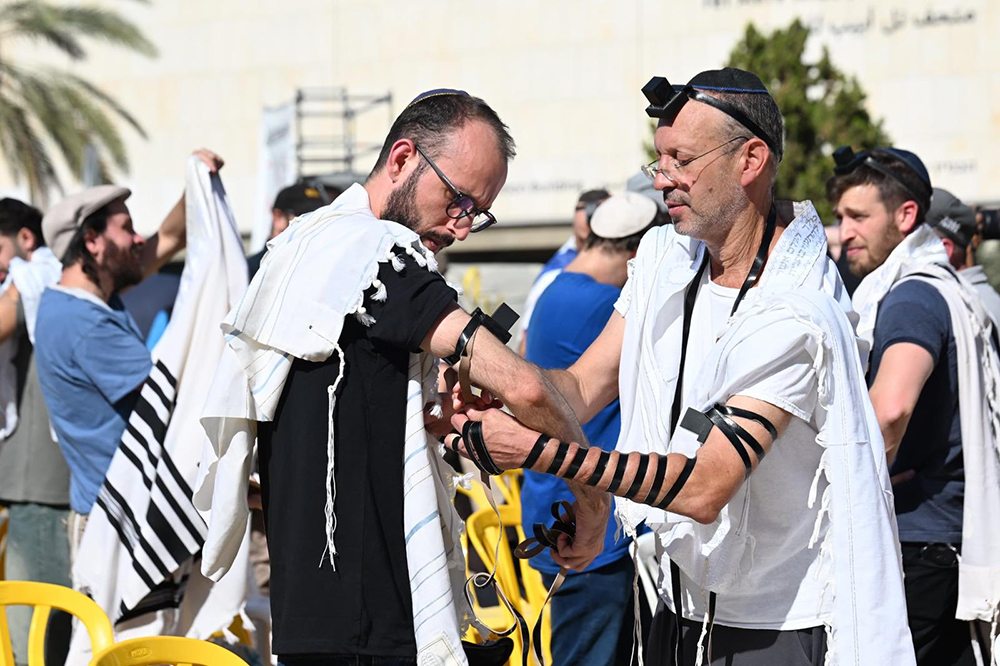
By midday, Tel Aviv’s Hostage Square — once the center of political rallies and protests — had been transformed into a sea of prayer shawls and Tefillin straps. Rows of men and boys stood shoulder to shoulder, wrapping the black leather around their arms and foreheads, murmuring ancient words that echoed through the plaza.
Volunteers handed out Tefillin sets, prayer cards, and refreshments. Dozens of rabbis from across the country — Ashkenazi, Sephardi, Haredi, and Religious Zionist alike — joined the crowd. There was no distinction between the observant and the secular, no division between left and right.
As VIN News reported, “The scene was remarkable not only for its size but for its unity. Tel Aviv, often portrayed as the symbol of secular Israel, became for one afternoon a sanctuary of collective prayer.”
Julie Kuperstein’s presence at the event was met with waves of emotion. Standing beside her son, she described how her own spiritual journey had begun years earlier, long before October 7. “When Bar was taken, I didn’t know if I would ever see him again,” she said. “But I knew I could pray. I knew that somewhere in Gaza, he was praying too.”
According to the information contained in the VIN News report, Julie had launched an online initiative within days of her son’s abduction, asking Jews around the world to put on Tefillin, light candles, and say Tehillim (Psalms) for his safe return. Thousands responded. When Bar was finally freed, one of the first things he learned was the extent of those prayers — and that his mother’s campaign had gone viral.
“It gave me strength to know that people I had never met were praying for me,” he said. “And now I want to return that gift — by praying for those who are still there.”
Among the speakers at the event was Rabbi David Lau, Israel’s former Ashkenazi Chief Rabbi, whose moving address drew tears from many in attendance. As reported by VIN News, Rabbi Lau recounted stories from the October 7 attacks, when families trapped in their homes and shelters realized help had arrived only after hearing rescuing soldiers cry out, “Shma Yisrael, Hashem Elokeinu, Hashem Echad.”
“That moment — that cry — is our eternal code of faith,” Rabbi Lau said. “It is how Jews through every generation have proclaimed: We live, we believe, we endure.”
The rabbi commended Kuperstein for turning his trauma into a mission of unity. “There are tears of sorrow, and there are tears of faith,” he said. “Today, in this square, we are shedding the second kind — tears that bind heaven to earth.”
As the VIN News report emphasized, Kuperstein’s event was not a celebration but a call to action. Though freed, he carries the weight of those who remain behind — 11 hostages whose bodies are still being held in Gaza. The Tefillin gathering, he explained, was not merely symbolic but intercessory.
“Every mitzvah, every prayer, every Shma we say — it matters,” he told the crowd. “We don’t always see it, but the heavens hear it.”
Throughout the event, screens displayed photos of the remaining captives — soldiers, civilians, young and old. Families of the fallen stood near the front, clutching portraits and candles.
“Today, Bar speaks for those who cannot,” one organizer told VIN News. “He is proof that prayer and faith are not weakness. They are our survival.”
The sight of hundreds of men laying Tefillin in downtown Tel Aviv — a city often described as Israel’s cultural capital of modernity and pluralism — was, in itself, an act of profound symbolism.
As the VIN News report observed, “For one afternoon, Hostage Square became a crossroads of the nation’s soul — where the secular and sacred met not in conflict, but in harmony.”
One participant, a secular Tel Aviv resident who had never worn Tefillin before, told VIN News that he came “just to support the families” but ended up praying. “When I put on the Tefillin, something happened,” he said. “It’s hard to explain. It was like my heart remembered something ancient.”
That sentiment — that rediscovery of faith through national pain — has become a recurring theme in post–October 7 Israel. Moments like Kuperstein’s Tefillin gathering, observers note, reflect a broader spiritual reawakening that has quietly spread across the country.
Kuperstein concluded the event by addressing the crowd with quiet intensity. His voice, though weary, carried conviction. “When I was in Gaza, I heard them pray that Israel would fall,” he said. “So I prayed harder — that Israel would rise.”
He then invited participants to continue the mission: to put on Tefillin daily, to pray for the hostages, and to perform acts of kindness in their memory. “We can’t all fight on the front lines,” he said. “But every one of us can fight for light, for faith, and for unity.”
As he finished, hundreds joined in a collective cry of “Am Yisrael Chai” — the people of Israel live.
For VIN News, the story of Bar Kuperstein’s public prayer gathering is not simply a postwar human-interest story; it is a lens into Israel’s national psyche. His journey — from captivity in Gaza to leading prayer in Tel Aviv — embodies both trauma and transcendence, fear and faith.
In a country still raw from grief, Kuperstein’s message landed with unmistakable clarity: Faith is not a relic of the past. It is the lifeline of the present.
As the sun set over Tel Aviv, participants slowly dispersed from Hostage Square, the sound of prayers still lingering in the air. Some stayed behind, wrapping up Tefillin, others embracing strangers who felt like family.
For Bar Kuperstein, this was not an ending, but a continuation — of faith, of memory, and of the unbreakable bond between a people and their Creator.
As VIN News poignantly summarized, “Bar’s story is not just about one man’s redemption. It is about a nation that refuses to stop praying — even when surrounded by darkness. Because in Israel, even captivity cannot silence the Shma Yisrael.”