



|
Getting your Trinity Audio player ready...
|
By: Fern Sidman
A series of deliberate attacks on Jewish institutions in the United States and Germany this week has ignited fresh alarm among Jewish communities and international watchdog organizations, as acts of antisemitic violence increasingly shift from hateful rhetoric to physical destruction. According to monitoring and documentation provided by the Combat Antisemitism Movement (CAM), the torching of synagogues in Jackson, Mississippi, and Giessen, Germany, represents part of a disturbing global pattern in which prejudice against Jews is being expressed with growing brazenness and brutality.
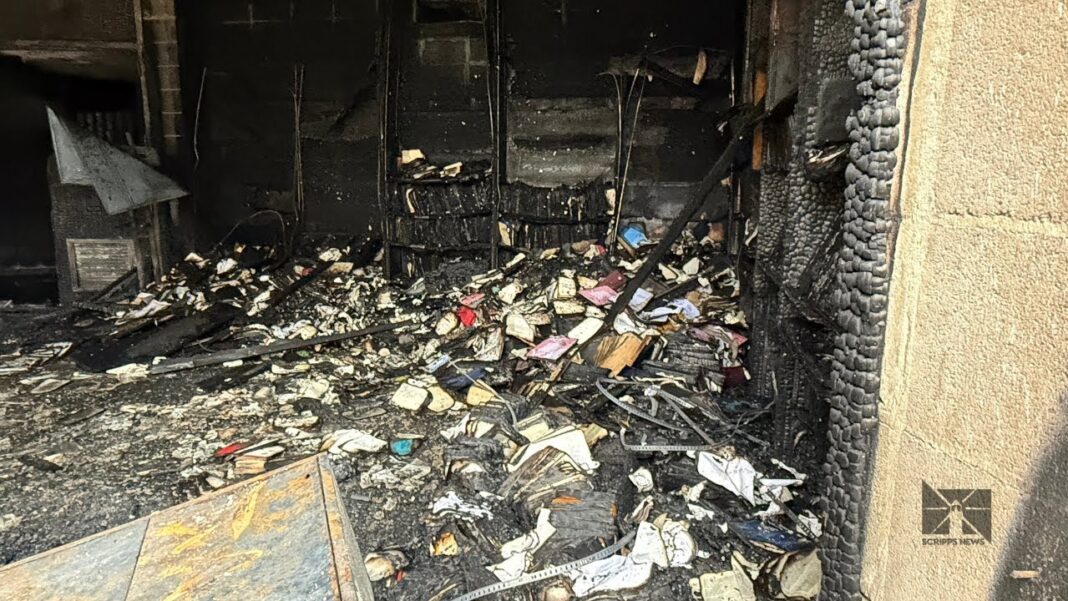
The most devastating incident occurred in the predawn hours in Jackson, where the historic Beth Israel Congregation — a spiritual and cultural anchor of Mississippi’s Jewish community for more than 150 years — was severely damaged by an arson attack. Federal investigators say the suspect, 19-year-old Stephen Spencer Pittman, intentionally targeted the building because of its Jewish identity. Court documents reviewed by law enforcement indicate that Pittman allegedly described the synagogue as “the synagogue of Satan,” a phrase steeped in centuries-old antisemitic demonization.
The Combat Antisemitism Movement, which has been closely tracking the case, condemned the attack as emblematic of a frightening trend in which extremist ideology is translating into tangible violence. In a statement, CAM emphasized that the arson was not an isolated act but part of a broader international environment in which Jews and Jewish institutions are increasingly seen as legitimate targets.
Beth Israel Congregation is no stranger to such hatred. In 1967, during the turbulent civil rights era, the synagogue was bombed by the Ku Klux Klan. That an institution scarred by historical antisemitism should again be attacked more than half a century later underscores, as CAM observers noted, the cyclical nature of anti-Jewish bigotry and the resilience of those who promote it.
Across the Atlantic, a similarly chilling episode unfolded in Giessen, Germany, where a 32-year-old man was arrested after setting fire to the entrance of the Beith-Jaakov Synagogue. Witnesses reported that the suspect performed a Nazi salute as the flames took hold — a grotesque gesture that evoked the darkest chapters of European history. German authorities moved swiftly to detain the perpetrator, yet Jewish leaders there expressed profound concern that such acts are becoming increasingly common.
The Combat Antisemitism Movement highlighted both incidents in its weekly global antisemitism report, warning that arson attacks on synagogues represent one of the most severe manifestations of hatred. “When a synagogue is set ablaze, it is not merely a crime against property,” a CAM spokesperson noted. “It is an attack on a community’s sense of safety, continuity, and belonging.”
Beyond these two headline-grabbing assaults, CAM documented a cascade of additional antisemitic episodes across several continents, illustrating the geographic breadth of the problem.
In Canada, a man from Saskatoon was arrested after allegedly posting explicit antisemitic threats on social media. Local authorities charged the individual under hate-crime statutes, an action welcomed by CAM as a necessary response to the normalization of online incitement that often precedes real-world violence.
Germany witnessed another disturbing incident in Leipzig, where a group of youths hurled bottles, shouted racist slurs, and attempted to force their way into a kosher café. CAM reported that the attackers specifically targeted the establishment because of its Jewish affiliation, leaving patrons shaken and once again raising questions about the safety of openly Jewish spaces in modern Europe.
In Switzerland, antisemitic vandalism appeared at a train station in Montreux, where perpetrators spray-painted slogans including “Globalize the Intifada” and “Long Live the Palestinian Resistance.” The graffiti also featured the inverted red triangle symbol commonly associated with Hamas propaganda. CAM analysts emphasized that such imagery is not merely political expression but a thinly veiled endorsement of violence against Jews worldwide.
The United Kingdom, meanwhile, was rocked by a different form of antisemitic controversy. West Midlands police admitted that they had relied on false, AI-generated information to justify barring Israeli soccer fans from attending a match between Maccabi Tel Aviv and Aston Villa in Birmingham last month. CAM sharply criticized the decision, arguing that it reflected institutional bias and effectively punished Jewish sports fans for their nationality.
In Argentina, antisemitism took on a conspiratorial dimension, as social media users spread baseless claims blaming Israelis for devastating wildfires in the Patagonia region. The Combat Antisemitism Movement praised Argentine President Javier Milei and Jewish communal leaders for swiftly condemning the rumors, which evoked age-old tropes about Jews as malevolent manipulators of world events.
Perhaps most emblematic of the cultural struggle over historical truth was a controversy that erupted in France, where a prominent educational publisher was forced to recall high school textbooks accused of distorting the October 7 Hamas massacre in Israel. The Hachette Education company issued a public apology after critics, including CAM and French Jewish organizations, pointed out that the materials minimized and misrepresented the atrocities committed during the attacks.
French President Emmanuel Macron himself intervened, labeling the textbooks “intolerable” and denouncing them as a “falsification of the facts.” CAM welcomed the recall as an important victory, arguing that educational institutions have a responsibility to combat antisemitism rather than inadvertently perpetuate it.
Taken together, these incidents paint a sobering picture. According to the Combat Antisemitism Movement, the current global climate is one in which hatred of Jews is being mainstreamed in ways not seen for decades. What begins as dehumanizing language online too often culminates in threats, vandalism, and ultimately violence.
Experts affiliated with CAM warn that the normalization of extremist rhetoric — particularly on social media platforms — has lowered psychological barriers to action. The arson attacks in Mississippi and Germany, they argue, are the logical endpoint of a process that begins with slurs, conspiracy theories, and historical revisionism.
CAM has called on governments, law enforcement agencies, and civil society to respond with urgency and resolve. Among the measures advocated by the organization are enhanced security for Jewish institutions, stronger hate-crime legislation, improved education about antisemitism, and more aggressive monitoring of online incitement.
The organization has also urged political leaders to speak out clearly and unequivocally. As CAM officials frequently emphasize, silence in the face of antisemitism is interpreted by perpetrators as permission.
For the congregants of Beth Israel in Jackson and Beith-Jaakov in Giessen, the week’s events have been traumatic reminders that Jewish life, even in established democracies, remains vulnerable. Yet both communities have vowed to rebuild and persevere — a determination that CAM leaders say reflects the enduring resilience of Jewish people worldwide.
Still, the flames that engulfed two synagogues this week carry a symbolic weight far beyond the buildings themselves. They illuminate a harsh reality: antisemitism, far from receding into history, is adapting to the modern world with frightening speed.
As the Combat Antisemitism Movement continues to document and expose these incidents, its message grows more urgent: combating antisemitism is not solely a Jewish concern, but a test of the moral health of societies everywhere. The question confronting the global community is whether it will meet that challenge before the next spark becomes another inferno.

https://tjvnews.com/opinion/oped/op-ed-bullet-proof-laments/
Why isn’t your entire Jewish community enrolled in hard core, professional self defense to learn how to take down an attacker without hesitation, using every form of legal self defense? Why isn’t your synagogue visibly surrounded by guards, 24/7, and/or Jewish men and women, in uniforms, patrolling with all the visible, legal gear they are allowed? Why aren’t all places where Jews gather surrounded by solid heavy gates, topped off with barbed wire? With bullet proof glass; electronic surveillance, alarms, and other deterrence? Why are we not fierce and feared? Why are we becoming used to being victims?