



|
Getting your Trinity Audio player ready...
|
By: Fern Sidman
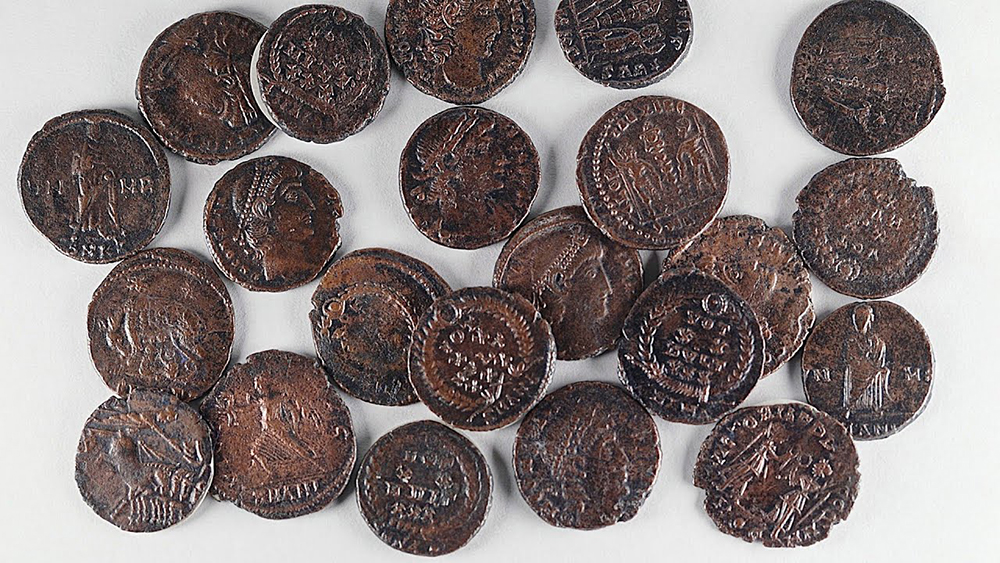
In a groundbreaking discovery that sheds new light on a turbulent and often overlooked chapter of Jewish history, archaeologists in Israel have unearthed a rare hoard of bronze coins dating back more than 1,600 years. The 22 coins, bearing the faces of Roman emperors Constantius II and Constans I, were discovered this week in the ancient settlement of Hukok in the Lower Galilee. According to a report on Thursday at i24 News, the treasure was hidden at the end of a narrow tunnel within one of the largest and most elaborate underground complexes ever excavated in the region.
Researchers from the Israel Antiquities Authority, in collaboration with Zefat Academic College, believe the coins were concealed during the Gallus Revolt of 351–352 CE—the last known Jewish uprising against Roman rule. For historians and archaeologists alike, the find is extraordinary: it provides one of the few tangible pieces of evidence attesting to a rebellion for which written sources are exceedingly scarce.
“This shows that hundreds of years after these tunnels were dug out, they were reused,” said the excavation team, as was reported by i24 News. “The hoard provides—in all probability—unique evidence that this hiding complex was used in one way or another during another crisis, during the Gallus Revolt.”
The bronze coins were found inside a pit carved at the farthest end of the subterranean tunnels, suggesting they were deliberately stashed away in haste, perhaps by a family or group of fighters seeking refuge from Roman reprisals. The location of the hoard—deep within a sprawling network of tunnels and chambers—underscores the desperation of the community, which sought safety underground as imperial forces tightened their grip on the Galilee.

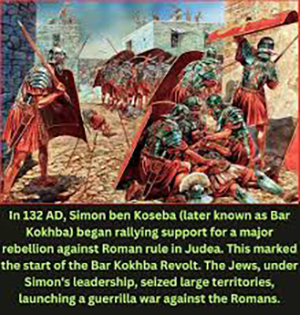
As i24 News reported, the Gallus Revolt remains a largely enigmatic chapter of Jewish history. Unlike the Great Revolt against Rome (66–70 CE) or the Bar-Kochba Revolt (132–136 CE), both of which were well documented by Jewish and Roman historians, the Gallus uprising is scarcely mentioned in historical sources. The newly uncovered hoard therefore provides rare and invaluable archaeological evidence, offering a glimpse into how Jewish communities resisted imperial authority centuries after earlier revolts had been brutally suppressed.
The Hukok complex itself has a storied history. First carved out during the Great Revolt in the first century CE, the labyrinth of tunnels and chambers was later expanded during the Bar-Kochba uprising. Its reuse during the Gallus Revolt demonstrates the continuity of Jewish resistance against Rome and the enduring role of underground complexes as sanctuaries in times of crisis.
According to the information provided in the i24 News report, excavations at Hukok have been ongoing since 2019, involving not only professional archaeologists but also students, volunteers, Israeli soldiers, and local residents. Their work has revealed an intricate system of tunnels and rooms, alongside artifacts that chronicle centuries of conflict and survival. The discovery of the coin hoard now situates Hukok as one of the most significant archaeological sites for understanding the persistence of Jewish identity under Roman domination.
While the hoard testifies to the hardships endured by the Jewish community, the settlement’s subsequent revival is equally striking. As the i24 News report highlighted, not long after the Gallus Revolt, the people of Hukok constructed a grand synagogue atop the hill. Adorned with intricate mosaics, the synagogue is considered one of the finest of its era and stands as a testament to the resilience and cultural creativity of Galilee’s Jews.
The juxtaposition of hidden coins in subterranean tunnels and dazzling mosaics above ground speaks volumes about the community’s determination to survive, adapt, and reaffirm its identity despite cycles of repression. It is this duality—struggle and renewal—that gives the Hukok site such profound symbolic weight.
Israeli Minister of Heritage Amichai Eliyahu hailed the discovery as “a living testimony to the determination of the Jews of the Galilee and their struggle to maintain their identity under Roman rule.” The report at i24News indicated that his remarks illustrate the significance of the find not only for historians but also for contemporary Israelis, who see in such relics a direct link to the endurance of Jewish life in the Land of Israel.
The coins, minted under the reigns of Constantius II and Constans I, serve as reminders of an empire that stretched from Britain to the Near East. Yet their concealment in Hukok tells a different story: one of a local community caught in the gears of imperial power, struggling to carve out its own path amid relentless pressure.
The discovery will be formally presented this Thursday at the “Between Josephus and Eusebius” conference at Kinneret Academic College, a fitting venue given the absence of detailed historical sources about the Gallus Revolt. As the i24 News report noted, the event will bring together leading scholars to assess the implications of the find and explore how archaeology can fill the gaps left by silence in the written record.
A full scientific analysis will be published in the forthcoming issue of the Israel Numismatic Research Journal, ensuring that the significance of the discovery will be preserved for scholars worldwide.
For centuries, the Gallus Revolt has been little more than a footnote in Jewish history, overshadowed by the cataclysmic revolts that preceded it. Yet, as the i24 News report emphasized, archaeology has the power to rewrite historical narratives. By uncovering material evidence of Jewish resistance during this poorly documented period, the Hukok hoard opens new avenues of inquiry and challenges the assumption that Jewish defiance against Rome ended with the Bar-Kochba defeat.
The discovery also illustrates the critical role of interdisciplinary collaboration. The combined expertise of archaeologists, numismatists, and historians has allowed for a more comprehensive understanding of the site. As the Israel Antiquities Authority and Zefat Academic College researchers observed, the find is not just about coins—it is about the human stories of concealment, survival, and continuity they represent.
Beyond the academic and archaeological significance, the Hukok discovery resonates deeply in the realm of collective memory. For modern audiences, particularly in Israel, the hoard is a reminder of both vulnerability and perseverance. It illustrates the lengths to which Jewish communities went to preserve themselves, and the resilience that enabled them to rebuild, even after devastating defeats.
As i24 News reported, the symbolism of the discovery is particularly poignant at a time when questions of identity, continuity, and survival remain central to Jewish discourse. The coins, silent yet eloquent, tell a story of endurance in the face of overwhelming odds—a story that continues to inspire nearly two millennia later.
The 22 bronze coins unearthed in Hukok are more than relics of an ancient empire; they are artifacts of a people’s determination to endure. Concealed in darkness during the Gallus Revolt, they have emerged into light to testify to a chapter of Jewish history long neglected and nearly forgotten.
The discovery highlights both the hardships and resilience of the Galilee’s Jews under Roman rule. It also reaffirms the role of archaeology in bridging the gaps of history, ensuring that even when written sources fail, the ground beneath our feet preserves the voices of the past.
The hoard from Hukok is not just a treasure of coins; it is a treasure of memory—a living reminder that identity can be hidden, tested, and threatened, but never extinguished.
