




|
Getting your Trinity Audio player ready...
|
Chabad on Campus: A Global Movement Rekindling Jewish Identity in the Heart of Academia
By: Jewish Voice News
Across bustling college quads, ivy-covered libraries, and dormitory halls from New York to Melbourne, a quiet revolution in Jewish life has been unfolding for decades — one built not on politics or protest, but on hospitality, warmth, and purpose. This is Chabad on Campus, a sprawling global network of Jewish educational and community centers dedicated to bringing Jewish life, learning, and joy to college students, wherever they may be.
From humble beginnings as small outposts serving isolated Jewish students at American universities in the 1960s, Chabad on Campus has evolved into one of the most dynamic, far-reaching Jewish movements in the modern world. Today, it operates on more than 500 campuses across North America, Europe, South America, and Asia, led by thousands of young Chabad emissaries — known as shluchim and shluchos — whose mission is to build spiritual homes for students far from their own.
The genesis of Chabad on Campus can be traced directly to the visionary leadership of Rabbi Menachem Mendel Schneerson, known universally as the Lubavitcher Rebbe, who led the Chabad-Lubavitch movement from 1951 until his passing in 1994. The Rebbe believed that every Jew — regardless of background, denomination, or observance — possessed an intrinsic and indestructible connection to Judaism.
He saw university campuses not as secular threats to Jewish identity, but as fertile ground for spiritual awakening. At a time when assimilation and apathy were eroding Jewish continuity, the Rebbe urged his emissaries to meet young Jews “where they are” — intellectually, emotionally, and socially — and to offer them not judgment, but belonging.
Out of that philosophy was born a radical model of engagement: Jewish centers planted not in synagogues, but in the middle of campuses; rabbis and rebbetzins not cloistered behind pulpits, but walking alongside students in cafeterias, coffee shops, and classrooms. The approach was, and remains, deeply personal.
As one student at UCLA told The Jewish Voice, “Chabad doesn’t ask what kind of Jew you are — they ask how you’re doing. That’s the difference.”
At its core, Chabad on Campus operates on a deceptively simple premise: that a warm, welcoming environment — a home away from home — can transform Jewish engagement.
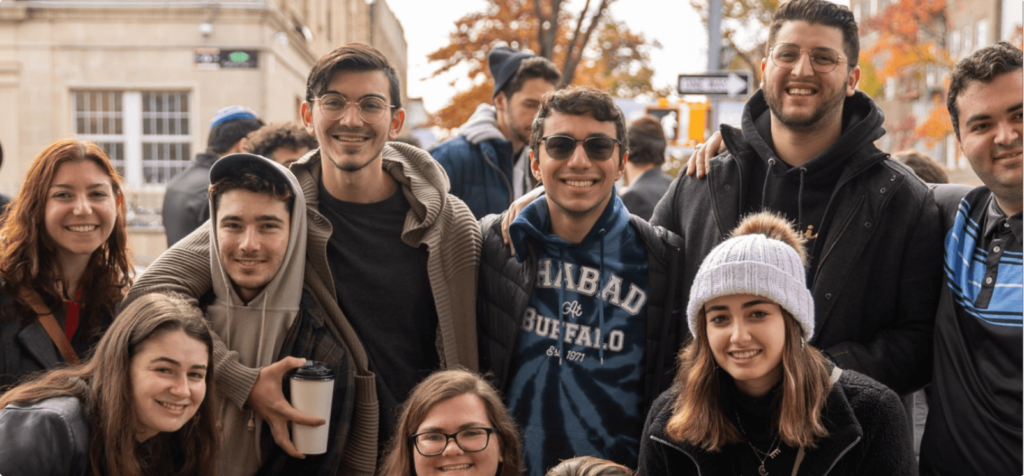
Every Friday night, tens of thousands of students worldwide gather around Shabbat tables at Chabad houses, where candlelight, song, and homemade challah replace the week’s chaos with a sense of belonging. These meals, often hosted in the homes of campus rabbis and their families, are renowned for their inclusivity — open to anyone, free of charge, and suffused with warmth that transcends denominational divides.
Many participants are encountering their first traditional Shabbat experience. For others, it’s the only Jewish space in their college lives. And for countless more, it becomes a lifelong anchor — the beginning of sustained involvement in Jewish life.
Beyond Shabbat dinners, Chabad on Campus offers a robust array of programs:
Torah study sessions and philosophical debates tailored to the intellectual rigor of university students.
Holiday celebrations such as public menorah lightings on Hanukkah and Passover seders drawing hundreds.
Social events and volunteer projects that emphasize both Jewish unity and universal responsibility.
Israel advocacy and solidarity initiatives, often countering rising anti-Israel sentiment on campuses.
What distinguishes Chabad from other campus organizations is its non-transactional approach. There are no membership fees, no ideological litmus tests. A student can come once or a hundred times; they will be greeted each time as family.
As Rabbi Dovid Tiechtel, who directs Chabad at the University of Illinois, once said, “We don’t count who comes in. We count who feels at home.”
In recent years, the role of Chabad on Campus has expanded from nurturing Jewish identity to defending it. As universities have become flashpoints for rising antisemitism and anti-Israel activism, Chabad houses have become sanctuaries — both literal and symbolic.
During the surge of antisemitic incidents that followed Hamas’s October 7, 2023, terror attacks, Chabad centers across North America mobilized almost instantly. They offered safe havens for frightened students, coordinated pro-Israel vigils, and organized humanitarian efforts for Israeli civilians under fire.
On many campuses, Chabad rabbis found themselves standing between mobs and their students. In places like Columbia, UCLA, and Harvard, where anti-Israel protests spilled into harassment of Jewish students, Chabad leaders worked around the clock to ensure security while emphasizing compassion and dialogue.
As The Algemeiner and Israel National News reported at the time, “Chabad rabbis emerged as the moral conscience of the campus, protecting students not only from hate but from despair.”
Chabad’s approach, rooted in positivity and Jewish pride, resists the narrative of victimhood. Rather than retreating, the movement encourages students to stand tall as Jews — wearing kippot, displaying mezuzot, and embracing their identity publicly.
As Rabbi Levi Duchman, a Chabad emissary and university chaplain, said during a panel on faith and activism: “The Rebbe taught us never to be reactive, only proactive. When there is darkness, you don’t curse it — you bring more light.”
Chabad’s global campus network is unified by shared purpose but deeply adapted to local realities. In New York City, Chabad on Campus serves thousands of students across NYU, Columbia, and CUNY institutions, addressing everything from Jewish ethics to career mentoring. In small-town America, Chabad houses serve as the lone Jewish lifeline for miles.
Internationally, the network stretches across five continents. In London, Chabad at Cambridge and Oxford blends scholarship with tradition, hosting debates between rabbis and philosophers. In Buenos Aires, Paris, and Tel Aviv, campus emissaries fuse Jewish culture with local language and art. In Melbourne and Sydney, they cater to students navigating Jewish life in multicultural settings.
Each outpost operates autonomously, but all are guided by Merkos L’Inyonei Chinuch, Chabad’s educational arm headquartered in Brooklyn. Funding comes from private donors and alumni rather than centralized dues, ensuring independence from university bureaucracy.
What unites these far-flung centers is a shared ethos: warmth, joy, and nonjudgmental outreach — all anchored in Torah learning and love of the Jewish people.
At the heart of this global enterprise are the shluchim, the emissary couples who dedicate their lives to Jewish campus service. Usually in their twenties or early thirties, these men and women leave the Chabad communities in which they were raised and relocate to campuses, often with young children in tow.
Their homes double as synagogues, classrooms, counseling offices, and dining halls. Their roles blend the pastoral and the practical — part rabbi, part teacher, part social worker, part surrogate parent.
As Rabbi Yossi Bryski of Chabad at UCLA once put it, “We are not administrators of a program; we are builders of lives.”
The work is demanding. Chabad emissaries often work with limited budgets and no formal staff, relying on volunteer students and alumni. Yet their impact is immeasurable. Many Jewish leaders in public service, academia, and business trace their rekindled identity to a Chabad house they stumbled into as college students.
One alumnus, now a physician in Chicago, recalled: “At a time when being Jewish felt like a liability on campus, Chabad reminded me it was my greatest strength.”
While Chabad on Campus is synonymous with Shabbat dinners and menorah lightings, its intellectual depth is equally profound. Chabad philosophy — or Chassidus — is deeply rooted in intellectual engagement, emphasizing the harmony of faith and reason.
Many campus Chabad centers offer weekly or even daily learning sessions, where students grapple with questions of ethics, identity, and spirituality through classical texts and contemporary discussion. Programs such as Sinai Scholars, Torah and Tea, and JewishU blend ancient wisdom with modern application.
As one Cornell student told The Jewish Voice, “It’s not about being told what to believe. It’s about being invited to think deeply about why we believe.”
This intellectual rigor appeals even to non-observant or secular students, who often find in Chabad’s teachings a philosophical depth missing from the hyper-politicized environment of the modern university.
Chabad on Campus faces formidable challenges in the years ahead: intensifying polarization, dwindling institutional trust, and an increasingly hostile environment for Jewish and Zionist expression. Yet, paradoxically, these challenges also strengthen its relevance.
Where other organizations see ideological fault lines, Chabad sees opportunity — an opening to demonstrate that Judaism, at its core, is not political but profoundly human. Its emissaries operate not as culture warriors, but as bridge builders, committed to fostering understanding even amid hostility.
Moreover, the movement’s decentralized structure ensures its adaptability. Without bureaucratic red tape, Chabad centers can respond swiftly to crises — whether it’s organizing emergency flights for stranded Israeli students or counseling those targeted by antisemitic harassment.
As one senior emissary told The Jewish Voice: “We are not an institution. We are a family. Families don’t quit when things get hard.”
Sixty years after its inception, Chabad on Campus stands as one of the most successful Jewish outreach efforts in modern history. What began as a handful of emissaries on American campuses has blossomed into a worldwide network connecting hundreds of thousands of students to their heritage — and, often, to each other.
As the Rebbe once said — a line echoed in countless Chabad houses each Friday night — “A little bit of light dispels a great deal of darkness.”
And on campuses around the world, that light burns brighter than ever.