



|
Getting your Trinity Audio player ready...
|
By: Fern Sidman
Israeli archaeologists have revealed one of the most significant finds of recent years: a treasure of nearly 100 pure gold coins and elaborate jewelry from the Byzantine period, discovered at the ancient city of Hippos (Sussita), overlooking the Sea of Galilee. The University of Haifa, which oversees the excavation, announced the find on Thursday, calling it “an extraordinary window into the economic and cultural life of Byzantine Palestine.” The discovery was reported by The Jewish News Syndicate (JNS) on Friday, which emphasized both the historical value and the rarity of such a hoard in Israel.
The breakthrough came in July, when Edie Lipsman, a metal detector operator working with the excavation team, picked up a strong signal near a large stone wedged between two walls at Hippos. “The device went crazy,” Lipsman recounted. “I couldn’t believe it—gold coins started appearing one after another.”
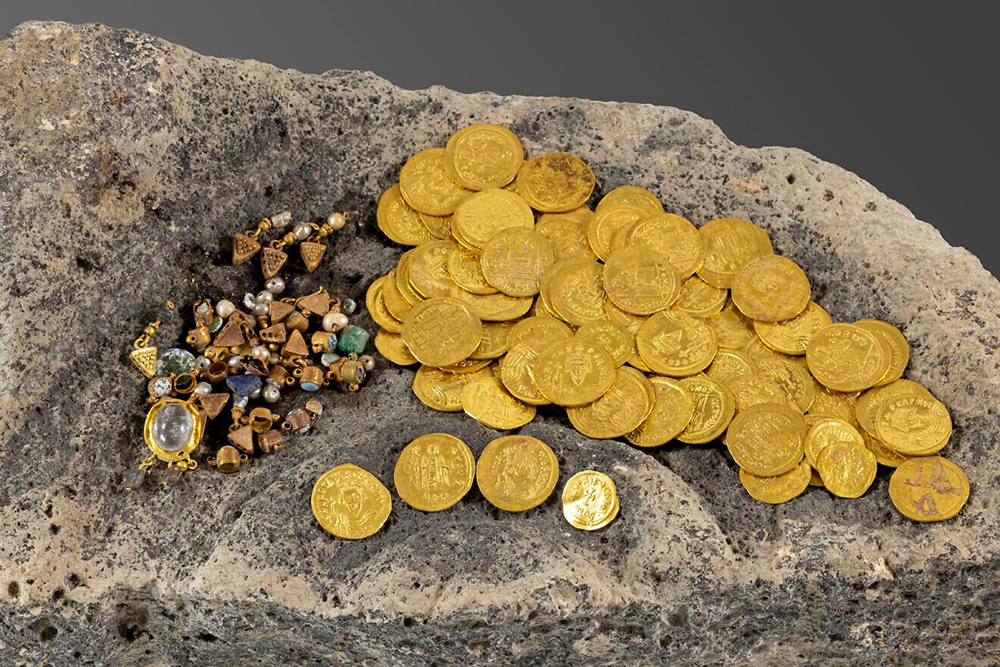
Underneath the stone, archaeologists unearthed 97 Byzantine gold coins, along with dozens of fragments of gold earrings delicately inlaid with pearls, semi-precious stones, and colored glass. According to the JNS report, some coins still bore traces of fabric, suggesting they had once been kept in a cloth pouch before being hidden in the wall.
Dr. Michael Eisenberg, co-director of the Hippos excavation project at the University of Haifa, said: “This is one of the largest hoards from the Byzantine period discovered on dry land in Israel, and its uniqueness lies in the combination of jewelry and gold coins from the reigns of different emperors.”
The coins date from the rule of Emperor Justin I (518–527 CE) through the early years of Emperor Heraclius (610–613 CE). This situates the hoard in a time of profound transformation for the Byzantine Empire, marked by both flourishing Christianity and looming external threats.
Hippos itself, founded by the Seleucids in the Hellenistic period, had become by the 6th century a major Christian episcopal seat. Archaeologists have identified at least seven churches at the site, underscoring its importance as a religious and cultural hub. JNS notes that during the Byzantine era, Hippos stood as one of the “jewels” of the Decapolis—a group of Hellenistic cities east of the Jordan River that became critical nodes of trade and faith.
But prosperity was fragile. In 614 CE, during the Persian and Arab invasions of the region, many Christian communities—including Hippos—hid valuables in the hope of recovering them after the conflict subsided. The hoard discovered this summer is almost certainly the product of such fearful concealment.
Although Hippos initially survived the Arab conquest, the city’s fate was sealed more than a century later by a devastating earthquake in 749 CE, which destroyed much of the settlement. It was never resettled, leaving its treasures entombed beneath rubble for over 1,400 years.
One of the striking aspects of the find is the condition of the artifacts. “Gold is a noble metal,” Eisenberg observed, “and when you find coins and jewelry nearly 1,400 years old that look new, it is a rare experience.”
The coins gleam almost as if freshly minted, bearing crisp images of Byzantine rulers. Their survival is not merely aesthetic—it allows historians to cross-reference imperial portraits and inscriptions with numismatic records, refining timelines of currency circulation. The jewelry, meanwhile, highlights the cosmopolitan craftsmanship of Byzantine artisans: pearls and stones likely sourced from trade routes stretching into Arabia and the Indian Ocean.
For scholars, the treasure speaks not only of personal wealth but also of the broader economic networks that sustained Byzantine cities in the Levant. The JNS report pointed out that such finds complicate the often one-dimensional narrative of decline, instead suggesting vibrant prosperity right up until the region was convulsed by conquest and catastrophe.
- One of the Largest Hoards in Israel
While Israel has produced several Byzantine coin hoards, most have been found in smaller quantities and often in rural settings. The Hippos discovery ranks among the largest uncovered on land, underscoring the city’s wealth and its residents’ instinct to protect it during times of instability.
- Coins Spanning Multiple Reigns
Because the coins span emperors from Justin I to Heraclius, they offer a snapshot of a century’s worth of political and economic transitions. Historians can analyze metallurgical content to track inflation, regional minting practices, and the empire’s evolving financial strategies.
- Jewelry and Personal Belongings
The inclusion of earrings sets this hoard apart from purely monetary caches. They speak to personal loss—a family or merchant forced to abandon not only wealth but sentimental possessions. As JNS highlighted, these artifacts remind us that behind the coins lie the lives of men, women, and children whose fates were upended by history’s upheavals.
Hippos (Sussita, “horse” in Aramaic) was perched dramatically on a hill a mile east of the Sea of Galilee. The city’s strategic location gave it both defensive strength and access to major trade arteries. In its Byzantine heyday, it boasted basilicas, marketplaces, and civic infrastructure reflecting both Greek and Christian heritage.
The archaeological expedition led by the University of Haifa has been working at Hippos for decades, gradually piecing together its layered history. The site has yielded churches adorned with mosaics, residential quarters, and evidence of a thriving local economy.
Yet the coin hoard, JNS emphasized, is in a class of its own—“a once-in-a-generation discovery” that anchors Hippos not only in religious history but also in the story of wealth, crisis, and survival.
The discovery has stirred conversations well beyond the academic world. In Israel, such finds reinforce both the deep historical continuity of the land and the sense of rootedness that underpins contemporary debates over heritage and identity.
Internationally, the Hippos hoard adds a new chapter to Byzantine studies, reminding scholars that the empire’s reach extended vibrantly into the Levant. It underscores how cultural and economic life continued in these cities until disrupted by wars and natural disasters.
The University of Haifa plans to conserve and study the artifacts in detail. Experts will analyze the fabric remnants attached to some coins, potentially revealing information about Byzantine textile production. Gemologists will examine the earrings’ inlays to trace their origins across global trade networks.
The hoard is expected to be displayed publicly once conservation is complete, likely at the Israel Museum or another national institution. JNS reported that Israeli authorities view the discovery as an opportunity to deepen public engagement with the country’s Byzantine past—an era often overshadowed by Roman and Crusader narratives.
The unearthing of 97 gold coins and exquisite earrings at Hippos is not just an archaeological triumph. It is a human story—of wealth accumulated and suddenly abandoned, of fear during invasion, and of a city that ultimately succumbed not to armies but to nature’s fury.
