



|
Getting your Trinity Audio player ready...
|
Binyamin & Talya Kahane to Be Remembered 25 Years After Their Murder
By: Fern Sidman
Twenty-five years after the fatal ambush that claimed the lives of HaRav Binyamin Ze’ev Kahane and his wife, Talya, Israelis across ideological, religious, and geographic divides are once again confronting the enduring complexities of their legacy—one shaped by Torah scholarship and familial devotion.
Next week, a series of memorial gatherings will mark the quarter-century anniversary of their murder near Ofra on December 31, 2000, during the height of the Second Intifada. The events are expected to draw family members, former students, rabbis, community leaders, and observers seeking to reflect on the remarkable legacy of the Kahane family.
Born on the 19th of Tishrei, 5727 (October 1966) in New York, Binyamin Ze’ev Kahane was the youngest son of Rabbi Meir Kahane, a controversial American-Israeli rabbi and political activist whose ideas profoundly influenced Jewish political discourse in the late 20th century. In 1971, the Kahane family relocated to Israel, where Binyamin immersed himself in religious study, enrolling at Yeshivat Mercaz HaRav, one of the country’s most influential religious Zionist institutions.
By the late 1980s, Binyamin Kahane had begun to carve out his own role within Israel’s religious and ideological landscape. In 1987, he co-founded the Yeshiva of the Jewish Idea alongside his father, an institution dedicated to exploring Jewish nationalism through a rigorous Torah-based framework. Around the same time, he launched Darka Shel Torah, a weekly publication that combined commentary on the Torah portion with reflections on contemporary political and social developments.
For fourteen years, the younger Kahane edited and authored the newsletter, developing a distinctive voice characterized by textual fluency, ideological consistency, and an unwavering commitment to what he and his followers termed the “Jewish Idea.” Admirers recall his writing as methodical rather than incendiary, presenting arguments rooted in classical sources while applying them to modern dilemmas.
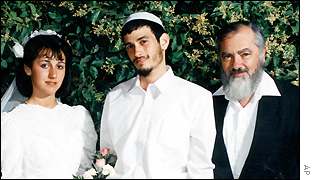
In 1989, Binyamin married Talya Herzlich. The couple settled in Kfar Tapuach, a community in Samaria, where they built a home and raised six children. Those who knew them describe a household defined by warmth, discipline, and deep religious commitment. Talya Kahane, in particular, was remembered by friends and neighbors as a stabilizing presence—quietly managing family life while supporting her husband’s demanding public role.
Many within their community recall the family primarily through a personal lens: parents devoted to their children, educators committed to their students, and neighbors actively engaged in communal life.
The trajectory of Binyamin Kahane’s life changed dramatically in November 1990, when his father was assassinated in New York. In the aftermath, Binyamin assumed a leadership role among his father’s followers and became a central figure in the movement known as “Kahane Chai.”
That movement was subsequently barred from participating in Israeli elections in 1992 and designated a terrorist organization by Israeli authorities in 1994. These designations placed Kahane under sustained scrutiny from the state, resulting in repeated arrests, interrogations, and periods of detention related to his public statements and organizational activities.
Supporters viewed these measures as political suppression. Throughout this period, Kahane continued to teach and write, serving as rosh yeshiva of the Yeshiva of the Jewish Idea and maintaining his intellectual output despite legal and social pressure.
On the evening of the 5th of Tevet, 5761 (December 31, 2000), Binyamin and Talya Kahane were traveling home from Jerusalem when gunmen opened fire on their vehicle near Ofra. Both were killed in the attack, which Israeli authorities later linked to Palestinian terrorists affiliated with Yasser Arafat’s Fatah movement. The couple’s six children were left orphaned.
The murders occurred during a period of intense violence, when ambushes and shootings on roads in Judea and Samaria had become a grim feature of daily life. The Kahane killings sent shockwaves through Israeli society, symbolizing both the vulnerability of civilians and the brutal reach of the conflict into family life.
In the years since his death, Binyamin Kahane’s writings have continued to circulate among followers, some of whom argue that his analyses anticipated later developments in Israeli society. They point to his warnings about internal division, judicial authority, national identity, and the long-term consequences of unresolved security threats—topics that remain fiercely debated today.
This year’s commemorations are framed not as political rallies, but as moments of remembrance and reflection. On Tuesday, December 23, an English-language memorial will be held at Kehilat Menorat HaMaor in Ramat Beit Shemesh, bringing together family members, former students, and community figures. The following evening, a Hebrew-language gathering will take place at the Oz V’Gaon Nature Reserve Memorial near Kibbutz Migdal Oz.
Organizers say the events aim to honor the personal lives of Binyamin and Talya Kahane, to acknowledge the pain of their loss, and to engage thoughtfully with the questions their story continues to raise.
A quarter-century after their death, the Kahane murders remain more than a historical footnote. They are a prism through which Israelis continue to examine the sanctity of life, and the enduring challenge of forging a shared future.