



|
Getting your Trinity Audio player ready...
|
By: Fern Sidman
In a deeply emotional moment that resonated throughout Israel, Ashkenazi Chief Rabbi Kalman Ber paid a visit to two recently freed hostages — Bar Kupershtein and Segev Kalfon — at Sheba Medical Center, following their long-awaited release from Hamas captivity. The meeting, reported by VIN News on Sunday, offered a glimpse into both the relief and the enduring sorrow that continue to define the nation’s struggle since the events of October 7, 2023.
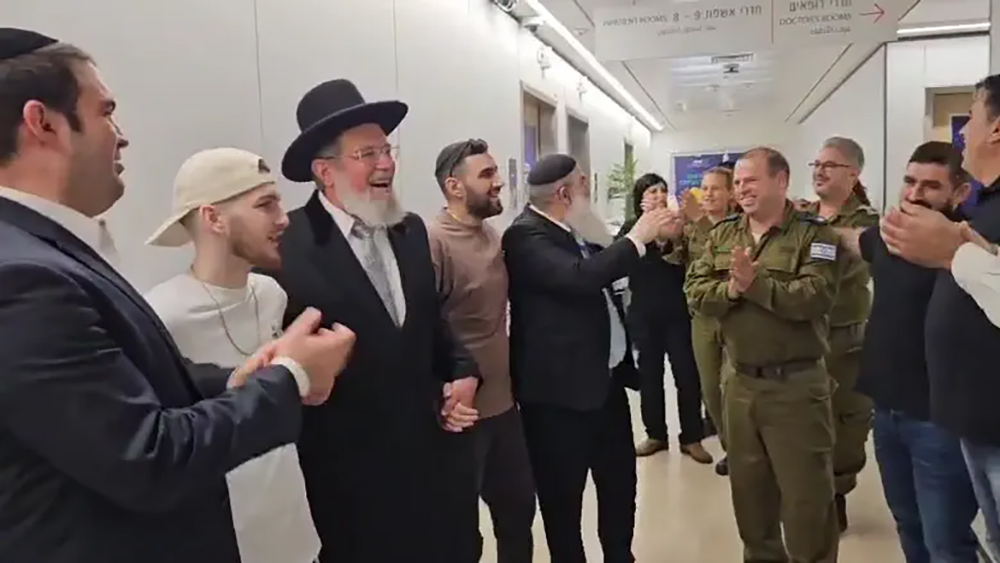
A video released by the Chief Rabbinate, and shared by VIN News, captured a scene that transcended words: Rabbi Ber standing hand-in-hand with Kupershtein and Kalfon, forming a small circle of song and dance within the hospital ward. Their voices rose in gratitude and faith — a powerful symbol of resilience after months of unimaginable torment.
According to the information provided in the VIN News report, the two young men had been abducted from the Nova music festival, the site of one of the most horrific massacres carried out during Hamas’s coordinated terror assault on southern Israel. Their release, part of a painstaking and often uncertain negotiation process, brought a measure of comfort to a nation still grieving and searching for answers.
During the visit, Rabbi Ber spoke quietly with the two survivors about their experiences in captivity — moments of despair, fleeting glimpses of hope, and the strength it took to hold on. Kupershtein and Kalfon, visibly moved, shared with the Chief Rabbi their commitment to recovery and gratitude to those who fought for their freedom.
“Baruch Hashem that you have returned home,” Rabbi Ber told them, according to VIN News. “We thank the Ribbono Shel Olam (Master of the Universe) for this miracle, but our hearts remain bound with those still in the hands of evil. We will not rest until every one of our brothers and sisters is brought home — whether alive or for a proper burial in the land of Israel.”
The Chief Rabbi’s words reflected a theme that the VIN News report described as “both joyous and mournful” — a duality that has defined Israel’s national mood since the hostages began to return. While celebrations have erupted across the country each time another captive is freed, the pain of those still unaccounted for remains an ever-present shadow.
Rabbi Ber also emphasized, as reported by VIN News, the religious and moral duty to ensure that those who perished during the October 7 massacre are brought back to Israel for burial with full kavod hameis — the dignity and sanctity accorded to the deceased under Jewish law. “The commandment to honor the dead is among the holiest we possess,” he said. “Every effort must be made to return those who have not yet come home — body and soul — to their people.”
Kupershtein and Kalfon expressed their gratitude to Rabbi Ber for the visit and for the prayers that sustained them while in captivity. The VIN News report noted that both men have undergone extensive medical and psychological care since arriving at Sheba Medical Center, where they are surrounded by family, friends, and a team of doctors and mental health professionals trained in trauma recovery.
Hospital officials told VIN News that the visit had an uplifting effect on both the patients and staff, many of whom have been treating survivors of the Hamas atrocities for nearly two years. “There was a sense of collective healing,” one hospital worker said. “For a few minutes, the singing and dancing reminded us of who we are as a people — bound by faith, compassion, and unity.”
The Chief Rabbi’s visit also served to spotlight the broader communal response that has emerged across Israel and Jewish communities worldwide. As VIN News reported, prayer gatherings and Torah learning sessions continue to be dedicated daily to the safety of those still missing and the memory of those killed. Synagogues throughout the country have added special tefillot (prayers) for the hostages to the morning and evening services, echoing Rabbi Ber’s call for ongoing spiritual solidarity.
“Each name still in captivity represents an entire world,” Rabbi Ber said during his visit, according to the VIN News report. “We must not forget them for a single day. The strength of our nation lies in our refusal to grow numb to their pain.”
Kupershtein and Kalfon’s ordeal has drawn attention to the human face of Israel’s ongoing hostage crisis — one that extends far beyond politics or diplomacy. VIN News reported that both men described moments of terror in Hamas tunnels, where they were deprived of sunlight, food, and communication with the outside world. Yet even in those conditions, they said, they found strength through prayer and through remembering the faces of loved ones waiting for them at home.
For Rabbi Ber, the visit was not just pastoral but profoundly symbolic. In his view, each freed hostage represents a miracle — a spark of divine mercy amid the darkness of war. But he also warned, as quoted in the VIN News report, that complacency must not set in: “We rejoice today, but tomorrow we must continue to act — through prayer, through unity, through every possible means — to bring the rest of our people home.”
As the meeting concluded, the three men once again joined hands and sang “Am Yisrael Chai” — “The People of Israel Live.” The moment, captured in the Chief Rabbinate’s video and shared widely across Israeli media, became a potent image of faith enduring through suffering.
The VIN News report described it as “a scene both tender and defiant — an affirmation that even in the aftermath of unspeakable cruelty, the Jewish spirit remains unbroken.”
For Kupershtein and Kalfon, their road to recovery is only beginning. For Rabbi Kalman Ber and the nation he represents, the mission continues — to bring every captive home, to honor every victim, and to remind the world that faith, hope, and solidarity still light the way forward for Israel.
