



|
Getting your Trinity Audio player ready...
|
As missiles fly overhead and sirens pierce the night, the exhausted-yet-hopeful city readies for Passover
By: Ariel Fine
As Passover approaches, this holy city is preparing seder tables with contingency plans, as ballistic missiles from Iran and quick dashes to shelters disturb them night after night.
The calendar has not gone unnoticed. The ongoing war began in Adar, the month of Purim, when Jewish communities around the world marked the downfall of Haman in ancient Persia. Now Nissan is here—the season referred to as “the month of redemption.”
“The timeline of this war has been really interesting, starting on Purim and continuing through to Passover,” said Raizy, a young woman who has been in Israel since the escalation began. “I feel like this is the major change in our story, one that people will look back and reflect on.”
On Jerusalem’s streets, in its shelters and at its Shabbat tables, one theme surfaces again and again: exhaustion. Not panic. Not despair. A deep, bone-tired fatigue—and a city quietly learning to function inside it.
“It’s all just been a blur,” said Leah Davidson. “Every day feels like a month, and every week feels like a minute. I genuinely couldn’t tell you what happened this week. How many sirens did I hear? Did I work? We are all just in this fog together.”
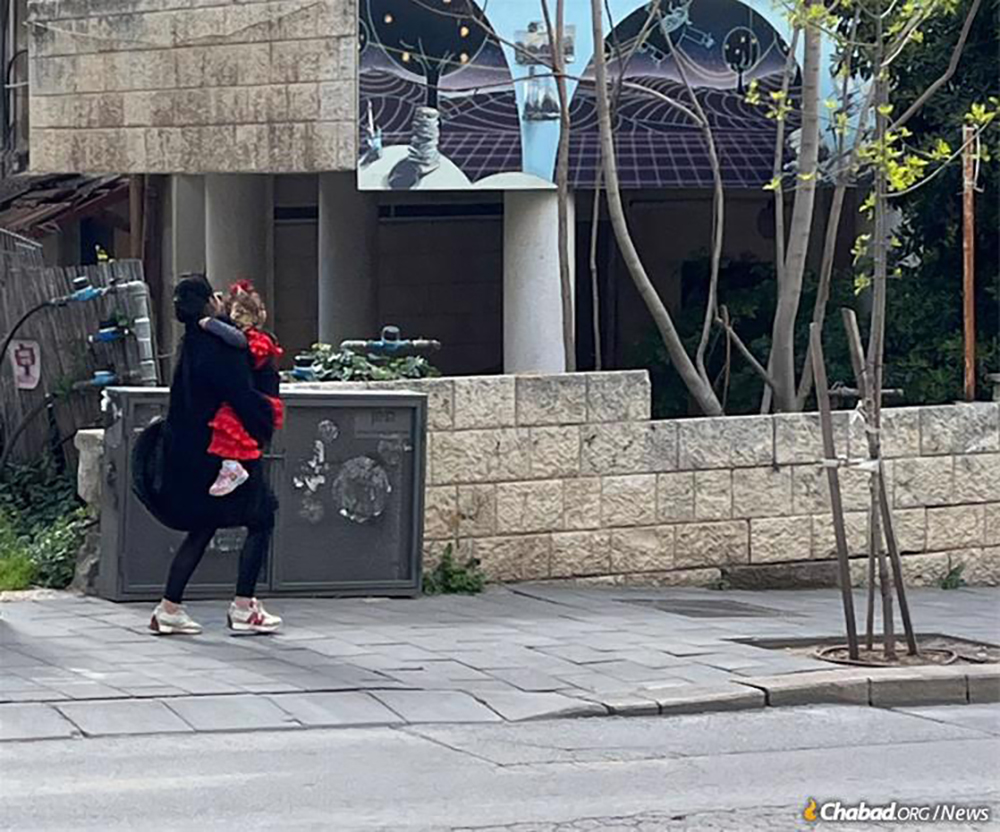
Schools are suspended. Businesses that should be open are not. The ordinary rhythm of the week has softened into something harder to track. “The whole country is tired and on edge,” said Miriam Katz, a Jerusalem mother. “We are treading water and the days are just slipping by.”
What stands out, speaking with Jerusalemites across neighborhoods and backgrounds, is how little social fracturing there is. In shelters and stairwells and at packed Shabbat tables, there is a rare and striking unity. There is confusion and disrupted sleep and children being carried down staircases in the dark. But buttressed with an ever present fortitude and faith in G‑d, there is also something that looks, unmistakably, like hope.
“Our lives will be freer and better than ever after this,” says Raizy. “Which is just how it was in the original Passover story.”
‘A Jew Is Never Stuck’
For families across the city, every siren demands a rapid and personal calculation. Yonah Levine, a father of young children whose apartment includes a safe room, counts himself among the more fortunate. “It’s not like we don’t feel it,” he said. “But at least my kids sleep at night. That matters more than people realize.”
The alerts themselves add another layer of bewilderment. Judy Friedman, an elderly resident, described the frustration of the overnight hours.
“The most annoying thing is when we get that 2 a.m. warning on our phones, but then there isn’t even a siren outside,” she said. “And other times, I hear the siren in the street, but nothing comes through on my phone at all. You’re just standing there at 3 in the morning trying to figure out if you need to run.”
With university classes moved online, students have found themselves sharing the experience of remote learning under fire. At one recent cohort meeting, a dark running joke quickly emerged: “So what number war is this for you?”
“We are all just adjusting to this new reality,” said Lior Blum, a graduate student attending online lectures with his children beside him. “You lower your expectations of what normal looks like, and you just keep going.”
On the streets, the contrast between first-timers and veterans plays out in real time. Avi Shaked, who owns a shop near a neighborhood shelter and has lived through several previous escalations, leaned against the shelter wall with the ease of someone who has done this many times before.
“The vibe of this war is just different from the others,” he said. “In previous rounds, there was always the fear of something coming in on the ground. Now it is only missiles from above. More threatening because there is nowhere to hide from the sky. Less threatening because the Iron Dome is a miracle that makes the missiles seem like they aren’t really there.”
Among the quieter stories in Jerusalem’s shelters are those of unintended long-term guests — visitors caught here when flights were grounded. Sara Cohen, an American who had planned a two-week visit, described her attempts to return home with cheerful resignation.
“I tried my luck. I even went to the airport twice,” she said. “Both times I was sent back, flights canceled. At a certain point, I just accepted it. A Jew is never stuck in Israel. So at least I am with my people, in the right place.”
Many others have found their footing in something more spiritual.
“Missiles are being shot at us from multiple directions, and the mortality rate—while tragic—is miraculously low,” said Menachem, a Jerusalem resident. “People don’t want to say it too loudly, but we all know what that means. It is an open miracle in front of our eyes.”
