



|
Getting your Trinity Audio player ready...
|
By: David Avrushmi- Jewish Voice News
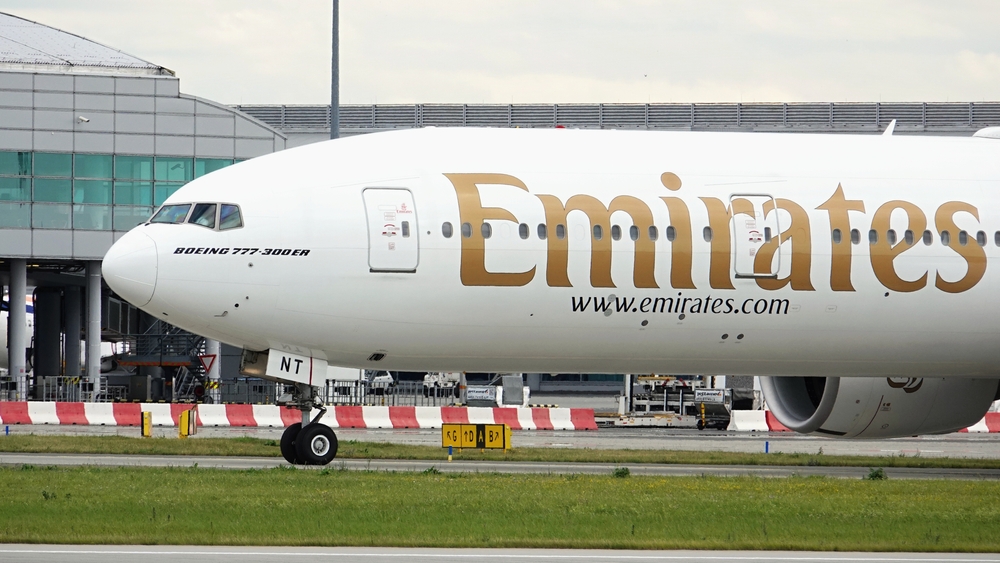
In a development viewed as both a practical transportation restoration and a symbolic diplomatic milestone, Dubai-based Emirates airline is preparing to resume its Tel Aviv–Dubai route in early 2026, according to report on Monday from Israel’s public broadcaster KAN News. The announcement represents the most concrete indication to date that commercial aviation links severed in the wake of Hamas’s October 7, 2023 massacre may soon be reinstated, signaling a cautious but deliberate return to regional stability and economic cooperation.
Emirates—the UAE’s flagship carrier and one of the most recognized aviation brands in the world—halted all Israel-bound service immediately following Hamas’s large-scale attack on southern Israel, which triggered a defensive war in Gaza and led to prolonged regional uncertainty. The suspension, mirrored by several Gulf-based carriers, was widely understood as a necessary safety measure amid rapidly escalating security concerns. But the decision also carried broader geopolitical meaning: commercial air routes are among the most visible markers of normalized diplomatic relations, particularly under the framework of the Abraham Accords.
Now, more than two years after the rupture, the airline appears poised to restore the route, subject to operational assessments and regional security evaluations.
KAN News reported that Israel’s Transportation Minister Miri Regev traveled to Dubai last week for discussions with senior Emirates executives. During the meeting, the airline confirmed its intention to reinstate flights between Tel Aviv’s Ben Gurion Airport and Dubai International Airport in the first quarter of 2026.
Although no precise date has been set, officials described the timeline as realistic and achievable, contingent on continued stabilization in the post-war environment and on regulatory coordination between civil aviation authorities in both countries.
According to individuals familiar with the talks, the tone of the meeting was constructive, with both sides emphasizing the importance of restoring passenger and business connectivity. Regev reportedly stressed that Israel views the resumption of flights not only as an economic priority but as a reaffirmation of the historic partnership forged between Jerusalem and Abu Dhabi since 2020.
For its part, Emirates expressed readiness to mobilize resources, aircraft, and ground support to reestablish the popular route, which had quickly become one of the most in-demand short-haul links in the Middle East after its inaugural launch. Before the suspension, the Tel Aviv–Dubai service served thousands of passengers weekly, supporting tourism, cross-border investment, and cultural exchange.
The introduction of direct flights between Israel and the United Arab Emirates in late 2020 was one of the most tangible fruits of the Abraham Accords. Emirates, along with Etihad Airways and Israel’s El Al, rapidly transformed what had once been an unthinkable air connection into a bustling corridor for business travelers, tourists, technology entrepreneurs, and financial-sector delegations.
Between 2021 and 2023, Israeli travelers flocked to Dubai—drawn by its world-class hospitality, retail landscape, and openness to commercial partnerships. Emirati investors, likewise, began exploring opportunities in Israel’s tech and energy sectors, and a steady flow of governmental visits cemented the Accords as more than a symbolic agreement. The direct flights became a physical manifestation of regional realignment and mutual opportunity.
The abrupt termination of the route after October 7 did not signal a collapse of diplomatic relations—the UAE maintained its formal ties with Israel—but it did reflect heightened security volatility and a politically sensitive moment for Gulf states navigating public opinion and regional dynamics. The suspension underscored how quickly the connective tissue of normalization could be disrupted by conflict.
Emirates’ choice of early 2026 is not arbitrary. Several converging considerations appear to shape the decision.
Civil aviation authorities typically require multi-year evaluation cycles following a major conflict. Airspace risk mapping, insurance recalibration, and coordination with international aviation bodies take time, especially when dealing with geographic areas deemed high-risk.
With the Gaza conflict now in a postwar stabilization phase, 2026 provides a cautious but achievable horizon for risk mitigation to be deemed adequate.
Emirates operates one of the most complex long-haul fleets in the world. Restoring a suspended route requires allocation of aircraft, staffing, slot coordination, and marketing campaigns. Major carriers often plan schedules 12–18 months in advance.
The UAE remains committed to the Abraham Accords, but it is sensitive to regional sentiment, particularly during and after conflict. Waiting until 2026 allows for public-diplomacy groundwork and gradual normalization without abrupt political backlash.
Travel between Israel and Gulf states is expected to grow steadily as economic conditions stabilize. Airlines typically restore routes when they forecast sufficient demand elasticity—and by 2026, bilateral tourism is expected to rebound strongly.
The resumption of Emirates service to Tel Aviv would carry profound diplomatic weight. Analysts note several key implications.
Direct flights are the circulatory system of normalization. Once restored, they will once again facilitate joint business ventures, tourism flows, academic collaborations, cultural and religious travel and technology-sector partnerships.
Restoring these exchanges strengthens normalization at the societal—not merely governmental—level.
Before the suspension, bilateral trade surpassed $2.5 billion annually, with Expos, tech summits, and investment forums driving commerce. Reopening the flight corridor is expected to accelerate economic partnerships disrupted since late 2023.
A flagship airline such as Emirates reentering the Israeli market signals the UAE’s confidence in long-term regional security. It also reinforces Abu Dhabi’s geopolitical posture as a pragmatic, forward-looking power balancing global relationships.
Etihad Airways, flydubai, and even Bahrain’s Gulf Air will likely monitor the move as a model for reinstating their own suspended routes. Emirates’ decision could catalyze a broader aviation recovery connecting Israel to the Gulf.
The UAE has maintained a carefully calibrated diplomatic approach since October 7. While expressing concern over civilian suffering in Gaza and coordinating humanitarian initiatives, Abu Dhabi has not reversed its diplomatic recognition of Israel—a point frequently emphasized in regional analyses.
Instead, the UAE has taken a long-view perspective: normalization, once established, is intended to endure turbulence, not retreat from it. Yet air travel remains an especially sensitive barometer of geopolitical confidence.
Thus, Emirates’ planned return stands as an indicator that the UAE believes in long-term stability post-Gaza, channels of cooperation remain open at the highest levels, and that public diplomacy will once again move toward rebuilding people-to-people ties.
For Minister Miri Regev, the announcement is a diplomatic victory. It demonstrates that Israel’s aviation and diplomatic outreach remain robust despite the prolonged conflict and shifting geopolitical dynamics.
Israel’s aviation sector has faced significant strain since the October 7 massacre, with many foreign carriers temporarily halting service and relying on national-level risk assessments before resumption.
Emirates’ planned return—if realized—would signal to other global airlines, insurers, and aviation regulators that Ben Gurion Airport is experiencing sustained stabilization and that Israel’s skies are once again reliable for long-distance commercial operations.
Diplomatically, Israel sees the announcement as affirmation that the Abraham Accords endure beyond crisis, and that regional partnerships cannot be severed by terrorist actions.
Emirates’ intention to resume Tel Aviv–Dubai flights in early 2026 marks a cautiously optimistic moment in a region still navigating post-war complexity. It demonstrates the UAE’s strategic patience, its enduring commitment to normalization, Israel’s ongoing diplomatic engagement and the region’s slow but deliberate return to interconnectedness.
The period between now and 2026 will be crucial. Aviation authorities will assess risk, diplomatic channels will refine cooperation, and both nations will prepare for a new chapter of cross-border partnership.
But if realized, Emirates’ return to Israel will not simply be the resumption of a route. It will be a statement — that the bridges built between Israel and the UAE remain standing, weathered but intact, ready once again to carry people, commerce, and the promise of a more connected Middle East.
