



|
Getting your Trinity Audio player ready...
|
By: Russ Spencer
Over the next three days, the gravitational pull of professional basketball will bend unmistakably toward Southern California. Not quite Hollywood in the mythic sense of red carpets and soundstages, but Inglewood—where the LA Clippers’ Intuit Dome stands as the newest cathedral of the sport—will become the epicenter of a global sporting convocation that fuses athletic excellence with cultural theater. According to a report on the National Basketball Association web site, known as NBA.com, which has positioned its All-Star 2026 hub as the definitive guide to the weekend’s unfolding drama, this year’s festivities promise to be not merely another iteration of an annual tradition, but a reinvention of the All-Star experience itself, recalibrated for a league that now speaks fluently to the world.
The NBA.com report framed the weekend as a convergence of scale and spectacle. The All-Star Game’s newly introduced global format, the curated schedule of events, and the seamless orchestration of competitions and entertainment mark a conscious effort to mirror the NBA’s international footprint. Inglewood, long a cultural crossroads, now becomes the stage upon which basketball’s most recognizable figures and its most ardent followers from around the globe assemble. NBA.com’s live updates and event guide promise to chart every pivot of this sprawling production, from the first celebrity tipoff to the final whistle of the championship round.
At the heart of the weekend lies a reimagined All-Star Game, structured not as a singular exhibition but as a sequence of contests that dramatize the league’s evolving demographics. NBA.com detailed how three distinct rosters will contest the 75th All-Star Game, culminating in a championship faceoff that promises to compress rivalry, showmanship, and national pride into a few incandescent hours. Team USA Stars, with an average age that barely crests the mid-twenties, embodies the league’s generational turn.
The presence of Anthony Edwards, Cade Cunningham, and Tyrese Maxey on this roster signals the NBA’s investment in a future that is already luminous. NBA.com has highlighted the symbolic resonance of this youth movement: a league unafraid to place its brightest prospects under the most intense lights.
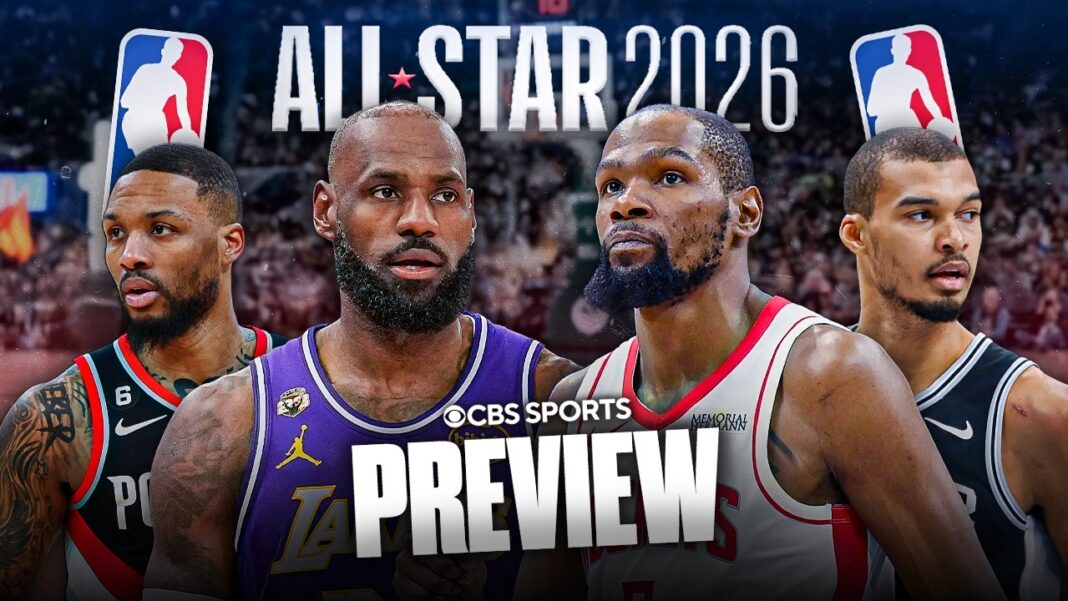
Opposite them stands Team USA Stripes, a living archive of modern basketball greatness. NBA.com noted that this roster aggregates seventy-six combined All-Star selections, a statistic that reads like a ledger of contemporary legend. LeBron James’s twenty-two appearances, Kevin Durant’s sixteen, and Stephen Curry’s twelve do more than quantify excellence; they map an era. Their inclusion transforms the All-Star court into a dialogue between epochs, a choreography of experience and audacity. NBA.com has suggested that the Stripes roster carries a dual mandate: to perform and to personify continuity in a league perpetually in motion.
Then there is Team World, the embodiment of basketball’s centrifugal expansion beyond American shores. NBA.com emphasized the presence of Nikola Jokić, a three-time MVP whose game has redefined the geometry of the center position, alongside Victor Wembanyama, Alperen Şengün, and Karl-Anthony Towns, whose versatility reflects the league’s stylistic evolution. The World roster is not a novelty; it is a statement.
First Israeli Player on the Team
Deni Avdija crossed a threshold that generations of Israeli basketball players had approached but never breached. Selected to the NBA All-Star Game roster, Avdija became the first Israeli ever to earn a place in the league’s most celebrated midseason showcase, a moment of recognition that transcends individual achievement and resonates deeply with a nation long striving for validation on basketball’s grandest stage.
Avdija will take the floor as part of the “World Team,” a constellation of international stars that reads like a roll call of modern basketball royalty. Among those sharing the roster are Nikola Jokić, Luka Dončić, and Shai Gilgeous-Alexander—players who have not only redefined positional play but reshaped the league’s global identity. Avdija’s inclusion alongside such figures is a testament to how far Israeli basketball has traveled from its once-peripheral status.
Now in his sixth NBA season and his second with the Portland Trail Blazers, Avdija has reached a level of performance that few could have predicted with certainty when he entered the league. Drafted ninth overall in 2020 by the Washington Wizards, he spent his formative professional years in Washington, honing a versatile game built on physicality, court vision, and defensive intelligence. The trade to Portland ahead of the 2024–25 season, initially viewed by some as a lateral move, has proven transformative. The Blazers’ system offered Avdija both the minutes and the responsibility to evolve from promising contributor into bona fide star.
The statistical evidence is compelling. This season, Avdija is averaging 25.5 points per game while shooting 46.7 percent from the field and 35.6 percent from beyond the arc, all in a demanding 34.6 minutes per night. These numbers, impressive in isolation, gain further weight when considered in context: Avdija has become the focal point of opposing defenses, routinely tasked with creating offense while maintaining his customary defensive assignments.
NBA.com framed this international assembly as both a celebration of global talent and a tacit acknowledgment that the NBA’s identity is no longer geographically bounded. The All-Star Game thus becomes a proxy for a broader cultural narrative in which basketball functions as a lingua franca.
Yet the weekend’s allure extends well beyond the hardwood. NBA.com has curated a parallel narrative of music and performance, underscoring the NBA’s longstanding courtship with popular culture. The presence of Ludacris, Shaboozey, and the K-pop group CORTIS situates the All-Star Weekend within a transnational pop ecosystem. Particularly evocative is the first-ever live performance of “Roundball Rock” by John Tesh, a theme that has long served as an auditory emblem of basketball’s televised spectacle. NBA.com framed this moment as a ritualistic convergence of memory and immediacy, a nod to the league’s media history even as it scripts new spectacles for the digital age.
The magnitude of the gathering itself is unprecedented. NBA.com reported that fans from a record fifty-six countries are expected to attend in person, transforming Inglewood into a mosaic of languages and loyalties. For those unable to make the pilgrimage, the broadcast reach extends to 214 countries and 50 languages, a statistic that underscores the NBA’s evolution into a truly planetary enterprise. The presence of more than 200 global content creators, collectively commanding an audience exceeding one billion followers, further amplifies the weekend’s digital reverberations. NBA.com’s coverage situated these creators not merely as observers but as conduits through which the spectacle will be refracted to audiences far removed from the arena’s glare.
The ceremonial rhythm of the weekend unfolds with a sequence of marquee events that NBA.com has meticulously cataloged. The Ruffles NBA All-Star Celebrity Game at the Kia Forum inaugurates the festivities, a ritual that collapses the boundary between sport and celebrity culture. This is followed by the Castrol Rising Stars showcase at Intuit Dome, a tableau of emergent talent that NBA.com framed as the league’s most candid preview of its immediate future. These early events establish a narrative arc that crescendos toward Saturday night’s triad of competitions and Sunday’s climactic tournament.
All-Star Saturday Night, as detailed by NBA.com, functions as a crucible of specialized excellence. The State Farm 3-Point Contest assembles a constellation of sharpshooters whose collective résumé spans past triumphs and contemporary stardom. Devin Booker’s experience, Tyrese Maxey’s kinetic scoring, Donovan Mitchell’s explosiveness, Jamal Murray’s poise, and Norman Powell’s precision converge with Damian Lillard’s two-time championship pedigree. The inclusion of first-time participants Kon Knueppel and Bobby Portis introduces an element of unpredictability that NBA.com suggests will animate the contest with fresh narrative tension.
The Kia Shooting Stars event, returning to the All-Star program, extends the weekend’s intergenerational dialogue. NBA.com’s description of the format—teams composed of two NBA players and one legend—evokes a lineage of skill and memory. The affiliations that structure the teams, whether by school, franchise, or family ties, infuse the competition with layers of personal resonance. This is not merely a shooting exhibition; it is a dramaturgy of inheritance, in which the gestures of past greatness are echoed in present form.
The AT&T Slam Dunk contest, meanwhile, promises the coronation of a new aerial monarch. NBA.com’s profile of the four first-time participants reads like a study in aspiration: Carter Bryant of the Spurs, Jaxson Hayes of the Lakers, Keshad Johnson of the Heat, and Jase Richardson of the Magic, whose lineage carries the weight of his father Jason’s two dunk championships. The contest’s enduring appeal lies in its capacity to distill athletic audacity into moments of suspended disbelief, and NBA.com has framed this year’s field as a generational handoff of spectacle.
Sunday’s All-Star Game, the weekend’s apotheosis, will unfold as a compact tournament of interlocking contests. NBA.com has outlined a round-robin structure that heightens stakes and compresses drama, culminating in a championship confrontation between the two best-performing teams. The architecture of this format, with its rapid succession of games, mirrors the contemporary appetite for condensed spectacle, a recognition that attention in the modern media ecosystem is both precious and perishable.
In the end, what Inglewood hosts is more than an All-Star Weekend. NBA.com’s comprehensive framing reveals a carefully choreographed assertion of the NBA’s global identity, an event that functions simultaneously as celebration, exhibition, and cultural diplomacy. The convergence of youth and legacy, domestic and international talent, sport and music, physical attendance and digital amplification, produces a tableau that is as much about what the NBA has become as what it continues to aspire to be. As the lights rise over Intuit Dome and the first ball is lofted into the California night, the spectacle will affirm a simple but profound truth articulated again and again by NBA.com: basketball, in this moment, is not merely a game played on a court. It is a global language spoken in unison.
