



|
Getting your Trinity Audio player ready...
|
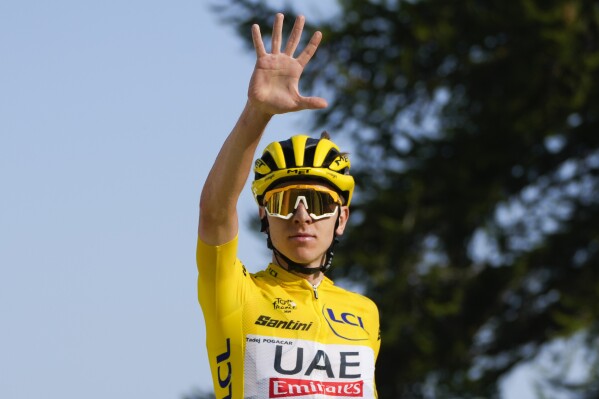
Tadej Pogacar and the Historic Riviera Finish of the Tour de France
Edited by: TJVNews.com
Tadej Pogacar knows every twist and turn of the Col d’Eze intimately. This winding road, which ascends from behind the port of Nice to the hills above Monaco, is not just a training ground for the two-time Tour de France champion—it’s practically his backyard, according to a report that appeared on Thursday in the Wall Street Journal. Pogacar often embarks on coffee rides here, effortlessly outpacing amateur cyclists and honing his skills to secure victories in the world’s most prestigious cycling race.
Pogacar’s frequent presence on the Col d’Eze has turned the 6-mile mountain pass into a local legend. Cyclists in the nearby cafés exchange Pogacar sightings with the same enthusiasm that hotel bar patrons might discuss celebrity appearances. As indicated in the WSJ report, this weekend, the familiar climbs of the Côte d’Azur, including the Col d’Eze, will play a pivotal role in determining the outcome of the Tour de France.
For the first time in its 121-year history, the Tour de France will forgo its traditional finish in Paris. Instead, the race will culminate in the Côte d’Azur with a pair of grueling stages on Friday and Saturday, followed by a Sunday time trial ending in Nice. This alteration is due to Paris preparing for the Summer Olympics, which begin on July 26. The WSJ report explained that the logistical challenges of securing major roads and ensuring safety for the peloton on the Champs-Elysées proved too great, prompting organizers to choose familiar terrain on the Riviera.
This unprecedented change is both a nod to logistical necessity and a testament to the region’s enduring appeal to cyclists. Thierry Gouvenou, the mastermind behind the Tour de France course, acknowledged that Nice was the obvious solution due to its familiarity and variety. “We know it so well and it just gives us so much variety,” Gouvenou told the WSJ.
Pogacar, who resides in Monaco, is uniquely positioned to benefit from this year’s route. “Afterward,” he remarked, “I can just get on my bike, ride home, and go to sleep,” as was reported by the WSJ. This proximity offers a significant psychological and physical advantage, allowing Pogacar to maintain a sense of normalcy even as he competes in the final, decisive stages of the race.
The Riviera is not just a playground for Pogacar. It is one of the world’s premier locations for professional cyclists, alongside art dealers, oligarchs, and tax exiles. The WSJ report affirmed that once the Tour de France concludes, many riders will return to their homes along the coast between Nice and Monaco, enjoying the comfort of their own beds for the first time in over a month.
Traditionally, the Tour de France finishes in Paris, a tradition upheld since the race’s inception in 1903. However, the impending Summer Olympics necessitated a change. The report noted that organizers decided to leverage the familiarity and logistical advantages of the Côte d’Azur, a region regularly featured in the Tour’s sister race, Paris-Nice, every March.
This historic alteration has significant implications for the race. The Riviera stages, known for their challenging climbs and scenic beauty, promise to deliver a dramatic conclusion to the Tour. Riders will face the demanding terrain with the added twist of a final time trial, ensuring that the battle for the yellow jersey remains fiercely contested until the very end.
The allure of the Riviera for professional cyclists is multifaceted. Over the past two decades, riders have been drawn to the region by its ideal training conditions, abundant sunshine, and, for some, the tax advantages of residing in Monaco. The trend began in the 1990s when notable cyclists like Lance Armstrong moved to Nice, setting off a wave of migration among their peers. “One person goes there, then another follows, and that’s how it starts,” explained Greg LeMond, a three-time Tour de France winner, as was mentioned in the WSJ report. The trend was further fueled by the increasing earnings of professional cyclists, making the luxurious lifestyle of the Riviera more accessible.
The final three days of this year’s Tour de France promise to be among the most grueling in the race’s history. The riders will face six of the most challenging climbs, including a mountaintop finish at the Isola 2000 ski resort and a perilous descent off the Col de Turini. The grand finale will take place along the picturesque pebble beaches of the Promenade des Anglais, providing a striking contrast to the typical Parisian conclusion, as per the information contained in the WSJ report. These stages are not just about the beauty of the landscape but also the sheer difficulty of the terrain, testing the cyclists’ endurance and skill after three exhausting weeks of racing.
While the Côte d’Azur is known for its idyllic summer scenery, it also presents formidable challenges for the cyclists. “It’s going to be super-hot and humid,” noted Tadej Pogacar, who is intimately familiar with the region’s summer climate, the WSJ report said. “I know the conditions of July and August well and I think they’re terrible.” The heat and humidity can significantly impact performance, making hydration and stamina crucial factors in these final stages.
In a bold departure from tradition, the organizers of the Tour de France have scheduled a grueling time-trial for the final day of the race, replacing the usual ceremonial ride onto the Champs-Elysées. This decision aims to infuse the 2023 Tour with late-stage drama, reminiscent of the electrifying climax of the 1989 Tour. The WSJ reported that that year, American Greg LeMond narrowly edged out France’s Laurent Fignon by a mere 8 seconds in a Stage-21 time-trial into Paris, marking the closest overall margin of victory in the race’s 121-year history.
The idea behind the final time-trial is to keep the competition alive until the very last moment. “They’re really smart to have it,” said Greg LeMond, reflecting on the strategy to maintain suspense, as was reported by the WSJ. “Because it does bring it to the very end.” This change is designed to offer a stark contrast to the traditional Paris stage, which typically sees sprint specialists competing for stage victory while the general classification remains largely uncontested.
However, Tadej Pogacar has somewhat thwarted the organizers’ hopes for a nail-biting finish by building a significant lead of more than 3 minutes over defending champion Jonas Vingegaard. As per the information in the WSJ report, Pogacar’s dominance throughout the race has been such that the final time-trial, while still crucial, may not provide the nail-biting conclusion envisaged.
Despite Pogacar’s lead, Vingegaard and his Visma-Lease a Bike team are not giving up. They are expected to mount a major effort on Friday in a bid to close the gap and bring Pogacar back within striking distance for Sunday’s decisive time-trial, the report added. If they succeed, the final day could still see an exciting battle for the yellow jersey. If they fail, Pogacar will secure his third Tour de France victory, achieving what would be the closest thing to a home victory for a Slovenian rider in this iconic race.
Pogacar’s familiarity with the Côte d’Azur gives him a unique advantage in this year’s concluding stages. “I sometimes go for an easy ride to Nice and back and you could see they already had a Tour atmosphere, even 5 months ago,” Pogacar shared with the WSJ. “You feel lucky to be there.” This local knowledge and the supportive atmosphere of the Riviera could bolster his confidence and performance as he aims for yet another Tour de France title.
The Côte d’Azur is known for its stunning landscapes but also its demanding riding conditions. The final stages will feature six of the Tour’s hardest climbs, including a mountaintop finish at the Isola 2000 ski resort and a harrowing descent off the Col de Turini, the WSJ report pointed out. The final time-trial along the Promenade des Anglais will not only test the riders’ endurance but also their ability to handle the intense summer heat and humidity of the Mediterranean.
