



|
Getting your Trinity Audio player ready...
|
There comes a moment in international affairs when the language of diplomacy, once a necessary instrument of restraint, hardens into an excuse for inaction. With Iran, that moment is no longer approaching—it has arrived. For decades, the Islamic Republic has mastered the art of negotiation as a delaying tactic, using talks not to resolve disputes but to buy time: time to enrich uranium, time to entrench regional proxies, time to tighten its grip on a suffering population. If diplomacy fails once more to produce a verifiable, enforceable end to Iran’s nuclear ambitions, the United States, under the leadership of President Donald Trump, must act decisively. A bold military strike would not be an act of recklessness; it would be an act of necessity—strategic, moral, and humanitarian.
The Iranian nuclear threat is not theoretical. It is not speculative. It has been a looming danger for years, openly acknowledged by Tehran’s own leadership and reinforced by repeated violations of international commitments. The regime under Ayatollah Ali Khamenei has demonstrated, time and again, that it has no genuine interest in abandoning its pursuit of nuclear weapons capability. Agreements are signed, then hollowed out. Inspections are promised, then obstructed. Red lines are crossed, and the world is asked to accept each transgression as the last. This cycle has one predictable outcome: a nuclear-armed Iran or a nuclear-capable Iran that can cross the threshold at a moment of its choosing.
Such an outcome would be catastrophic—not only for regional stability, but for the global order. A regime that openly chants for the destruction of another sovereign state cannot be treated as a normal actor. Iran’s threats against Israel are not rhetorical flourishes; they are doctrinal. Israel, a democracy surrounded by hostile forces, has lived for years under the shadow of annihilation promised by Tehran. To demand that Israel accept the risk of nuclear destruction in the name of endless diplomacy is not realism—it is moral abdication. No nation should be asked to tolerate the possibility of its own eradication.
Yet the nuclear issue, grave as it is, represents only one dimension of the Iranian crisis. The other, often discussed in hushed tones, is the humanitarian catastrophe unfolding within Iran’s borders. The Iranian people have not been silent. They have risen—again and again—against a regime that governs through fear, brutality, and systematic repression. Women have torn off mandatory head coverings in defiance. Students, workers, and ordinary citizens have filled the streets demanding dignity, accountability, and freedom. Their courage has been extraordinary. The regime’s response has been monstrous.
Human rights organizations have produced concrete, harrowing evidence of mass executions. Protesters are arrested in the dead of night, swallowed by a prison system designed not for justice but for disappearance. Thousands are detained, many never to be heard from again. Torture is routine. Trials, when they occur at all, are theater. This is not a government struggling to maintain order; it is a regime waging war on its own population. To treat such a system as a legitimate negotiating partner indefinitely is to ignore the blood staining its hands.
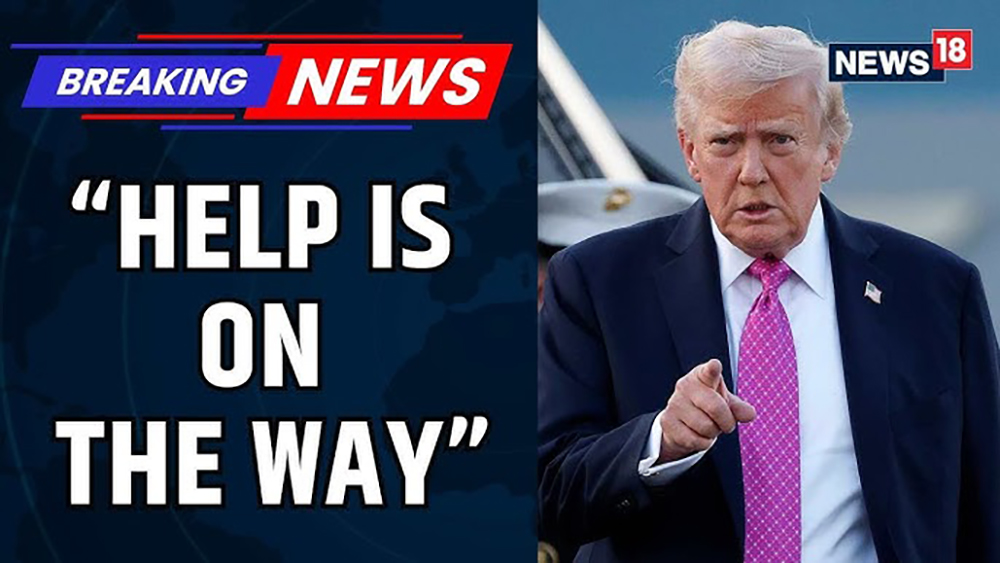
President Trump once declared, “Help is on the way.” Those words resonated not in diplomatic salons, but in the hearts of Iranians who dared to believe that the world had not abandoned them. But help delayed too long becomes help denied. Negotiations that drag on without consequence signal not patience, but weakness. The regime in Tehran interprets delay as permission. Every month spent talking without results is another month of executions, another month of enriched uranium, another month in which hope is strangled in prison cells.
A military strike, if diplomacy fails, must be understood in this context. It would not be a war against the Iranian people; it would be a confrontation with a rogue regime that has hijacked a nation. Carefully targeted action against nuclear facilities and key military infrastructure would serve multiple purposes: halting Iran’s nuclear march, degrading the regime’s capacity for regional aggression, and shattering the illusion of invincibility that sustains its rule. Authoritarian systems often collapse not when they are persuaded, but when they are exposed as fragile.
Critics will argue that regime change cannot be imposed from outside. They are correct—and they are missing the point. The goal is not to dictate Iran’s future, but to remove the boot from the neck of its present. Regime change in Iran will ultimately be achieved by Iranians themselves. But history shows that internal liberation movements often require external catalysts. By dismantling the regime’s most dangerous capabilities and confronting it with the consequences of its crimes, the United States can create the conditions in which the Iranian people can reclaim their country.
