



|
Getting your Trinity Audio player ready...
|
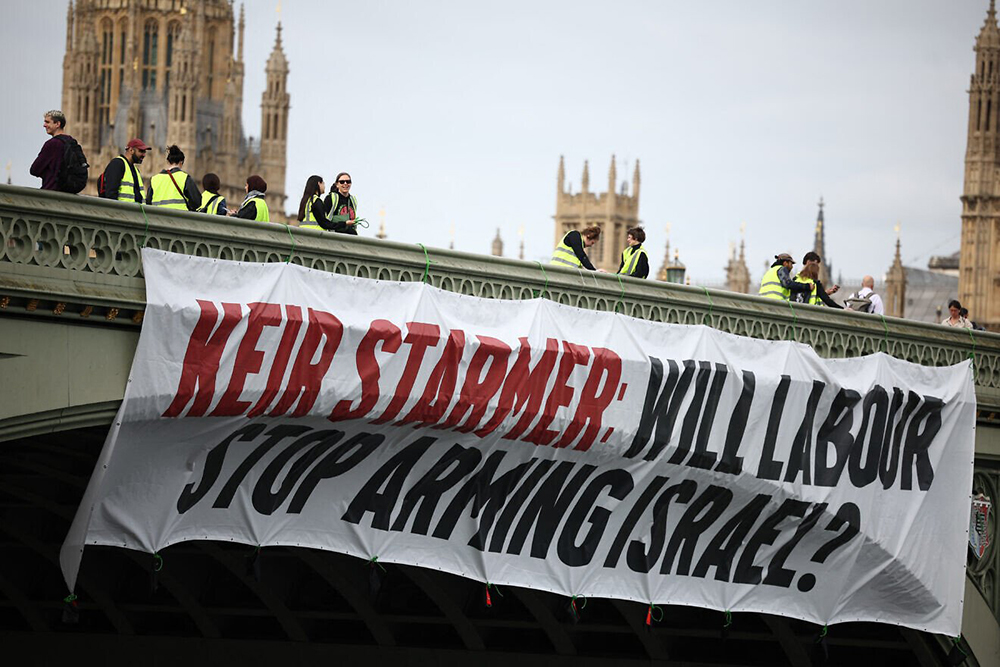
A banner reading “Keir Starmer: Will Labour Stop Arming Israel?” is hung over the side of Westminster Bridge in front of the Palace of Westminster, home to the Houses of Parliament, during early morning rush hour in London on June 3, 2024. Photo by Henry Nicholls/AFP via Getty Images.
By: Ben Cohen
One year after being elected as Britain’s prime minister, Sir Keir Starmer looks increasingly isolated and alone.
His positive approval ratings in the wake of his victory have sunk to their lowest level so far amid a slew of domestic crises and social issues–around immigration, cuts in benefits, unrest in the National Health Service, sluggish economic growth, a deteriorating law and order situation, and much else.
But during what the London Times has described as the prime minister’s “summer of pain,” Starmer has faced his one of his biggest challenges on an issue that makes literally no difference to the paychecks of British voters, the quality of the schools their children attend, the efficiency and responsiveness of their health service, or any other aspect of their daily lives. That issue is the war in Gaza.
Sad to say, this is likely the first time that a foreign war with no British boots on the ground has become a wedge issue in domestic British politics. Other, more terrible wars past and present– such as the current Russian aggression against Ukraine, the most pressing security threat and moral challenge facing both the United Kingdom and European continent–have led to furrowed brows and hand-wringing, but they haven’t really impacted voting intentions. The fundamental reason for this difference–that the aggressors in this case are smeared as “Jewish colonists” ethnically cleansing an indigenous non-Jewish population–will probably be the subject of a future column. Why are so many voters in Britain and elsewhere vexed and angry about the plight of children in Gaza, ignoring the fact that Hamas uses them as human shields while skillfully exploiting the images of their suffering, yet shamefully silent on the fate of the thousands of Ukrainian children abducted by Vladimir Putin’s regime?
But back to Starmer. His anxiety that his continuing refusal to label Israel’s war against Hamas a “genocide” will cost him support was a major factor in his ill-advised announcement that the United Kingdom will recognize a Palestinian state by the time the U.N. General Assembly meets in September, unless Israel declares a unilateral ceasefire and gets on board with a two-state solution (which, in these febrile conditions, isn’t going to happen.)
Since that announcement, much attention has been paid to the international context around it. Of special importance here is France’s decision to recognize an independent Palestinian state, which prodded Starmer in the same direction, as well as the leaders of other countries from Canada to Malta.
Less attention has been devoted to the more immediate circumstances around Starmer. Despite him taking action against the antisemitism that plagued his ruling Labour Party under his predecessor Jeremy Corbyn, including turfing Corbyn out of the party’s ranks, its “Palestine First” wing has become increasingly assertive over the past year.
Over the last fortnight, the noise from this crowd has swelled against the background of viral images of hungry children in Gaza, buoyed further by polls showing that more than half of British voters oppose Israel’s “aggression” and that nearly half want the creation of a Palestinian state. Growing numbers of cabinet ministers pushed Starmer to announce British recognition, with one of them inadvertently acknowledging the emptiness of the gesture by telling The Guardian, “We say that recognizing Palestinian statehood is a really important symbol that you can only do once. But if not now, then when?”
As more than 100 Labour members of parliament signed a cross-party letter to Starmer urging the same, media coverage of the issue depicted the premier as an outlier morphing into an outcast, struggling to impose his view that “Palestine” should only be granted recognition as part of a peace process with Israel. With the scent of rebellion in the air, one Labour Parliament member told Politico that Starmer was “all words–no action, no further sanctions.” Another claimed, presciently as it turned out, “I don’t think people will settle for anything less than recognition now.”
Outside of Labour, Starmer faces a threat from the “Green Left” coalition of Islamists and Socialists, most immediately through the Independent Alliance, a parliamentary grouping formed by Corbyn following his expulsion from Labour. Alongside Corbyn are five other independent MPs, all elected last year and all of them Muslim, whose platforms centered on the war in the Gaza Strip and alleged Islamophobia inside the Labour Party. The grouping is now focused on becoming a new far-left political party, having been joined by Zarah Sultana, originally elected as a Labour MP, whose antisemitism-inflected barbs against Israel are widely covered in British media outlets.
According to the Times, the new formation “has the potential to do real damage to Labour.”
Why? “The Corbyn pitch is simple–the ‘mass redistribution of wealth and power’ and an end to the ‘genocide’ in Gaza,” the paper argued. “For those on the left disenchanted with Starmer after the compromise of a hugely challenging first year in power, it may prove to be irresistible.”
Nigel Farage, the roguish leader of the right-wing populist Reform Party, certainly hopes so; if a far-left party is “able to organize sufficiently and field large numbers of candidates, it will help us enormously,” he said.
The notion that Israel’s fate should be held hostage to the domestic fissures within other countries is offensive on its face, and is another good reason to dismiss the mudslide of Palestinian state recognition as performative nonsense that will never sway Israel nor feed a single child in Gaza. If it has any importance at all, that lies in what it tells us about the influence on British politics, and perhaps the domestic politics of those other countries that have opted to reward Hamas by recognizing a Palestinian state, of Hamas apologists.
Yet in the case of Britain, there is an additional, historical consideration. The 1917 Balfour Declaration supporting the establishment of a Jewish “national homeland” in what was then Mandatory Palestine–one of the greatest and most consequential moves in British diplomatic history–is now seen by many as an additional mark of shame on Britain’s imperial legacy. In many ways, Starmer’s move is compensation for that document, which is held up by Hamas supporters as “Exhibit A” in what they present as the Zionist “colonization” of Palestine. The apologia surrounding a decision more than a century old feeds the notion that Israel is an illegitimate state, the reward given to Jewish colonizers by a devious, manipulative empire run from London.
The irony here is that, for all the opprobrium that Starmer has understandably attracted from supporters of Israel, he remains a bulwark against the more extreme positions advocated by members of his cabinet and backbench Labour parliamentarians, such as expelling the Israeli ambassador and imposing sanctions against the Jewish state. Israeli diplomacy and Israel’s advocates abroad must therefore confront the same strategic dilemma: should they try to influence Europe, which has long seemed like a losing battle, or should they concentrate efforts on keeping the United States on board?
How that is resolved will impact Israel’s global standing for the coming decade, at least.
(JNS.org)
Ben Cohen is a senior analyst with the Foundation for the Defense of Democracies (FDD) and director of FDD’s rapid response outreach, specializing in global antisemitism, anti-Zionism and Middle East/European Union relations. A London-born journalist with 30 years of experience, he previously worked for BBC World and has contributed to Commentary, The Wall Street Journal, Tablet and Congressional Quarterly. He was a senior correspondent at The Algemeiner for more than a decade and is a weekly columnist for JNS. Cohen has reported from conflict zones worldwide and held leadership roles at the Anti-Defamation League and the American Jewish Committee. His books include Some of My Best Friends: A Journey Through 21 st Century Antisemitism.
