



|
Getting your Trinity Audio player ready...
|
Israel’s Targeted Killing of Fuad Shukr: A Justified Act of Defense and Justice
Israel’s recent targeted killing of Fuad Shukr, a high-ranking leader of Hezbollah’s Jihad Council, marks a pivotal moment in the ongoing battle against terrorism. Shukr, a figure notorious for orchestrating heinous terrorist attacks, including the 1983 Beirut Marine barracks bombing that claimed 241 U.S. servicemen’s lives, represents the epitome of violent extremism. His elimination is not only a significant victory for Israel but also a moment of justice long overdue for his countless victims, including hundreds of Americans and Israelis.
Fuad Shukr’s involvement in terrorism spans decades, with a litany of atrocities attributed to his planning and execution. Most recently, Shukr masterminded a brutal strike that resulted in the deaths of a dozen Druze children in Majdal Shams in the Golan Heights. This act alone underscores the indiscriminate nature of his violence and his willingness to target innocents to further his objectives.
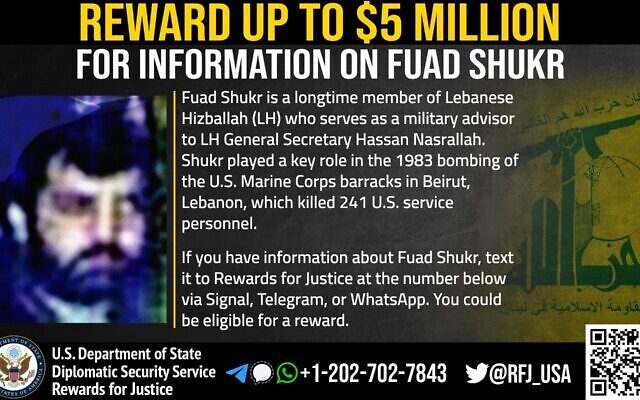
Shukr’s most infamous act was the Beirut Marine barracks bombing in 1983, a catastrophic event that left 241 U.S. servicemen dead. This attack was a turning point in the history of international terrorism, demonstrating the lethality and reach of Hezbollah’s terror operations. In recognition of his role, the U.S. State Department designated Shukr as a “Specially Designated Global Terrorist” and offered a $5 million reward for information leading to his capture. Despite this, years of inaction allowed Shukr to continue his campaign of terror—until Israel took decisive action.
Israel’s elimination of Shukr should be seen as a necessary and justified act of self-defense. Vice President Kamala Harris rightly acknowledged that “Israel has a right to defend itself against a terror organization, which is exactly what Hezbollah is.” This statement encapsulates the core principle that sovereign nations must protect their citizens from imminent threats, particularly from organizations that have repeatedly demonstrated their capacity and intent to inflict mass casualties.
However, Harris’s additional call for a diplomatic solution, while well-intentioned, highlights a historical pattern of mixed messaging from the United States regarding Islamic terrorism. This inconsistency dates back to the 1983 massacre when President Ronald Reagan, despite condemning the attack as “despicable,” opted for a strategic redeployment of Marines rather than direct retaliation. This move, perceived as a retreat, arguably emboldened terrorists, contributing to a surge in global terror activities.
The Central Intelligence Agency’s now-declassified report from the mid-1980s reveals that international terrorism incidents soared following the Beirut bombing. In 1985 alone, terrorists carried out 784 attacks, marking a 30% increase from the previous year. The Middle East, fueled by figures like Shukr, was a significant contributor to this uptick in violence. This historical context calls attention to the dangers of passivity and the necessity of robust counterterrorism measures.
Given the U.S. historical and ongoing commitment to combating global terrorism, it is only fitting that America should recognize and support Israel’s efforts in this regard. The elimination of Fuad Shukr not only serves Israel’s national security interests but also aligns with broader international efforts to dismantle terrorist networks. In this light, the United States should symbolically support Israel’s action by fulfilling the $5 million reward it once placed on Shukr. This gesture would reaffirm America’s commitment to holding terrorists accountable and demonstrate unwavering support for its allies in the fight against terrorism.
The history of terrorism and the West’s response to it provides invaluable lessons on the effectiveness of decisive retaliation over negotiation. The mounting violence of the 1980s, including high-profile hijackings and bombings served as a catalyst for President Ronald Reagan to adopt a stronger stance against terrorist threats. This approach, characterized by targeted military action, yielded significant results in curbing the momentum of terrorist groups. Today, as the world faces renewed threats, it is crucial to understand and emulate these lessons to restore global stability and counter the ever-present menace of terrorism.
In 1985, Palestinian terrorists hijacked an Italian cruise ship, taking hundreds of passengers hostage and murdering an American citizen. The hijackers, after fleeing to Egypt, attempted to reach Tunisia, expecting a hero’s welcome. President Reagan, demonstrating a no-nonsense approach, authorized four Navy F-14s to intercept the hijackers’ jet, declaring, “You can run, but you can’t hide.” This decisive action highlighted the U.S. commitment to pursuing justice and holding terrorists accountable, regardless of their location.
A year later, in response to a terrorist attack on a West Berlin disco frequented by American soldiers, America launched airstrikes against Libya, which had ties to the attackers. Despite criticism from international leaders such as French President François Mitterrand, who argued that such actions did not effectively combat terrorism, the raid had a profound impact. Moammar Gadhafi, Libya’s leader, significantly reduced his direct confrontations with the United States following the airstrikes. This outcome highlighted the deterrent effect of demonstrating military might.
Confidential assessments from the Central Intelligence Agency in the mid-1980s provide further evidence supporting the effectiveness of retaliatory measures. A 1986 assessment linked the decline in jihadist terrorism to the West’s “unprecedented military, diplomatic, and economic retaliatory measures.” The following year, the CIA noted that “enhanced” counterterrorism operations had succeeded in keeping terrorists off balance, disrupting their operations, and limiting their capacity to execute attacks.
These findings speak volumes about a critical truth that may be uncomfortable for the conflict-averse Western mindset: Negotiating with jihadists often signals weakness and emboldens them. In contrast, a firm and united response, characterized by decisive retaliatory actions, can significantly disrupt terrorist networks and deter future attacks.
In light of these historical lessons, Americans must reevaluate their approach to dealing with terrorism. Calls for cease-fires and attempts to mollify perpetrators of terror often result in temporary peace that terrorists exploit to regroup and plan future attacks. Instead, projecting power and demonstrating an unwavering commitment to retaliate against terrorism are essential strategies for restoring global stability.
The United States must unite the West behind allies such as Israel, which has consistently taken the lead in combating terrorist threats. Israel’s recent actions against figures such as Fuad Shukr, a leader of Hezbollah’s Jihad Council responsible for murdering hundreds of Americans and Israelis, exemplify the kind of decisive action needed. Shukr’s assassination not only delivers justice for his victims but also sends a powerful message to terrorist organizations about the consequences of their actions.
America owes Israel a debt of gratitude for its proactive stance against terrorism. By taking bold actions, Israel not only protects its citizens but also contributes to global efforts to combat terrorism. In recognition of Israel’s significant role, the United States should support its ally through both words and actions. This support includes fulfilling the $5 million reward for information on Fuad Shukr, a symbolic yet powerful gesture that reinforces America’s commitment to justice and counterterrorism.
The lessons of the past are clear: Retaliation and a firm stance against terrorism are far more effective than negotiation and appeasement. By projecting power, unifying the West behind Israel, and intimidating adversaries like Iran and its proxies, the United States can restore global stability and deter future terrorist threats. America must embrace these lessons and support allies like Israel, recognizing their crucial role in leading the fight against terrorism and ensuring a safer world for all.