



|
Getting your Trinity Audio player ready...
|
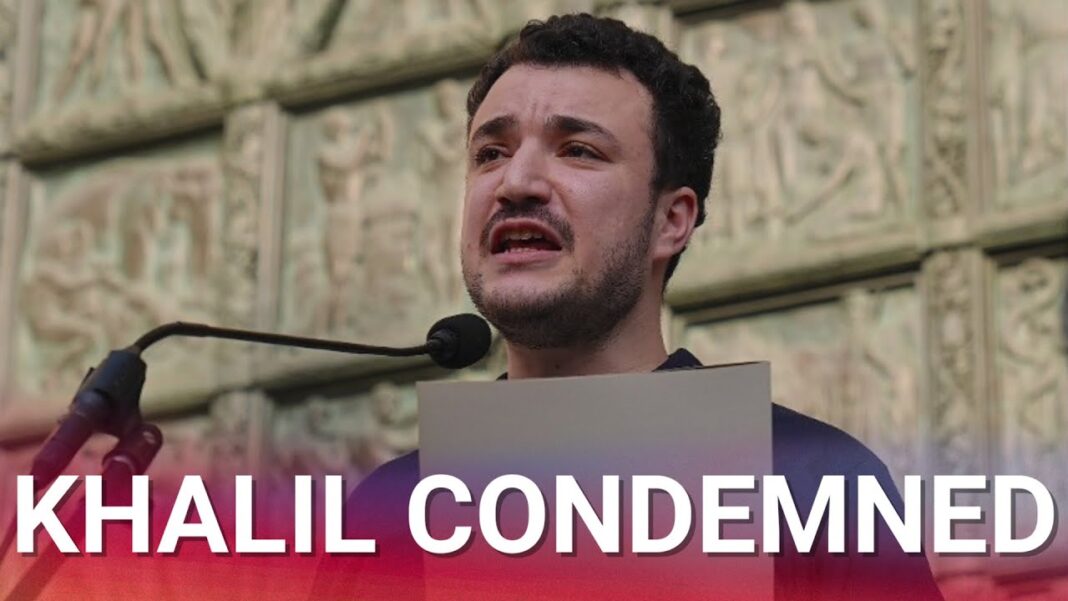
Hamas Apologist Mahmoud Khalil Reveals the Truth: For Him, Terrorism Is Preferable to Peace
Every so often, the mask slips. Beneath the slogans, the keffiyeh-clad theatrics, and the rhetorical flourishes about “justice” and “liberation,” the real objective of the so-called “pro-Palestine” movement comes into sharp focus. That moment came this week courtesy of Columbia University agitator Mahmoud Khalil, who in an interview with The New York Times’ Ezra Klein openly admitted what sober observers have long suspected: the movement’s leaders and ideologues believe the October 7, 2023, Hamas atrocities were justified — not despite their savagery, but because of it.
Khalil’s rationale was chilling in its clarity. The massacre, he explained, was a “desperate attempt” to forestall what he described as a “very imminent” normalization of relations between Israel and Saudi Arabia — a peace deal that would have marked one of the most consequential diplomatic breakthroughs in the Middle East in decades. To Khalil and those who think like him, mass murder, mass rape, and the kidnapping of civilians were morally preferable to regional stability.
Let that sink in: the deliberate slaughter of 1,200 men, women, and children, and the abduction of 250 more, was, in this worldview, the better path forward — the necessary price to keep alive the grievance industry that fuels Hamas’s grip on Gaza and its ideological supporters abroad.
Khalil’s talk of breaking “the cycle” is nothing more than the recycling of an old excuse. The “cycle” he decries is not one of violence and oppression — it is the cycle of progress toward peace. In reality, the Israel-Saudi normalization talks represented a rare and historic chance to move the region toward coexistence and economic integration. For Hamas and its apologists, however, peace is a mortal threat. Peace undermines their core narrative that Israel must remain in perpetual conflict with the Arab world until it is destroyed.
If Palestinian leaders truly wanted a better future for their people, the logical move would have been to seize the moment, join the diplomatic process, and secure tangible benefits for Gaza and Judea and Samaria. Instead, they chose mass terror — the ultimate self-sabotage — ensuring Israel’s security concerns would intensify and regional sympathy for their cause would erode further.
By speaking of the October 7 massacre in terms of “we,” Khalil has aligned himself directly with Hamas — a death cult that has repeatedly shown it values Palestinian lives only insofar as they can be used as propaganda tools. In his framing, the people of Gaza are pawns, their suffering a resource to be exploited for political capital. The point is not to alleviate their hardship but to perpetuate it, ensuring the “struggle” remains alive for another generation.
Hamas leaders themselves live in luxury abroad, far from the consequences of the chaos they unleash. In five-star Doha hotels, they plot the next escalation while their civilian population endures the inevitable Israeli response. That their actions plunge ordinary Gazans deeper into despair is not a bug in their strategy — it is the feature that sustains it.
The tragedy is compounded by the willingness of certain Western intellectuals and media figures to act as enablers. Khalil’s audience with Ezra Klein is emblematic of a larger problem: an elite class of commentators who, while enjoying the freedoms of open societies, extend rhetorical cover to movements that reject those very freedoms. They mistake moral relativism for moral sophistication, dressing up the endorsement of barbarity as an “understanding” of its “context.”
By platforming figures like Khalil without rigorous challenge, they contribute to a dangerous normalization of terror apologism. This dynamic not only emboldens extremists but also poisons public discourse, making it harder to rally consensus against acts that should be universally condemned.
No rational observer expects Palestinians to be “perfect victims,” as Khalil sneeringly suggests. The bar is far lower: refraining from the burning alive of families, the execution of concertgoers, the systematic rape of women, and the kidnapping of children should be the baseline for any movement claiming to seek justice. Such atrocities are not acts of resistance; they are war crimes, plain and simple.
History shows that every intifada, every wave of terror attacks, has worsened the Palestinian position. They have brought harsher security measures, economic isolation, and deeper mistrust from potential international partners. The idea that “freedom” will emerge from ever-greater bloodshed is a delusion — one that serves only the political fortunes of the men who orchestrate the violence from a safe distance.
The most revealing aspect of Khalil’s admission is what it implies about Hamas’s real fears. The group’s leadership understands that normalization between Israel and the Arab world would marginalize them. If Palestinians saw neighboring Arab states benefiting from cooperation with Israel, they might begin to question why they, too, should not pursue prosperity over perpetual resistance.
Peace would also undermine the rallying cry that Israel is an isolated pariah, surrounded by enemies. It would force Hamas to compete on the grounds of governance and economic performance — a contest they would inevitably lose. In short, peace would make them irrelevant, and so they act to destroy it at any cost.
It is not enough to condemn Hamas’s actions; we must also reject the sophistry of those who excuse them. Figures like Khalil are not simply misguided activists — they are active participants in the perpetuation of a toxic ideology that glorifies violence and despises compromise. By granting them credibility, we reward the very mindset that keeps the conflict alive.
The Palestinian people do deserve freedom, dignity, and self-determination — but these will never be won through the murder of innocents or the sabotage of peace initiatives. They will be won through the rejection of extremism, the embrace of pragmatic diplomacy, and the willingness to coexist with neighbors rather than seek their destruction.
For Western societies, this is a moment of moral clarity. Will we stand firm against the rationalization of terror, or will we allow the rhetoric of grievance to cloud our judgment? Will we insist that human rights apply universally, or will we accept their selective suspension when it suits a fashionable cause?
The correct path is obvious, though it requires moral courage: draw a bright line that separates legitimate advocacy from the defense of war crimes. That means holding accountable not only those who commit the atrocities, but also those who seek to justify them.
Mahmoud Khalil’s comments have done the world a service, albeit unintentionally. By speaking openly, he has stripped away the veneer of moral high ground claimed by the “pro-Palestine” activist class and revealed the grim calculus beneath: that peace is the enemy, and terror the preferred instrument of politics.
It is now the responsibility of political leaders, the media, and civil society to respond with moral clarity. The choice is between a future shaped by diplomacy and coexistence, or one dictated by those who view massacres as “desperate attempts” worth defending. For the sake of Palestinians, Israelis, and all who seek a more peaceful Middle East, the answer must be unequivocal.

Although the author states this: “History shows that every intifada, every wave of terror attacks, has worsened the Palestinian position. ”
It certainly hasn’t in this case. It has brought a wave of support never seen before.
I would like someone to explain to me why? Why has the murder, torture and kidnapping of mostly civilians brought them worldwide support?
I am with Maxwell. I fear, however, the answer(s) will suggest our political leaders are not up to the job as the enemies of Western Civilization are well placed. There is always the hope of the Messiah.
Author?