



|
Getting your Trinity Audio player ready...
|
If an investigation confirms Iranian involvement in the mass shooting on Chanukah, then Canberra must sever relations with Tehran.
By: Gregg Roman
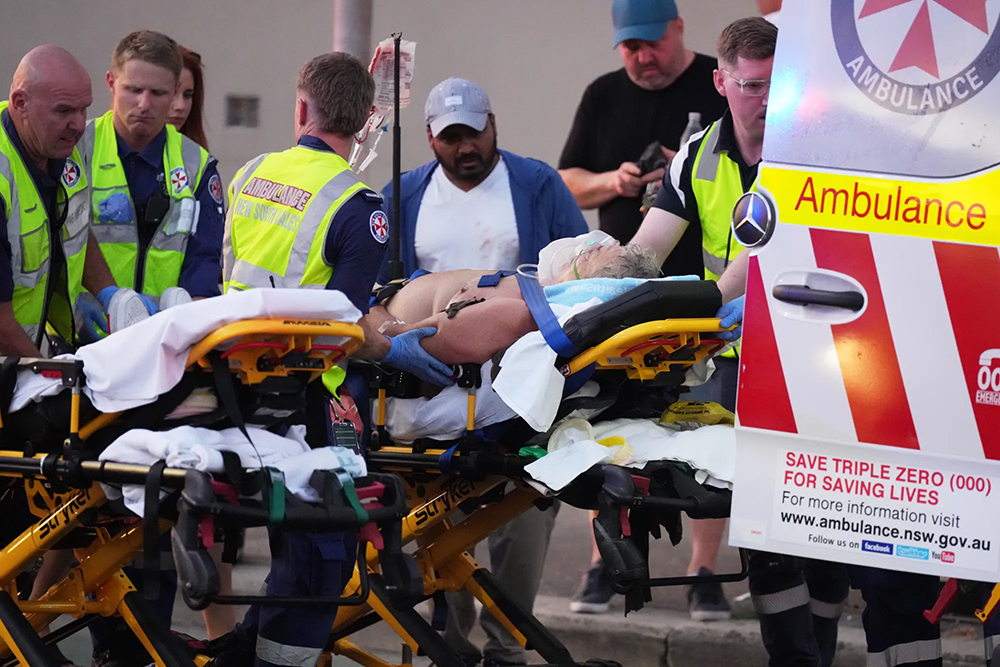
Among the 15 Jews shot and killed on Sunday at a Chanukah event on Bondi Beach was Rabbi Eli Schlanger, a 41-year-old father of five who had served Sydney’s Jewish community for 18 years. Police later found IEDs (improvised explosive devices) in the attackers’ vehicle. This was Australia’s deadliest mass shooting since 1996 in Port Arthur, a tourist town in the Australian state of Tasmania, and the most predictable terrorist attack in the nation’s history.
For 26 months, the warning signs accumulated. For 26 months, the Albanese government treated a developing terrorist campaign as a community relations problem. The result now lies on the blood-stained sand of Australia’s most iconic beach.
The trajectory was unmistakable. On Oct. 9, 2023, two days after the Hamas-led massacre of 1,200 people in southern Israel and kidnapping of 251 others, a mob descended on the Sydney Opera House, burning Israeli flags and chanting threats against Jews while police advised the Jewish community to stay away rather than dispersing the crowd. That failure to enforce basic public order established the permissive environment for everything that followed.

What followed was systematic escalation. The Executive Council of Australian Jewry documented a 316% surge in antisemitic incidents in the year after Oct. 7. Harassment of visibly Jewish individuals became routine. Jewish businesses were vandalized. Then came the arson campaign: Lewis’ Continental Kitchen, a kosher cafe in Bondi, was firebombed in October 2024. The Adass Israel Synagogue in Melbourne, set ablaze in December 2024.
This August, Australian Prime Minister Anthony Albanese was forced to acknowledge what the Australian Security Intelligence Organisation had concluded: Iran’s Islamic Revolutionary Guard Corps had directed both attacks, using local criminals as proxies. Australia expelled the Iranian ambassador, the first such expulsion since World War II.
However, the operational networks remained largely intact, and the escalation continued.
Mike Burgess, the director-general of the Australian Security Intelligence Organisation, could not have been clearer.
In February, he declared that “in terms of threats to life, our No. 1 priority now is investigating antisemitic acts in this country”—the first time any form of racism had been named as the agency’s highest threat category. He warned that threats had “transitioned from harassment and intimidation to specific targeting of Jewish communities, places of worship and prominent figures.”
Israeli officials delivered the same warnings repeatedly. After Bondi, Israeli Foreign Minister Gideon Sa’ar stated bluntly: “The Australian government, which received countless warning signs, must come to its senses.” The warnings were heard but not heeded.
The government’s response framework remained fundamentally inadequate. It appointed a special envoy to combat antisemitism and established “social cohesion” task forces. It funded training programs. Meanwhile, Hizb ut-Tahrir—banned in the United Kingdom, Germany and across much of Europe for glorifying terrorism—continued operating openly in Australia, recruiting on university campuses and injecting revolutionary Islamist ideology into what had been broader protest movements.
This institutional failure reflects a deeper paralysis. The Albanese government has been willing to ban right-wing extremist symbols but unwilling to confront Islamist extremism with equivalent force. Whether this stems from the fear of accusations of “Islamophobia,” electoral calculations in Western Sydney or simple diplomatic timidity regarding Iran, the effect has been the same: a permissive environment where hatred of Jews can escalate from chants to arson to mass murder.
Australia has demonstrated before that it can respond to national trauma with transformative action. After Port Arthur, Australian Prime Minister John Howard secured unanimous agreement on the National Firearms Agreement within 12 days. He traveled to hostile communities wearing a bulletproof vest. He spent political capital because he understood that decisive moments require decisive leadership.
The Bondi massacre demands an equivalent response—not against guns, which are already tightly controlled, but against the ideological and institutional infrastructure that produced the killers.
This means immediate proscription of Hizb ut-Tahrir and any organization meeting the threshold for glorification of terrorism. It means weaponizing the Foreign Influence Transparency Scheme to expose and sever funding flows from Iran, Qatar and other hostile state actors to Australian religious institutions and universities. It means making federal funding conditional on universities enforcing the International Holocaust Remembrance Alliance (IHRA) working definition of antisemitism. It means providing permanent security funding for Jewish schools and synagogues, acknowledging that the threat to these institutions is a national security failure, not a private burden.
If an ensuing investigation into the Bondi massacre confirms the involvement by Iran and the hallmarks of state-sponsored terrorism are unmistakable, then Australia must support allied kinetic action against IRGC facilities and sever diplomatic relations with Tehran.
Terrorists murdered 15 people gathered among families to light Chanukah candles and wounded nearly triple that number. The time for expressions of solidarity and incremental measures has passed.
In 1996, Howard understood that inherited political capital depletes whether or not you spend it; the only question is whether it depletes through action or inaction. Albanese now faces the same test. Not only is the Australian nation watching, but so is the world.
(JNS.org)