



|
Getting your Trinity Audio player ready...
|
There are moments when a society is forced to confront not only its extremists, but those who invite them inside, offer them a microphone, and then feign innocence when the damage is done. The decision by StopAntisemitism to name Tucker Carlson its 2025 “Antisemite of the Year,” as reported by The New York Post, is one such moment—and it is both justified and overdue.
This is not an award bestowed lightly, nor is it a casual insult hurled in the heat of political disagreement. It is a considered judgment rendered amid a historic surge in antisemitic incidents in the United States and across the Western world. Synagogues require armed guards. Jewish students are harassed on elite campuses. Jewish families are once again weighing whether public expressions of identity are worth the risk. Against that backdrop, Carlson’s conduct is not merely irresponsible; it is corrosive.
Carlson’s defenders insist that he is merely asking questions, challenging orthodoxies, or exercising free speech. That defense collapses under scrutiny. Free speech is not the issue. Editorial judgment is. And Carlson’s judgment—repeatedly, conspicuously, and recklessly—has favored the amplification of antisemites over the protection of truth.
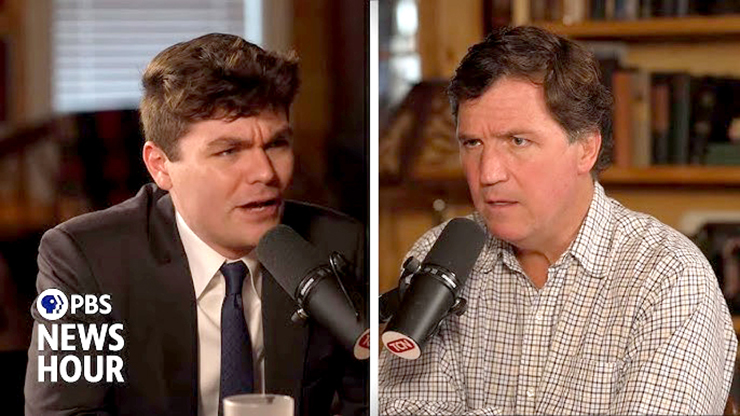
The clearest example, documented in The New York Post, was Carlson’s October interview with white nationalist Nick Fuentes. Fuentes is not a misunderstood dissident or an eccentric provocateur. He is an open Holocaust denier, a proponent of conspiracy theories about Jewish control of American life, and a man who has called for a so-called “holy war” against Jews. Carlson did not challenge these views with rigor or moral clarity. He normalized Fuentes by treating him as a legitimate voice in a national conversation. That alone would warrant condemnation.
But it did not occur in isolation. Carlson has made a habit of offering platforms to individuals who recycle some of history’s most lethal lies. He praised Holocaust revisionist Darryl Cooper as “the best and most honest popular historian in the United States,” despite Cooper’s grotesque efforts to exonerate Nazi Germany and blame Winston Churchill for World War II. He interviewed Munther Isaac, who labels Israel a “terrorist entity,” without serious interrogation of that claim’s implications or falsehoods. This is not journalism. It is ideological laundering.
Perhaps most revealing are Carlson’s repeated attacks on “Christian Zionists” and Jewish supporters of Israel, whom he has accused of being infected with a “brain virus.” As The New York Post detailed, Carlson singled out figures such as Mike Huckabee, Ted Cruz, and George W. Bush, declaring his animus toward them more intense than toward almost anyone else. The language is not accidental. It echoes a centuries-old antisemitic trope: that Jews and those aligned with them are irrational, disloyal, and dangerous to the societies in which they live.
StopAntisemitism is right to identify this pattern as a modern incarnation of the “dual loyalty” smear. Carlson rarely states outright that Jewish Americans cannot be trusted—but he does not need to. By relentlessly framing Jewish advocacy for Israel as suspect, manipulative, or destabilizing, he invites his audience to draw that conclusion themselves. This rhetorical sleight of hand is precisely what makes his influence so dangerous.
What distinguishes Carlson from fringe cranks is not the content of the ideas he circulates, but the size of the megaphone he wields. He reaches millions. His podcast and social media clips ripple through the conservative ecosystem and far beyond it. As StopAntisemitism founder Liora Rez told The New York Post, Carlson does not merely reflect antisemitism; he mainstreams it. He takes ideas once confined to extremist message boards and escorts them into the living rooms of ordinary Americans.
The consequences are not theoretical. History teaches, with brutal consistency, that antisemitic rhetoric precedes antisemitic violence. Words, as Rez observed, “dig the graves.” In an era already saturated with conspiracy thinking and political rage, Carlson’s calculated flirtation with Jew-hatred is not edgy commentary—it is a accelerant.
Carlson’s defenders on the right argue that criticism of him amounts to censorship or ideological gatekeeping. That argument collapses when confronted with reality. No one is silencing Carlson. He is wealthier, more visible, and more influential than ever. The question is not whether he is allowed to speak, but whether the rest of society is allowed to judge him.
StopAntisemitism has done exactly that. In naming Tucker Carlson “Antisemite of the Year,” the organization has issued a moral indictment—not of conservatism, not of debate over Israel, but of the reckless elevation of hatred masquerading as dissent. The title fits because Carlson earned it: not through a single remark, but through a sustained pattern of behavior that has helped drag antisemitism from the margins into the mainstream.
At a time when Jewish communities are asking whether America still has their backs, clarity matters. Silence is complicity. And calling things by their proper names is not extremism—it is civic responsibility.
