



|
Getting your Trinity Audio player ready...
|
There are rare moments when the aura of invincibility surrounding an autocrat collapses in a single, electrifying instant. The predawn operation that carried Nicolás Maduro from the presidential palace in Caracas into U.S. custody was such a moment — not merely for Venezuela, but for the sprawling architecture of impunity that has long permitted criminal autocrats to masquerade as heads of state while trafficking narcotics, laundering terror finance, and plundering foreign assets.
This was not a coup. It was law enforcement on a continental scale.
The United States acted pursuant to a standing federal indictment from the Southern District of New York, an indictment that had languished for half a decade while Maduro consolidated his grip over Venezuela as a narco-kleptocrat. In authorizing the seizure, President Donald Trump did not invent a novel doctrine; he revived one Washington has invoked before when criminal regimes metastasize into operational cartels. The most obvious precedent is Manuel Noriega, captured in Panama in December 1989 and tried not as a fallen statesman but as a trafficker. Convicted in a U.S. court, Noriega spent decades behind bars. Maduro, it now appears, is Noriega on a far more globalized scale.
The world is being forced to confront an uncomfortable truth: Nicolás Maduro no longer governed a state in the classical sense. Over the years, he presided over a hybrid regime sustained less by legitimacy than by a latticework of illicit networks fusing narcotics trafficking, terrorism, and transnational organized crime into what analysts have termed a parallel architecture of power.
That diagnosis was mapped with unsettling clarity in an October 7, 2020 article by Joseph M. Humire for the Atlantic Council. Nearly six years ago, Humire warned that Venezuela was not merely experiencing authoritarian decay but undergoing the transformation into a “criminalized state,” where armed groups, ideological extremists, and corrupted officials formed a self-reinforcing ecosystem impervious to conventional diplomacy. Time has only validated that assessment.
Humire traced the decisive pivot in U.S. policy away from incrementalism — the belief that calibrated sanctions might coax reform — toward “maximum pressure” in 2019. The shift, he emphasized, was forensic rather than ideological. Intelligence agencies and prosecutors had compiled evidence demonstrating that Maduro’s inner circle was structurally embedded in narcoterrorist enterprises.
The culmination came in March 2020, when the Department of Justice unsealed sweeping indictments against the regime, charging Maduro himself with narco-terrorism conspiracy, cocaine importation, and weapons offenses. Two months later, prosecutors indicted Adel El Zebayar, a Syrian-Venezuelan former legislator, for allegedly collaborating with Maduro, dissident FARC factions, Mexican cartels, Iran, Syria, and Hezbollah in a transnational narcoterrorism conspiracy.
This shattered the illusion that Venezuela’s crisis was domestic. It revealed a hemispheric network whose gravitational center had migrated decisively into the Western Hemisphere.
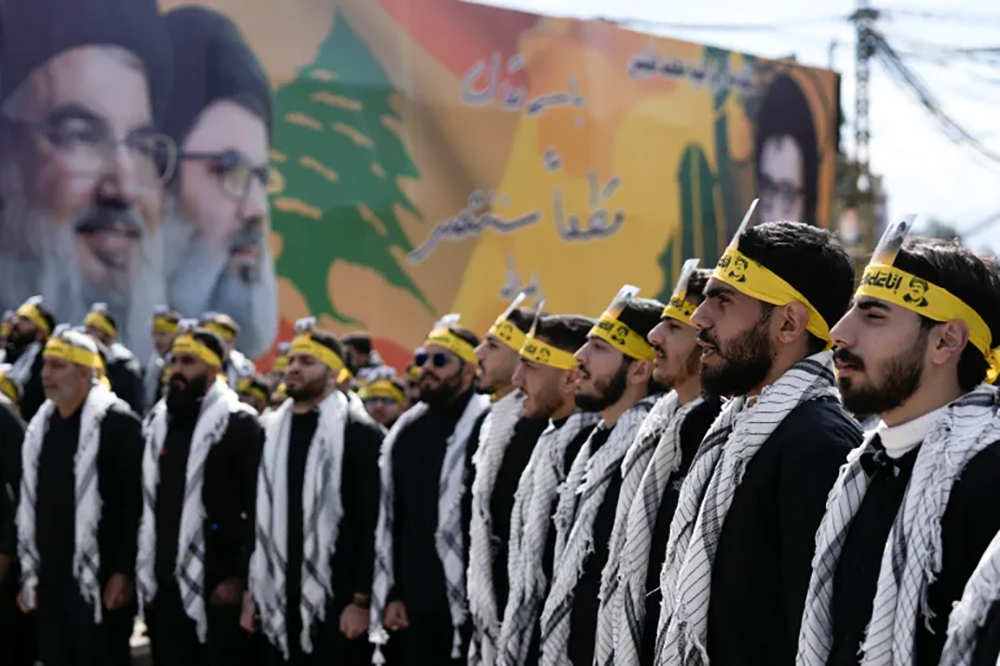
Among Humire’s most consequential contributions was his dismantling of two myths surrounding Hezbollah in Latin America. One is reductive alarmism — viewing Hezbollah solely as an imminent terrorist threat. The other is willful minimization — dismissing its relationship with Caracas as incidental. Humire rejected both. Hezbollah in Venezuela, he argued, functions as a multifunctional enterprise: laundering money, facilitating arms transfers, forging documents, and exploiting porous borders. Its purpose is infrastructural, not spectacular — an invisible scaffolding for Iran’s strategic penetration of the Americas.
What distinguishes Venezuela from other fragile states is the depth of this integration. Armed groups now control broad territories, particularly along Colombia and Brazil’s frontiers, extracting rents from illegal mining, narcotics production, and smuggling corridors. Rather than dismantle these enclaves, the Maduro regime fused with them. The so-called Cartel of the Suns — the term U.S. prosecutors use for the nexus of Venezuelan officials embedded in drug trafficking — became less an aberration than a governing framework.
In such a system, elections become theater. Ballots are cast in a country where real power resides in clandestine airstrips, jungle laboratories, and encrypted financial pipelines stretching from Caracas to Tehran to Beirut.
Humire was particularly scathing about Western blind spots. For Latin American policymakers, Hezbollah often appears a distant Middle Eastern concern. For U.S. and European officials, counterterrorism remains anchored in the Levant and North Africa. This cognitive bifurcation has produced legal and policy vacuums — gaps in designation regimes, financial oversight, and intelligence coordination — that Caracas and its allies exploited with clinical precision.
Iran stands at the center of this architecture. Its relationship with Maduro has been ideological and infrastructural: oil shipments, military cooperation, intelligence exchange. Hezbollah operates as both facilitator and guarantor, insulating Tehran’s interests from diplomatic turbulence.
Perhaps Humire’s most unsettling warning was that this system does not depend on Maduro’s personal survival. The networks are now self-perpetuating. Remove the figurehead and the infrastructure remains. Sham elections are no longer affronts to democracy; they are instruments of continuity for a transnational criminal regime.
Venezuela is not an anomaly but a blueprint. If the fusion of terrorism and organized crime can entrench itself in a resource-rich state with minimal resistance, it will be replicated elsewhere.
The seizure of Nicolás Maduro is therefore not merely the fall of a tyrant. It is a belated acknowledgment that Venezuela’s tragedy is not only stolen democracy, but institutionalized criminality — and that the cost of misunderstanding that reality will not be paid in Caracas alone.
