



|
Getting your Trinity Audio player ready...
|
New York City has seen its share of bizarre, bruising mayoral contests. From the days when Tammany Hall boss William M. Tweed used patronage and cash to control the levers of power, to the modern battles of celebrity candidates and insurgent outsiders, the city has long been a theater for political spectacle. Yet even by New York standards, the current mayoral race is extraordinary — both for its oddities and for the existential stakes involved.
At the center of the storm stands Zohran Mamdani, the 33-year-old state assemblyman from Queens who stunned the political establishment by winning the Democratic primary under the city’s ranked-choice system. His victory has thrown the race into disarray and sent shockwaves through political circles across the country. For Mamdani is no ordinary progressive. He is an avowed socialist with a radical agenda that would fundamentally reshape the city in ways both dangerous and destabilizing.
President Donald Trump is correct to call him what he is: a “communist lunatic” and, more importantly, a direct threat to the safety, solvency, and stability of New York City.
Mamdani’s platform reads like a left-wing wish list untethered from economic or social reality. He has supported “defund the police” efforts, openly called for legalizing prostitution, and backed decriminalizing a broad range of misdemeanors. These proposals would not only dismantle the city’s already fragile public safety apparatus but would turn New York into a magnet for crime and social disorder.
He promises steep tax hikes on high earners — the very people who fund the city’s budget and sustain its economy — alongside rent freezes on private apartments and even a city-run supermarket in every borough. Such measures may appeal to ideological purists, but they would cripple small landlords, drive businesses and taxpayers away, and saddle the city with costly new bureaucracies.
Perhaps most egregious is Mamdani’s record on Israel. In the city that is home to the largest Jewish population outside the State of Israel, his vehemently anti-Israel rhetoric makes him a disgraceful outlier. At a time when antisemitism is surging globally and Jews in New York already feel increasingly vulnerable, electing a mayor who aligns himself with radical anti-Israel movements would be an insult to history and a danger to the city’s Jewish community.
The numbers make the danger plain. Mamdani’s base of fervent supporters is more than enough to hand him victory in a fractured field. Polls consistently show him leading with 35% to 40% of the vote — far from a majority, but sufficient in a four-way contest.
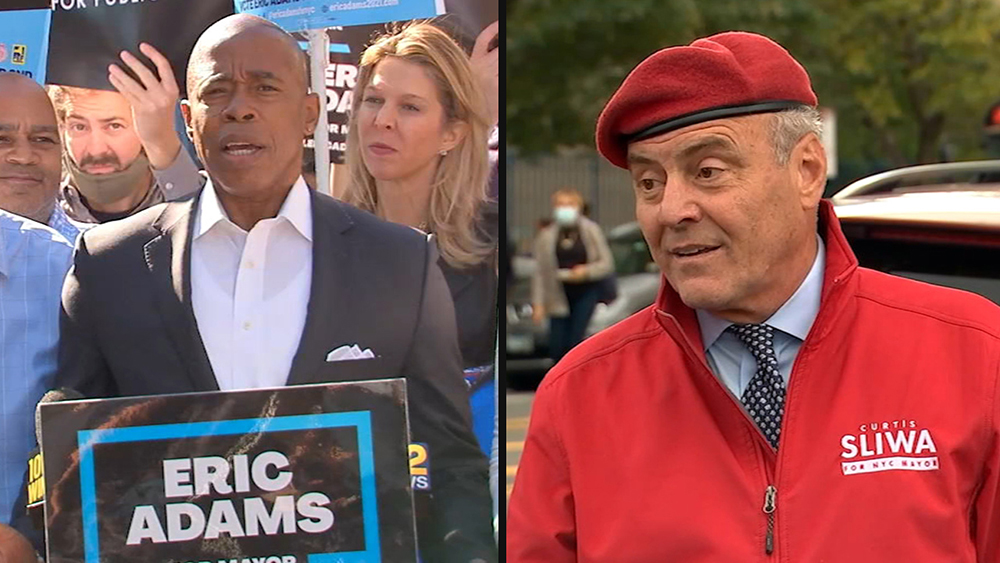
Andrew Cuomo, the former governor seeking redemption after a humiliating fall from grace, is running second in most polls with around 25%. Curtis Sliwa, the Republican and longtime Guardian Angels leader, hovers at 15% to 17%. Incumbent Mayor Eric Adams, weakened by scandals and poor approval ratings, languishes in the low double digits.
The simple math is this: so long as the anti-Mamdani vote is divided among Cuomo, Sliwa, and Adams, Mamdani coasts to victory with a minority of the electorate. New York could thus elect a mayor who commands neither consensus nor broad support, but who wields immense power with a radical minority’s backing.
This is precisely why President Trump and others are working — albeit through extraordinary means — to clear the field. By coaxing Adams and Sliwa out of the race, the city can arrive at the only realistic scenario in which Mamdani can be defeated: a one-on-one showdown with Cuomo.
Cuomo remains a deeply polarizing figure. His tenure as governor ended in scandal, resignation, and disgrace. Yet, as much as many New Yorkers may bristle at his return, there is a pragmatic reality: Cuomo is the only candidate polling within striking distance of Mamdani.
In a head-to-head matchup, polls suggest Cuomo could marshal a coalition of moderates, centrists, and pragmatic progressives alarmed at Mamdani’s extremism. While Sliwa commands loyalty among conservatives and Adams still clings to the trappings of incumbency, neither has demonstrated the capacity to build a broad enough coalition to surpass Mamdani.
Critics howl that President Trump’s role in all this smacks of Boss Tweed-style machine politics — dangling federal jobs and patronage to push candidates out of the race. But such complaints ignore the broader stakes. Trump has correctly identified the central danger: a divided opposition handing victory to a radical minority.
The president’s efforts to maneuver Adams toward a diplomatic posting, or to otherwise encourage him and Sliwa to step aside, may be unusual. But unusual times demand unusual remedies. New York is not merely any city; it is America’s economic engine, cultural capital, and global symbol. Allowing it to be led by a hardline socialist with anti-police, anti-capitalist, and anti-Israel views would reverberate far beyond the five boroughs.
Moreover, Trump’s calculus is national as well as local. A Mamdani mayoralty would hand Republicans a political weapon of enormous potency. As Senate Majority Leader Chuck Schumer and Governor Kathy Hochul surely understand, a radical socialist running America’s largest city would be a gift to the GOP nationwide — proof, in the eyes of swing voters, that Democrats are captive to their most extreme factions.
It is telling that leading Democrats have withheld support for Mamdani despite his primary victory. Schumer, Hochul, and House Minority Leader Hakeem Jeffries have all refused to endorse him. Their silence is strategic: they know a Mamdani victory would haunt the party, not only in New York but across the nation.
Progressives like Rep. Alexandria Ocasio-Cortez, predictably, have blasted them for failing to rally around the nominee. But AOC and Mamdani live in an ideological bubble, insulated from the broader electorate’s concerns about safety, taxes, and stability. Their purity tests may thrill activist bases, but they alienate the very voters needed to govern responsibly.
This is why moderates and pragmatists must prevail. The alternative is political suicide for Democrats and economic calamity for New York.
Mayor Eric Adams remains the great unknown. Weakened by scandals and sagging approval, facing the prospect of an embarrassing last-place finish, Adams is wavering. Rumors of his resignation and potential reassignment to a federal post — even as ambassador to Saudi Arabia — have swirled.
If Adams exits, it would not only clear the path for Cuomo but also eliminate the risk of splitting the anti-Mamdani vote. Yet Adams’ unpredictability remains a liability. His contradictory statements, attacks on both Cuomo and Mamdani, and refusal to clarify his intentions have deepened the uncertainty of this race.
Adams must recognize the gravity of the moment. His personal ambitions cannot outweigh the city’s survival. Should he cling to the race out of vanity, he risks being remembered not for his achievements, but for handing City Hall to a socialist radical.
This is not a normal election. It is not about whether one prefers Republican or Democrat, Cuomo or Adams, Trump or Schumer. It is about whether New York City — the financial hub of the world, the cultural beacon of America, and the home of millions — will be governed by competence or chaos.
Zohran Mamdani represents chaos. His agenda would erode public safety, drive away investment, and deepen social divides. His hostility to Israel would disgrace a city long known as the Jewish capital of the diaspora. His disdain for the economic realities of taxation and business would cripple the city’s budget and undermine its future.
Against that backdrop, Cuomo is not perfect — far from it. But he is a known quantity, a seasoned operator who, whatever his faults, understands governance. A one-on-one race between Cuomo and Mamdani offers voters the clarity they need to avert disaster.
