



|
Getting your Trinity Audio player ready...
|
By: Fern Sidman
For nearly a decade, the increasingly adversarial relationship between President Donald J. Trump and The New York Times has served as a defining symbol of the broader crisis of trust between large segments of the American public and the legacy media. What critics of the president have often dismissed as rhetorical excess or political theater has, for millions of Americans, come to represent a long-overdue confrontation with an institution they believe has abandoned objectivity, embraced ideological activism, and exhibited a persistent hostility toward conservatives, the MAGA movement, Israel, and the Jewish people.
🚨 NEW: Sen John Kennedy CALLS OUT liberal media for not giving Trump credit for his successes: “Nothing what Trump’s administration do – no matter what it is, even it’s very, very positive – is he given credit by many members of the media. That’s aggravating. It’s frustrating… pic.twitter.com/AaXo7oD4qb
— TV News Now (@TVNewsNow) December 24, 2025
To understand why Trump’s critiques of The New York Times have resonated so deeply—and endured so long—one must examine not only the chronology of events since 2016, but also the historical and institutional patterns that inform the paper’s modern posture.
Donald Trump’s clash with The New York Times did not begin in the White House. As a presidential candidate in 2016, Trump repeatedly accused the paper of distorting his words, caricaturing his supporters, and framing a populist political movement as a moral aberration. Shortly after his election victory, Trump took to social media to argue that the Times was suffering declining credibility and readership because of what he described as “very poor and highly inaccurate coverage of the Trump phenomenon.” He labeled the paper “dishonest” and “failing,” a characterization that CNN Money reported at the time captured Trump’s belief that the institution had lost touch with large swaths of the American electorate.
Trump’s objections were not limited to tone. He challenged the paper over revised headlines, selective framing, and an editorial tendency to blur opinion and reporting. The now-ubiquitous phrase “fake news,” which Trump popularized during the campaign, became shorthand for a deeper critique: that certain media outlets, chief among them The New York Times, were no longer merely reporting on politics but actively attempting to shape political outcomes.
Once in office, Trump’s criticism sharpened. In early 2017, he publicly demanded that The New York Times apologize for years of misreporting, accusing the paper of publishing “phony junk” and failing at basic fact-checking, according to The Washington Examiner. To Trump and his supporters, the paper’s coverage often appeared less interested in policy outcomes than in delegitimizing the president’s character and questioning the motives of those who voted for him.
By 2019, the conflict had escalated further. Trump’s description of the Times as an “enemy of the people” prompted fierce backlash from journalists and media executives, including a public denunciation by the paper’s publisher, as reported by CNBC. Yet among Trump’s base, the phrase captured a growing sense that elite media institutions were openly contemptuous of conservative voters and indifferent to their concerns.
Central to Trump’s critique—and one shared by many of his supporters—is The New York Times’ long-standing editorial hostility toward Israel. Critics have argued for years that the paper applies a double standard to the Jewish state, routinely minimizing terrorism against Israeli civilians while amplifying narratives that cast Israel as a perpetual aggressor. Under Trump, whose administration pursued the most overtly pro-Israel policies in modern U.S. history, this tension became especially pronounced.
This criticism is sharpened by history. During World War II, The New York Times notoriously buried reports of the Holocaust deep within its pages, downplaying or obscuring the systematic extermination of European Jewry. Stories about Hitler’s death camps were often framed as secondary war developments rather than front-page moral emergencies. That failure—documented by historians and media scholars—has left an indelible stain on the paper’s legacy. For many readers today, the Times’ modern treatment of Israel and antisemitism echoes a troubling pattern of moral minimization when Jewish lives are at stake.
By 2025, Trump’s conflict with the Times entered a new phase. In September, he announced plans to file a $15 billion defamation lawsuit against the paper, accusing it of decades-long character assassination and of functioning as a political arm of the Democratic Party, according to Reuters. Although the lawsuit was later dismissed on procedural grounds, as reported by The Washington Post, the move underscored Trump’s belief that the paper’s conduct had crossed from criticism into systematic defamation.
Later that year, Trump renewed his attacks with unprecedented force, warning on Truth Social that The New York Times posed “a serious threat to the national security of our nation,” accusing it of radical-left bias and deliberate misinformation, according to Yahoo News. Newsmax reported that he again labeled the paper “fake” and “a true enemy of the people,” framing the issue not merely as media bias but as institutional subversion.
The long-simmering conflict between President Trump and The New York Times reached a new crescendo on December 23, 2025, following the paper’s publication of a report revisiting Trump’s past social proximity to the late Jeffrey Epstein. The article, which framed the relationship as “intense and complicated,” immediately drew a forceful response from the president, who denounced the reporting as yet another example of the Times’ habitual distortion and ideological animus.
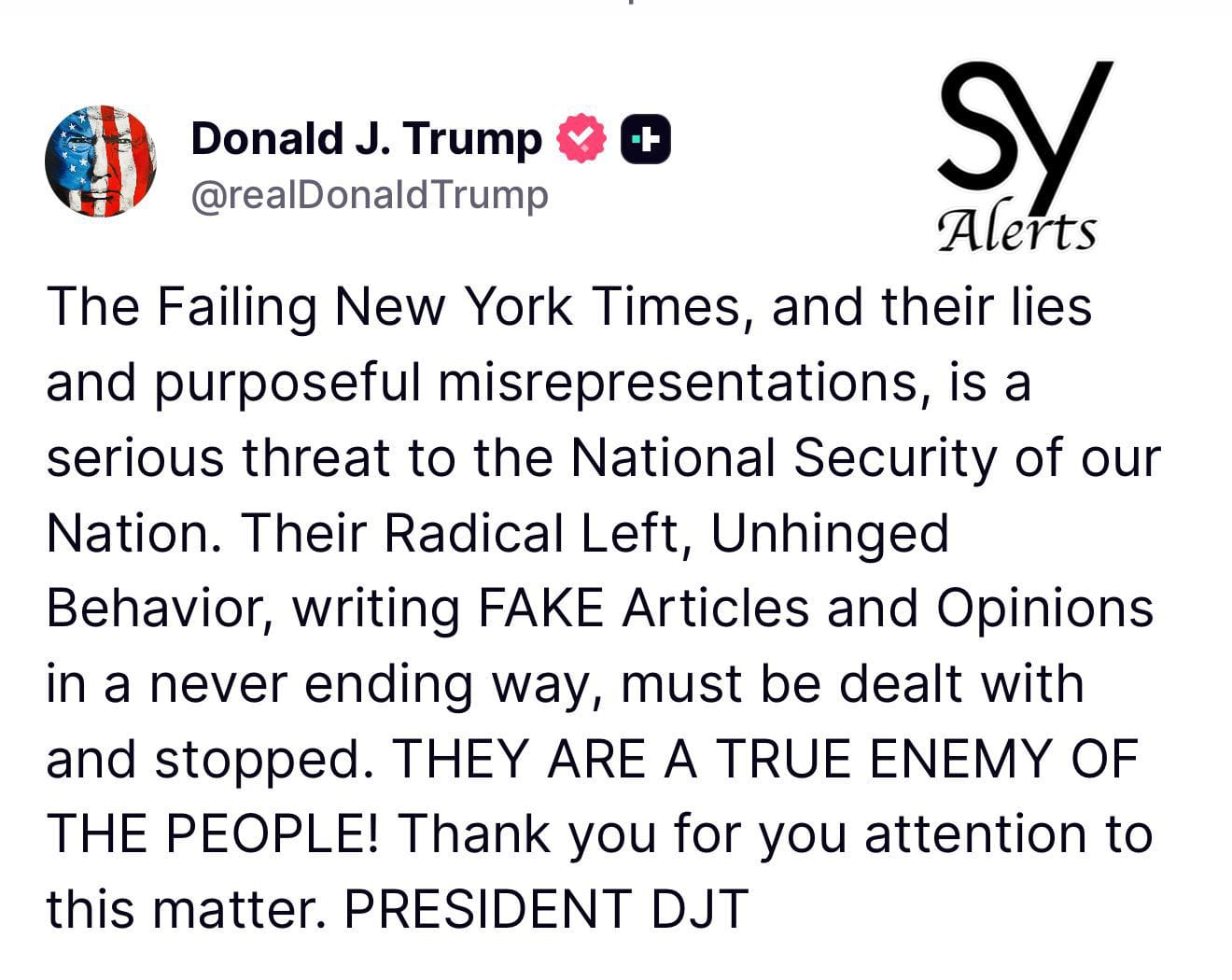
In a statement posted to Truth Social and reported by The Hill, President Trump accused the newspaper of deliberate falsehoods and strategic misrepresentation, declaring that “The Failing New York Times, and their lies and purposeful misrepresentations, is a serious threat to the National Security of our Nation.” He went on to condemn the paper’s “radical left, unhinged behavior,” asserting that its steady production of fabricated articles and opinion pieces had crossed from political bias into institutional sabotage. Once again invoking language that has become emblematic of his media critique, Trump concluded by calling the Times “a true enemy of the people.”
The president’s reaction came amid renewed scrutiny driven not by new evidence, but by the Times’ narrative framing. While the newspaper suggested that Trump had attempted to downplay his past acquaintance with Epstein, it simultaneously acknowledged—without presenting criminal allegations—that the relationship had been “improperly characterized” over time. A subheadline accompanying the article adopted provocative language, portraying elite social interactions through a moralized lens and insinuating dynamics of power and excess without alleging illegality.
Trump has consistently and unequivocally denied any wrongdoing connected to Epstein, a denial that has never been contradicted by charges, indictments, or findings from law enforcement. Notably, it was Trump himself who signed legislation only weeks earlier mandating the release of all remaining government-held materials tied to Epstein’s estate—an act that directly undercuts claims of concealment or evasion. As The Hill reported, Deputy Attorney General Todd Blanche, Trump’s former personal attorney and now a senior Justice Department official overseeing the document release, confirmed that any materials referencing the president would be included in the disclosure.
To Trump and his supporters, the episode exemplifies a familiar pattern: selective emphasis, suggestive prose, and guilt-by-association storytelling deployed in the absence of substantiating evidence. In their view, the Times’ continued fixation on Trump—particularly through insinuation rather than proof—underscores precisely why the president has long argued that the paper operates less as a neutral chronicler of events than as an ideological actor with a political agenda.
From early campaign tweets to sweeping indictments of institutional media behavior, Trump’s rhetoric toward The New York Times has evolved—but its core message has remained consistent. He has accused the paper of bias, historical amnesia, and moral inconsistency, particularly when it comes to conservatives, Israel, and the Jewish people.
For Trump’s supporters, this is not about bruised egos or thin skin. It is about accountability. They see a powerful media institution that helped shape public opinion for generations, yet rarely reflects on its own failures—whether burying Holocaust stories during World War II or advancing narratives today that undermine Israel’s right to defend itself and delegitimize half the American electorate.
The Trump–Times feud, then, is more than a personal rivalry. It is a referendum on trust, truth, and the role of legacy media in a fractured democracy. To millions of Americans, Trump did not create the divide—he exposed it. And in challenging The New York Times, he forced an uncomfortable question that still hangs over the institution: has it learned from its past, or is it repeating it in a different key?
