



|
Getting your Trinity Audio player ready...
|
AJC’s Security Failure Was Inexcusable — And It Cost Lives
Last Wednesday evening, two Israeli embassy staffers — Yaron Lischinsky and Sarah Milgrim — were gunned down in cold blood outside the Capital Jewish Museum during an event organized by the American Jewish Committee (AJC). Their blood now stains more than just the pavement — it marks a systemic and unforgivable failure of judgment, planning, and moral responsibility by the very organizations entrusted with protecting our community.
Despite the Jewish community being among the most “hardened targets” in the United States — with access to substantial federal security grants and the internal resources of some of the wealthiest advocacy organizations in the country — the AJC failed to deploy even the most basic, comprehensive security perimeter that could have prevented this tragedy.
This was not a surprise attack. It was an act of antisemitic terror, executed in plain view. And yet, no high-tech surveillance. No meaningful outer perimeter. No security detail sweeping the blocks surrounding the venue. Just three armed guards at the door and — evidently — not much else.
How is this possible?
We are told time and again that organizations like the AJC, the ADL, and local Jewish federations prioritize Jewish safety above all else. They raise tens of millions annually — not just from private donors, but from government grants — to ensure the security of Jewish gatherings. Following the 2018 massacre at Pittsburgh’s Tree of Life synagogue, Jewish institutions across the U.S. saw a surge in homeland security funding. After every attack, new grants are announced, new training protocols are touted, new press releases promise “never again.”
And yet, here we are.
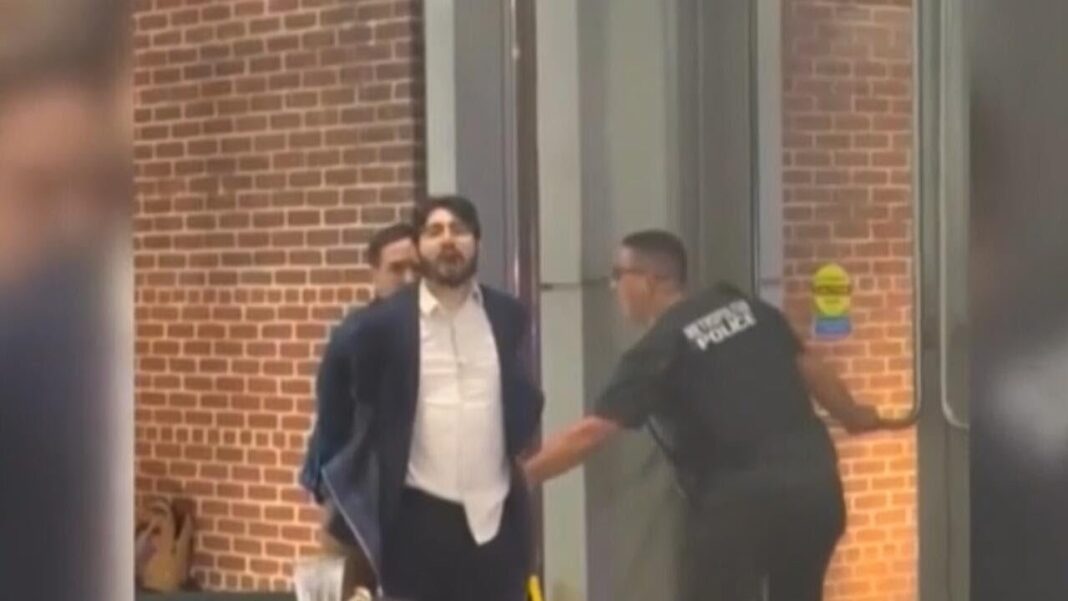
A recently published JTA report confirms that the shooter not only succeeded in murdering two people outside the venue — he then walked inside the museum and remained there for 10 full minutes before police arrived. That means the killer entered the very building in which AJC held its event, likely passing unnoticed or unchallenged by whoever was tasked with securing the premises. According to former Secure Community Network head Paul Goldenberg, the attacker’s erratic behavior “was almost literally screaming that there’s an issue here.” Yet no one stopped him. No lockdown protocol was triggered. No defensive perimeter had been established beyond the museum’s threshold.
This is not merely a breakdown of security. It is a scandal.
According to the JTA report, the museum had just received a $30,000 grant for “front desk” and “roaming” security — enough, supposedly, to keep guests “safe” and “prepared in the event of an emergency.” And still, a terrorist waltzed inside and sat there with a glass of water while the bodies of his victims lay just outside.
There is no sugarcoating it: the AJC failed to meet its most sacred obligation — to ensure the physical safety of its guests, especially when hosting representatives of the Israeli government in the heart of Washington, D.C., in an era of unprecedented anti-Semitic violence.
It is deeply troubling that neither the AJC nor the museum immediately clarified who was responsible for security that night. What’s clear, however, is that neither organization deployed the level of preparedness the situation demanded — not with today’s threats, not with today’s stakes. And for an organization like the AJC, with access to substantial private funding, there is no excuse.
Let us be absolutely clear: groups like the AJC, the Jewish Federations of North America, and the Anti-Defamation League receive tens of millions of dollars annually from both public and private sources. If they cannot use that money to secure even a 10-block radius around a Jewish event in the nation’s capital — especially when Israeli diplomats are on site — then we must ask: Where is that money going?
The tools exist. The funding exists. The risk assessments have long been done. Bulletproof glass, metal detectors, facial recognition systems, mobile command centers — all of these have been deployed at high-profile Jewish events. And yet this was treated as business-as-usual, as if the murder of Jews in America is not a very real and present threat.
Eric Fingerhut of the Jewish Federations of North America rightly noted after the attack, “The risks have continued to rise as antisemitism has risen… They obviously didn’t succeed tonight.” No, they didn’t. But vague regret is not enough. We need accountability.
If the AJC cannot handle the basic logistics of securing a single high-risk event, how can the Jewish community trust it to represent us on Capitol Hill, in corporate boardrooms, or in international coalitions?
Let us not be fooled by future pledges and security memos issued after the fact. Five major Jewish security organizations issued new “recommendations” the day after the shooting — suggestions that should have already been standard operating procedure. In 2024, after Colleyville, after Pittsburgh, after Poway, there is no excuse for reactive policy. We need proactive protection.
The time for condolences and vague assurances is over. Yaron Lischinsky and Sarah Milgrim are gone. Their murder was preventable. Their safety should have been guaranteed.
Until there is full transparency, a public reckoning, and serious reform, the AJC must not be allowed to deflect blame. The Jewish community deserves better. And the dead demand justice
