



|
Getting your Trinity Audio player ready...
|
By: Fern Sidman
In a ceremony marked by solemnity and historical resonance, ninety-one sacred religious and ceremonial artifacts looted from Greek Jewish communities during the Holocaust have been returned to Greece, closing a painful chapter that began more than eight decades ago amid the systematic devastation of European Jewry. The repatriation, facilitated by the World Jewish Restitution Organization (WJRO), represents not merely the physical transfer of objects, but the restoration of cultural memory and moral accountability long deferred.
The artifacts—among them Torah scrolls, silver ritual ornaments, and other liturgical treasures—were stolen by the notorious Nazi looting agency Einsatzstab Reichsleiter Rosenberg (ERR) during the German occupation of Greece in World War II. They are now en route to their permanent home at the Jewish Museum of Greece in Athens, where they will serve as enduring witnesses to a once-vibrant Jewish civilization nearly annihilated by genocide.
The initiative that culminated in this historic return was launched by Mark Weitzman, Chief Operating Officer of WJRO, who raised the issue during the June 2024 conference of the International Holocaust Remembrance Alliance (IHRA). Following that intervention, the Greek government formally submitted a restitution request in December 2024. What followed was an intensive collaborative effort involving WJRO, Greek and Polish authorities, the Emanuel Ringelblum Jewish Historical Institute (ŻIH) in Warsaw, and the Jewish Museum of Greece.
The formal handover took place on March 4 in Warsaw in a ceremony hosted by Marta Cienkowska, Undersecretary of State at the Polish Ministry of Culture and National Heritage. Representing the Hellenic Republic was Greece’s Minister of Culture, Lina Mendoni, who accepted the collection on behalf of the Greek government. The moment signified the culmination of meticulous provenance research and diplomatic coordination that sought to reconcile historical injustice with contemporary responsibility.
In a joint statement, Gideon Taylor, President of WJRO, and Mark Weitzman emphasized the profound symbolic weight carried by the returned artifacts. Each item, they noted, constitutes “a sacred link to a world destroyed.” They expressed gratitude to the Polish Ministry of Culture and National Heritage for taking what they described as “an important step in addressing the issue of looted cultural property in Poland,” while also acknowledging the decades-long stewardship of the artifacts by the Emanuel Ringelblum Jewish Historical Institute.
The journey of these objects traces a harrowing arc across the geography of wartime Europe. In 1941, following the German invasion and occupation of Greece, the ERR embarked on a systematic campaign to plunder Jewish communal and religious property. Synagogues were stripped of Torah scrolls and ceremonial objects, communal archives were seized, and cultural treasures were packed into crates destined for Nazi depots.
Many of these looted items were transported to repositories in Lower Silesia, then under German control. After the war, as borders shifted and territories were reassigned, the depots fell under Polish jurisdiction. The artifacts were discovered in the postwar period at the Central Museum Depository of the Polish Ministry of Culture and Arts at the castle in Bożków. In 1951, the Polish Ministry of Culture transferred the Greek Judaica to ŻIH in Warsaw, where they were preserved for decades, their origins documented but their ultimate return unrealized.
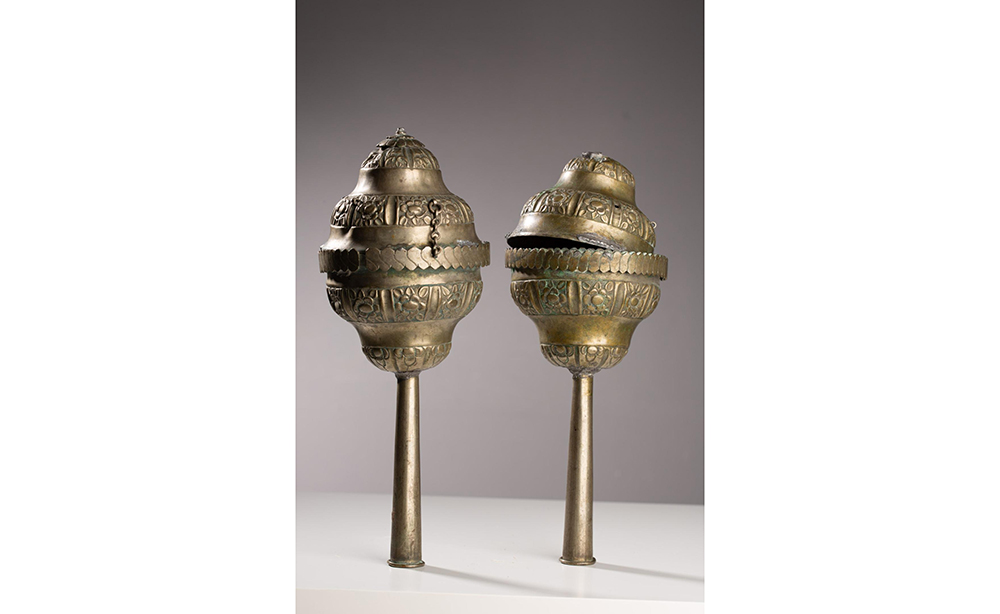
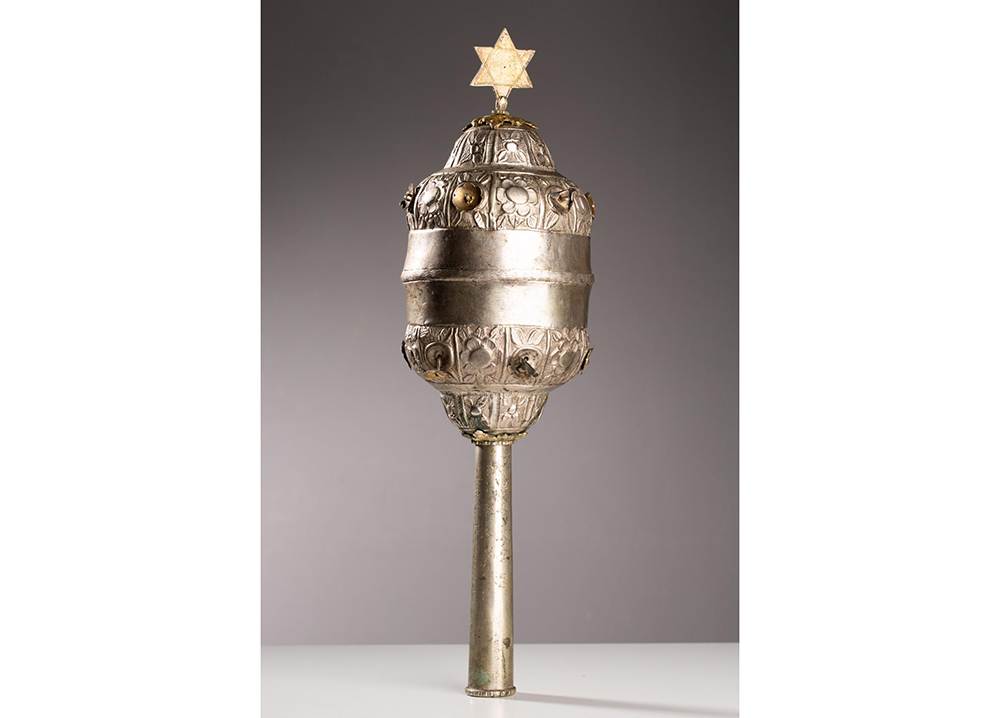
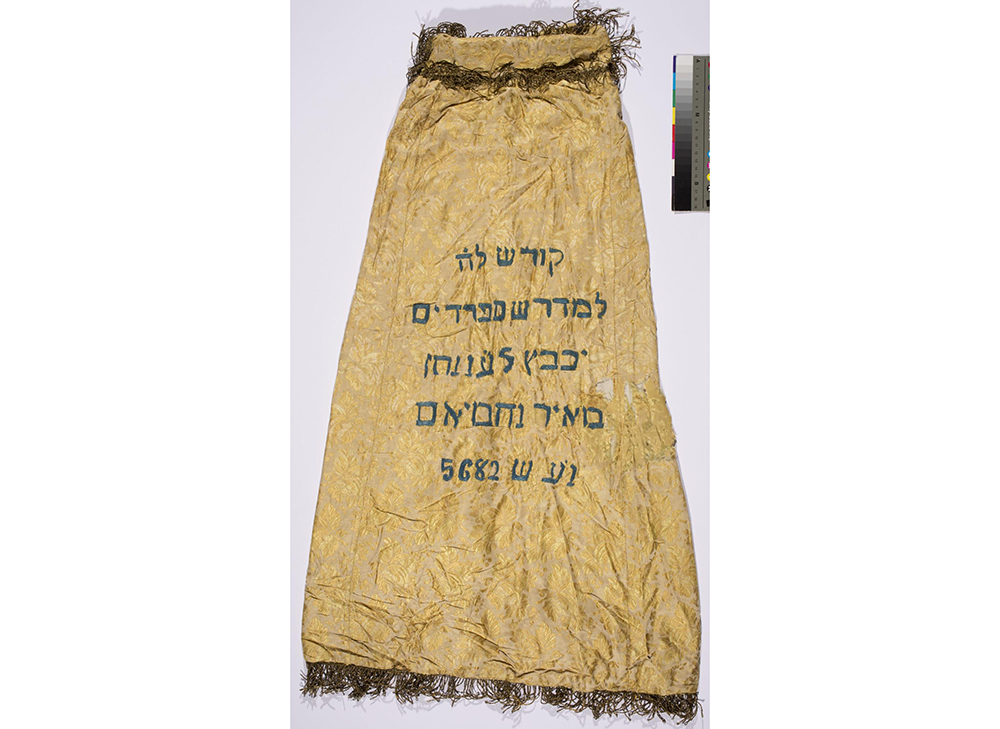
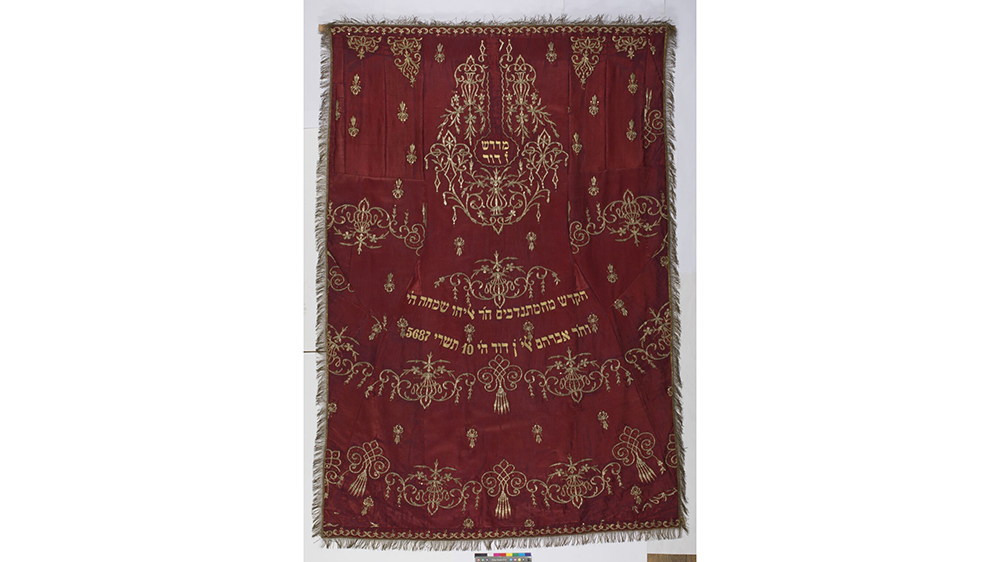
Among the artifacts now being repatriated is a Torah mantle from the centuries-old Sicilia Synagogue, a relic of a congregation that once formed part of Greece’s rich tapestry of Jewish life. Also included is a pair of Torah rimonim—ornate silver finials that crown the wooden rollers of a Torah scroll—dedicated to the Evora Synagogue in Thessaloniki. These ritual objects are rare survivors of communities that were almost entirely obliterated.
Before the Holocaust, Greece was home to approximately 72,000 Jews, with Thessaloniki—often referred to as the “Jerusalem of the Balkans”—serving as a major center of Sephardic Jewish culture. Jews constituted a substantial proportion of the city’s population, and Ladino, the Judeo-Spanish language carried from Iberia centuries earlier, echoed in its streets and synagogues. Greek Jewry’s history extended back millennia, encompassing Romaniote communities whose roots predated the expulsion from Spain.
That world was shattered with devastating efficiency. Approximately 59,000 Greek Jews—more than 83 percent of the country’s Jewish population—were murdered during World War II. Entire communities in Thessaloniki, Ioannina, Thrace, and elsewhere were deported to extermination camps, primarily Auschwitz-Birkenau. Synagogues were destroyed, cemeteries desecrated, and cultural institutions dismantled. The physical annihilation was accompanied by the systematic erasure of memory.
Today, Greece’s Jewish population numbers roughly 5,000, a small remnant of a once-flourishing civilization. For this community, the return of looted artifacts is not an abstract legal matter but a deeply personal restoration. The objects embody continuity across rupture, tangible proof that even in the wake of catastrophe, fragments of sacred life endured.
The repatriation also carries broader implications for Holocaust-era restitution. While many European nations have undertaken efforts to identify and return looted art and property, the process remains uneven and, in some cases, incomplete. The return of the Greek Judaica from Poland marks what WJRO described as a landmark moment in international cooperation. It demonstrates that even decades after the crimes were committed, restitution remains both possible and necessary.
At the same time, WJRO’s leadership acknowledged that Poland continues to face broader restitution challenges. The statement accompanying the ceremony expressed hope that this act would signal “the beginning of a consistent, systematic approach to historical justice.” Such language reflects ongoing debates about unresolved property claims and the moral obligations of successor states.
The Emanuel Ringelblum Jewish Historical Institute, named for the historian who chronicled the Warsaw Ghetto before perishing in the Holocaust, played a pivotal role in preserving the artifacts. For decades, ŻIH safeguarded the collection, ensuring that the objects were neither dispersed nor neglected. Its stewardship underscores the complex responsibilities borne by institutions that inherit cultural property displaced by war.
The Jewish Museum of Greece, which will now house the collection, stands as a custodian of a legacy both luminous and tragic. By displaying these artifacts in Athens, the museum will reconnect them to their cultural and historical context, allowing visitors—Greek and international alike—to confront the depth of loss inflicted upon Greek Jewry.
Beyond the immediate participants, the restitution reflects a growing recognition that cultural heritage is inseparable from human dignity. The Nazis’ campaign of plunder was not incidental to genocide; it was integral to it. By stripping Jewish communities of their sacred objects and communal records, the regime sought to erase not only lives but identity. The return of these artifacts repudiates that ambition.
The ceremony in Warsaw thus resonated as more than a diplomatic exchange. It symbolized a reweaving of threads severed by violence. The Torah mantle and silver rimonim, once torn from their sanctuaries, will now stand as emblems of endurance. They are fragments of a destroyed world, yet their survival challenges the finality of destruction.
For Greece, the repatriation affirms a commitment to honoring its Jewish heritage as an integral component of national history. For Poland, it constitutes an acknowledgment of custodial responsibility and the ethical imperative to address the legacies of Nazi looting. For the international community, it reinforces the principle that restitution, though complex and often delayed, remains a vital instrument of historical justice.
Eighty years after the Holocaust, the moral reckoning continues. The return of ninety-one sacred objects cannot restore the lives extinguished nor rebuild the communities obliterated. Yet it can, in its measured way, restore dignity to memory and reaffirm that even amid the darkest chapters of human history, there remains an obligation to repair what can be repaired.
As the artifacts make their journey from Warsaw to Athens, they carry with them the weight of history and the promise of remembrance. In their silver gleam and embroidered fabric resides not only ritual beauty but the testimony of a people whose legacy endures, despite the attempt to erase it.
