



|
Getting your Trinity Audio player ready...
|
By: Fern Sidman
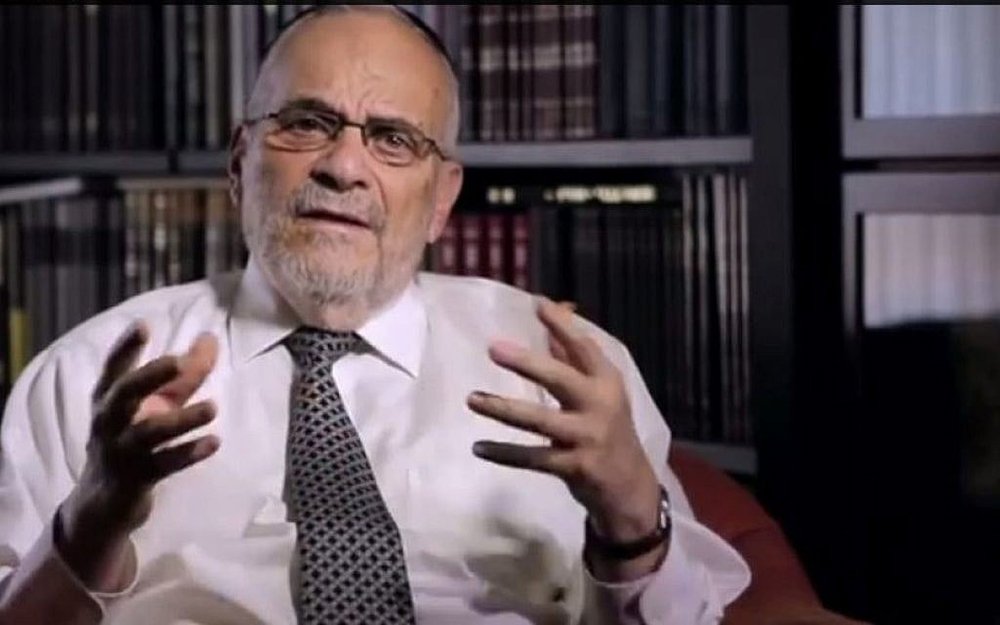
The Jewish world has been plunged into mourning over the passing of Rabbi Berel Wein, one of the most influential Torah scholars, historians, and orators of the modern era, who died on Saturday in Israel at the age of 91. His extraordinary ability to weave Jewish history with timeless Torah insights left a profound imprint on generations of Jews across the globe. According to a report that appeared at VIN News, Rabbi Wein’s life was one of remarkable achievement, shaping Jewish education, community life, and historical consciousness in ways few others have managed.
Born in Chicago in 1933, Rabbi Wein embodied a rare combination of classical rabbinic erudition and modern accessibility. He was not only a giant in the world of Torah learning—a true Talmud Chacham—but also a master communicator whose thousands of lectures and recorded talks brought Jewish history and Torah teachings to living rooms, classrooms, and synagogues worldwide.
As the VIN News report noted, Rabbi Wein’s lectures, first distributed on cassette tapes, later on C Ds, and eventually online, became a staple in Jewish households from North America to Israel. His distinctive oratorical style—erudite, passionate, and deeply human—enabled him to connect with audiences of all backgrounds. For many Jews seeking to understand their heritage, his voice became the bridge linking them to centuries of Jewish tradition.
In his early career, Rabbi Wein served as the spiritual leader of Congregation Bais Torah in Monsey, New York. His tenure there was marked by a unique blend of pastoral warmth and intellectual rigor, qualities that won him enduring respect among his congregants.
But it was his founding of Yeshiva Shaarei Torah in Monsey that cemented his role as a visionary institution builder. Under his guidance, Shaarei Torah became not merely a center of Torah study, but also a place where Jewish history, ethics, and tradition were taught with an expansive view of Klal Yisrael—the totality of the Jewish people. The yeshiva represented Rabbi Wein’s philosophy that Torah education must be both rooted in tradition and responsive to the modern Jewish experience.
Rabbi Wein’s influence extended far beyond the pulpit and the classroom. As director of the Orthodox Union’s Kashrut Division, he redefined the standards of kosher supervision in North America, overseeing a system that grew to become one of the most trusted and recognized kosher certifications worldwide. His tenure at the OU revolutionized kosher food availability, ensuring that kosher products could be accessed on a global scale.
The VIN News report observed that this achievement left a lasting legacy not only in the lives of observant Jews but also in how kosher food was integrated into mainstream consumer markets. By raising both the professionalism and reliability of kosher supervision, Rabbi Wein played a pivotal role in expanding Jewish observance and identity in the modern era.
In 1997, Rabbi Wein moved to Israel, settling in Jerusalem where he became the rabbi of Beit Knesset Hanassi, a prominent synagogue in the Rehavia neighborhood. His sermons there, much like his earlier lectures in America, attracted a wide audience of English-speaking olim and native Israelis alike.
At Beit Knesset Hanassi, Rabbi Wein continued to embody his philosophy of bridging past and present, always emphasizing the continuity of Jewish history with contemporary life in the State of Israel. His presence in Jerusalem allowed him to reach a new audience while deepening his role as a communal rabbi and historian.
Perhaps Rabbi Wein’s most enduring contribution was his monumental work as a historian. Through his multi-volume written histories, countless lectures, and recorded series, he presented Jewish history not as a dry academic discipline but as a vibrant narrative infused with faith and divine providence. His works, including the acclaimed “Echoes of Glory” and “Herald of Destiny,” became essential reading for those seeking to understand the arc of Jewish experience from biblical times to the modern State of Israel.
Rabbi Wein viewed history through the lens of Torah, offering a uniquely Jewish perspective that balanced fidelity to traditional sources with a willingness to grapple honestly with historical realities. In doing so, he shaped how generations of Jews perceive their past, seeing it as a continuum of resilience, tragedy, and redemption.
One of Rabbi Wein’s most remarkable qualities was his ability to serve as a living bridge between the pre-Holocaust rabbinic world and modern Jewry. He personally encountered towering figures of the 20th century, including Rabbi Joel Teitelbaum, the Satmar Rebbe. Despite their divergent ideological orientations—Rabbi Teitelbaum was fiercely anti-Zionist, while Rabbi Wein was a proud Zionist—Rabbi Wein later recounted his meeting with the Rebbe as transformative.
He described Rabbi Teitelbaum as one of the greatest minds and tzadikim he had ever met, demonstrating Rabbi Wein’s profound respect for greatness across ideological divides. This story encapsulated his approach to Jewish life: recognizing differences, yet elevating shared reverence for Torah and its sages.
Rabbi Wein’s oratory was legendary. With humor, gravitas, and encyclopedic knowledge, he could move audiences to both laughter and tears. His ability to illustrate timeless Torah values with stories drawn from Jewish history made his speeches accessible to a broad spectrum of listeners, from seasoned yeshiva students to lay audiences.
His lectures became cultural touchstones, with many families dedicating hours each week to listening to his recorded talks. For countless Jews, Rabbi Wein was the voice that explained not only what happened in Jewish history, but also why it mattered for their lives today.
The legacy of Rabbi Berel Wein is vast and multi-faceted. He was at once a rabbi, historian, educator, and builder of institutions. His influence was felt in the kosher food one eats, the synagogues where Jews pray, the yeshivot where they study, and the historical consciousness with which they view themselves as part of an eternal people.
Rabbi Wein’s life and work demonstrated the power of Torah not only to preserve tradition but also to inspire renewal across continents and generations. He gave Jews not just knowledge of their past, but also a vision for their future.
At the age of 91, Rabbi Berel Wein leaves behind a legacy that will continue to resonate in Jewish communities for decades to come. His passing marks the end of an era, but his voice—preserved in thousands of lectures, books, and teachings—will endure. For Jews in America, Israel, and beyond, Rabbi Wein was more than a historian of the Jewish people; he was a guide, mentor, and bridge to the eternity of Jewish tradition.
