



|
Getting your Trinity Audio player ready...
|
Iran’s Mojtaba Khamenei, Set to Succeed Supreme Leadership, Has History of UK Medical Treatments for Impotency
By: David Avrushmi
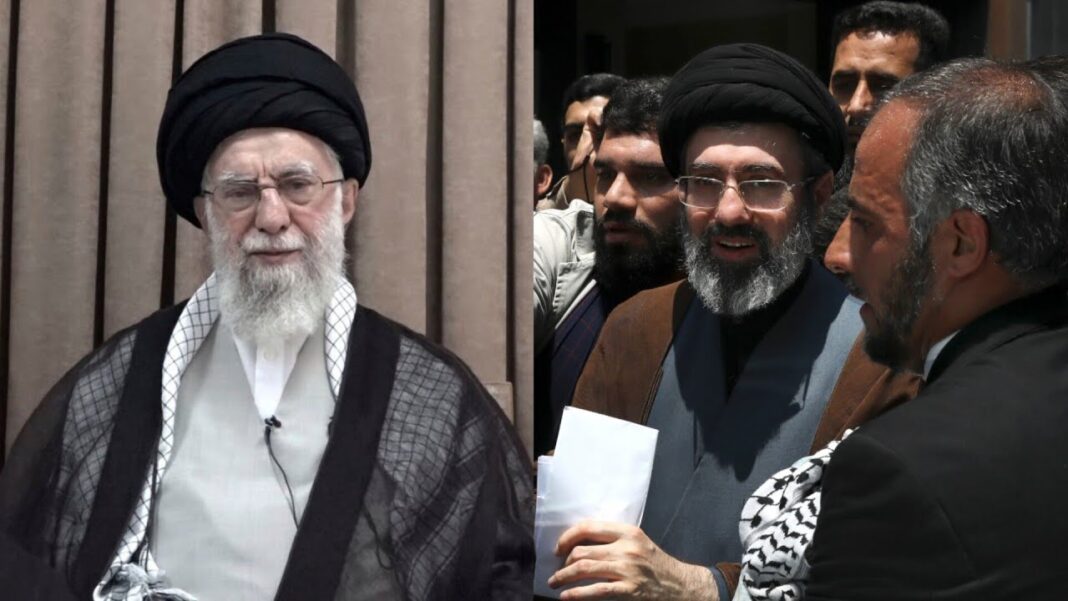
As the reverberations of the ongoing U.S.-Israel military campaign against Iran continue to reshape the region’s strategic calculus, attention is now turning inward—toward Tehran’s corridors of power and the question of succession at the apex of the Islamic Republic. According to a report on Wednesday at i24 News, Mojtaba Khamenei, the second son of Iran’s late Supreme Leader Ali Khamenei, is widely expected to assume the nation’s highest office following his father’s death, a development that could fundamentally recalibrate the regime’s posture both domestically and internationally.
The prospect of Mojtaba’s ascent has long lingered in speculative analyses of Iran’s opaque power structure. Yet the extraordinary context in which it now unfolds—a moment defined by direct military confrontation with the United States and Israel—renders the transition particularly consequential. i24 News has reported that Mojtaba’s succession is understood to be backed by the Islamic Revolutionary Guard Corps (IRGC), the regime’s most formidable and ideologically entrenched power center, though unease reportedly persists among elements of the clerical establishment.
For decades, Mojtaba Khamenei has operated largely behind the scenes, cultivating influence without the overt religious credentials traditionally associated with the office of Supreme Leader. Intelligence documents, once classified and later released publicly via WikiLeaks, shed light on both the personal and political dimensions of his trajectory. According to materials cited by i24 News, Mojtaba spent several months in the United Kingdom receiving private medical treatment for impotency, including extended stays at London’s Wellington and Cromwell hospitals. The disclosures, while intensely personal, were interpreted by analysts as indicative of the intense familial and political pressures shaping his life within Iran’s ruling elite.
Sources cited in reporting carried by i24 News suggest that these medical interventions ultimately enabled Mojtaba to father a son, named Ali in honor of his grandfather. Family expectations, rooted deeply in Iran’s dynastic and revolutionary traditions, reportedly played a decisive role in his decision to seek treatment abroad. In a regime that fuses theology with political symbolism, lineage carries profound weight. The birth of a male heir to the Khamenei line was therefore more than a private milestone; it was a reinforcement of continuity in a system that prizes dynastic stability even while outwardly rejecting monarchy.
Yet Mojtaba’s political evolution has never depended solely on personal legacy. Intelligence assessments describe him as a disciplined and calculating operator within the Supreme Leader’s office. Over the years, he became a gatekeeper of access to his father, managing the flow of information and influencing appointments. He reportedly traveled extensively with Ali Khamenei across Iran, consolidating relationships within provincial networks and reinforcing his proximity to the nucleus of power.
Crucially, Mojtaba cultivated robust ties with the IRGC, whose influence in Iran’s political and economic spheres has expanded dramatically since the early years of the Islamic Republic. The Guards control significant segments of the economy, oversee regional proxy networks, and play a central role in Iran’s missile and nuclear programs. Their endorsement of Mojtaba’s succession, as reported by i24 News, is widely viewed as decisive. In the Islamic Republic’s power architecture, the IRGC’s backing can compensate for deficiencies in clerical standing.
Those deficiencies are not trivial. Unlike his father, who achieved the rank of ayatollah and ultimately assumed the title of Supreme Leader through a complex political process following Ayatollah Ruhollah Khomeini’s death, Mojtaba lacks independent clerical authority. Intelligence documents cited by i24 News note that he is unlikely ever to attain the formal religious status of ayatollah or mujtahid. This absence of theological gravitas presents a structural vulnerability in a system theoretically anchored in religious jurisprudence.
Yet Iran’s political reality has often diverged from its doctrinal ideals. The office of Supreme Leader wields ultimate authority over the military, judiciary, and major policy decisions, including nuclear strategy and foreign relations. While religious legitimacy confers symbolic capital, operational power flows from institutional alliances and control over coercive instruments. In this regard, Mojtaba’s administrative acumen and network-building within the IRGC may outweigh his clerical limitations.
The timing of his anticipated ascent intensifies the stakes. The ongoing U.S.-Israel campaign has targeted Iranian missile capabilities and military infrastructure, placing unprecedented pressure on Tehran’s leadership. As the i24 News report observed, some clerics reportedly harbor reservations about elevating Mojtaba amid active hostilities. Placing a relatively untested figure at the helm during wartime could amplify internal dissent or embolden rivals.
Nevertheless, the regime’s calculus appears driven by considerations of continuity and cohesion. In moments of external threat, authoritarian systems often gravitate toward familiar insiders rather than risk fragmentation. Mojtaba’s long tenure within the inner sanctum of power positions him as a stabilizing figure in the eyes of the IRGC, even if segments of the clerical hierarchy remain circumspect.
The international implications of his succession are profound. As Supreme Leader, Mojtaba would inherit authority over Iran’s nuclear program and its network of regional proxies, including Hezbollah and various militias operating across Iraq and Syria. The i24 News report highlighted that the Supreme Leader’s office functions not merely as a ceremonial apex but as the strategic command center of Iran’s ideological and military posture. Decisions emanating from this office reverberate across the Middle East and shape global security dynamics.
Observers caution that Mojtaba’s lack of independent religious standing could paradoxically harden his reliance on the IRGC, thereby reinforcing the regime’s militarized orientation. If his legitimacy derives more from institutional backing than theological scholarship, his incentives may skew toward demonstrating resolve through confrontation rather than accommodation. In the context of U.S.-Israel operations, such a posture could intensify rather than temper escalation.
At the same time, Mojtaba’s reputation as a shrewd administrator suggests a capacity for pragmatic calculation. Intelligence analyses cited by i24 News portray him as methodical and discreet, favoring incremental consolidation of power over flamboyant displays. Whether this temperament translates into strategic restraint or calculated defiance remains to be seen.
Within Iran, public reaction to dynastic succession may prove complex. The Islamic Republic was founded in opposition to monarchical rule, yet the prospect of power passing from father to son evokes unmistakable parallels to hereditary systems. Critics within Iran’s reformist circles have long warned against the concentration of authority within a single familial lineage. However, the regime’s control over media and security institutions limits the visibility of dissent.
Externally, the anticipated transition will be scrutinized for signals regarding Iran’s future trajectory. Will Mojtaba seek to entrench the confrontational policies associated with his father’s later years, or will he recalibrate in response to mounting economic and military pressure? i24 News underscored that the coming months may prove decisive in answering this question.
For now, the Islamic Republic stands at an inflection point. The death of Ali Khamenei closes a chapter defined by ideological rigidity and regional assertiveness. The likely rise of Mojtaba Khamenei opens another, one shaped by war, generational transition, and the enduring tension between religious legitimacy and political power.
As the i24 News report observed, one reality is clear: the consolidation of authority in Mojtaba’s hands will reverberate far beyond Iran’s borders. In a region already convulsed by conflict, the character and calculations of the new Supreme Leader may determine whether confrontation deepens or diplomacy reemerges as a viable path.
