



|
Getting your Trinity Audio player ready...
|
By: Fern Sidman – Jewish Voice News
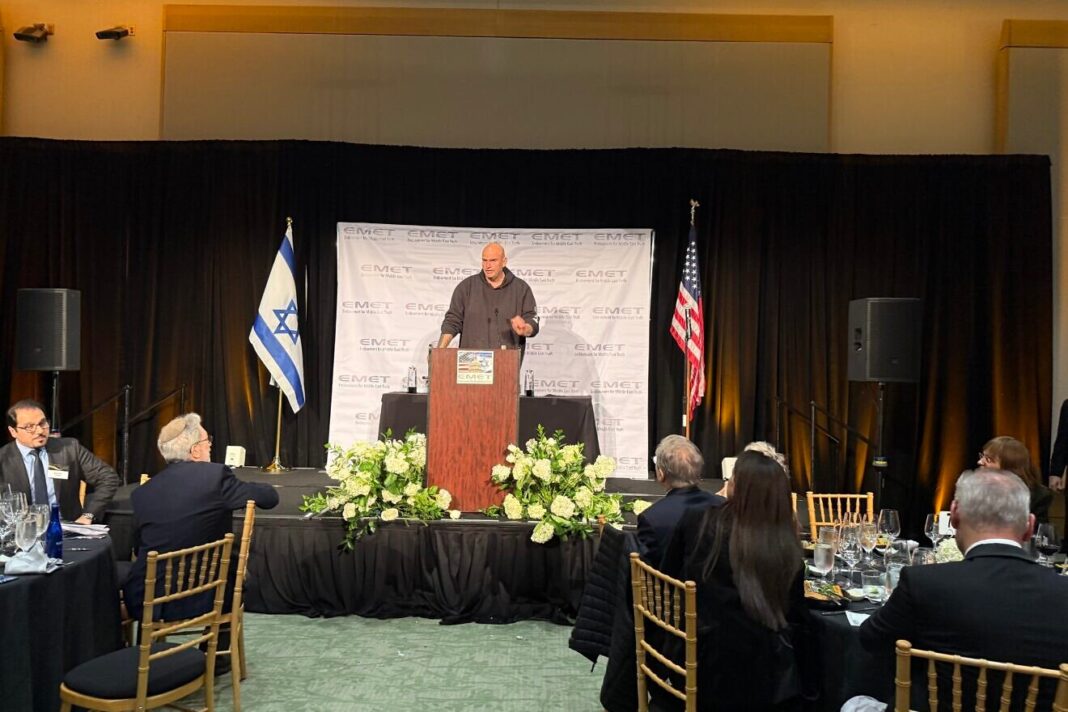
At a time when the Jewish community in the United States and abroad faces intensifying threats, a prominent gathering in Washington paid tribute to political leaders and advocates who have emerged as unwavering allies of Israel and defenders of Jewish security. As reported on Thursday by The Jewish News Syndicate (JNS), the Endowment for Middle East Truth (EMET) hosted its annual “Rays of Light in the Darkness” gala on Wednesday, honoring those whose public voices and policy commitments have positioned them at the forefront of the fight against antisemitism.
Among the honorees were Sen. John Fetterman (D-Pa.) and Leo Terrell, chair of the U.S. Justice Department task force to combat Jew-hatred. Their speeches, both urgent and unambiguous, underscored a shared conviction: that the battle against antisemitism—whether in the Middle East, Europe or the United States—is not episodic but existential, demanding vigilance, moral clarity and unrelenting resolve.
According to the information provided in the JNS report, Sen. Fetterman used his remarks to reaffirm his position as one of Congress’s staunchest supporters of Israel. His tone was as forceful as it was personal, reflecting a political trajectory that has increasingly aligned him with the Jewish community since the Hamas-led atrocities of October 7, 2023.
“What Hamas has started was a full-on war against civilization and trying to destroy Israel,” Fetterman told the audience, emphasizing that the group’s actions had set into motion not only a regional conflict but a global confrontation with barbarism. “It’s my supreme honor to be the very, very committed voice and vote whatever Israel needs to destroy their enemies and to create enduring peace in the entire region,” he continued.
The Pennsylvania senator added that Israel’s shrinking circle of political allies only deepens his sense of obligation. “The more people back away from Israel,” he said, “the more I lean in stronger.”
His remarks were met with standing applause, reflecting a sentiment shared by many in the room: that consistent support for Israel in moments of geopolitical turbulence is a measure not only of foreign policy judgment but of moral principle.
Another widely praised figure of the evening, according to the JNS report, was Leo Terrell, who chairs the Justice Department’s task force dedicated to combating Jew-hatred. Terrell’s speech delivered clarity and urgency, describing antisemitism as both a domestic crisis and a threat to the foundations of Western civilization.
At one of the most emotional points of the evening, Terrell invited Daniel and Ruth Lischinsky to join him on stage. Their son, Yaron Lischinsky, a staff member at the Israeli embassy in Washington, was gunned down alongside his fiancée-to-be, Sarah Milgrim, in May outside the Capital Jewish Museum. Witnesses reported that the assailant shouted “free Palestine” during the deadly attack—an incident that reverberated through Jewish communities nationwide.
“In Israel, we have a problem. Here in the states, you have a problem, and it’s called hatred of the Jewish people,” Daniel Lischinsky said, according to the JNS report. “The same antisemitism that provoked Oct. 7, that performed Oct. 7, the same antisemitism that killed Sarah Milgrim and Yaron Lischinsky,” he added. “We are all of us in the same boat. We are, all of us, in danger.”
Terrell echoed the family’s anguish and used their testimony as a warning to the broader American public. He criticized unnamed members of the Trump administration who he believes have succumbed to what he called “Jewish fatigue,” meaning an erosion of commitment to confronting antisemitism with full force.
“‘Oh, we’ve done enough. Oh, we’ve settled a few cases.’ We have never done enough as long as Jewish-Americans are not afforded the same rights,” Terrell declared, as reported by JNS. He underscored that antisemitism is not a niche issue or one isolated to Jewish communities: “This is an American issue, a Western civilization issue. You cannot get tired. I will never get tired.”
The gala also paid tribute to a distinguished roster of diplomats and activists whose work has strengthened Israel’s position abroad and advanced Jewish safety worldwide. JNS reported that honorees included Yechiel Leiter, Israel’s ambassador to the United States; Szabolcs Takács, Hungary’s ambassador to the United States; and Anila Ali, a Pakistani-American Muslim civil rights advocate known for her outspoken defense of Jewish communities and her denunciation of extremist ideologies.
Ambassador Leiter’s presence highlighted the strong security, intelligence and diplomatic coordination between Israel and the United States. His recognition at the gala underscored Washington’s ongoing role as Israel’s most important strategic partner amid escalating tensions in the Middle East.
Ambassador Takács’ selection reflected Hungary’s unique diplomatic stance within Europe. Unlike other EU member states that have adopted increasingly critical positions toward Israel, Hungary has persistently defended the Jewish state in international forums. As the JNS report noted, this has positioned the country as a crucial voice of support at times when Israel faces mounting international diplomatic pressure.
Anila Ali rounded out the slate of honorees as a symbol of the multi-faith coalitions being forged to combat antisemitism. Her work, celebrated by JNS and other outlets, has emphasized the shared struggles faced by Muslims and Jews in the face of rising extremism and her insistence that genuine interreligious solidarity cannot coexist with the demonization of Israel.
Throughout the evening, speakers and attendees returned again and again to the events of October 7, the subsequent war against Hamas, and the disturbing surge in antisemitic rhetoric and violence across American cities and college campuses. As the JNS report noted, Jewish institutions have reported heightened threats, vandalism, and targeted harassment—creating a climate of fear unknown in the United States for generations.
Against this backdrop, the honorees’ words carried a deeper weight. Fetterman’s pledge to continue “leaning in stronger,” Terrell’s insistence that “you cannot get tired,” and the Lischinsky family’s painful reminder of what is at stake together formed a unified message: that antisemitism, wherever it appears, must be confronted swiftly, courageously and without equivocation.
The EMET gala thus served not only as a ceremonial recognition of individual contributions, but as a broader call to action—an implicit declaration that the crisis will not be met with silence or surrender. The night illustrated that combating anti-Jewish hatred is a task that belongs not only to governments or institutions but to the conscience of the nation itself.