



|
Getting your Trinity Audio player ready...
|
By: Fern Sidman
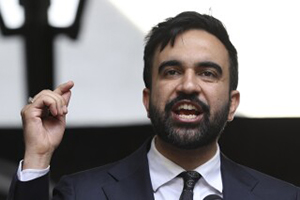
The meteoric rise of Zohran Mamdani, the Democratic socialist and state assemblyman now running for mayor of New York City, has sparked deep concern within Jewish and pro-Israel circles across the five boroughs. In a sharply worded statement to VIN News on Thursday, Herbert Block, executive director of the American Zionist Movement (AZM), warned that Mamdani’s candidacy represents more than a political shift—it threatens to erode a generations-long bond between New York City and the State of Israel.
“It’s troubling for people,” Block told VIN News, “because mayors have always stood up for Israel. There was an obvious relationship between the city of New York and Israel.” His remarks underscore the profound unease among Jewish leaders and community advocates as the city faces what many describe as an ideological crossroads.
Block, who has long served as a leading voice for Zionist advocacy in the United States, said Mamdani’s outspoken anti-Zionist positions and affiliations with the Democratic Socialists of America (DSA) could embolden those who seek to delegitimize the Jewish state. “Unfortunately,” he cautioned, “it might give people that are haters of Israel or anti-Zionist a feeling they can be more forthcoming.”
As VIN News has repeatedly reported, Mamdani’s campaign has drawn national attention—and controversy—for his calls to end U.S. military aid to Israel, his support for the Boycott, Divestment, and Sanctions (BDS) movement, and his public comparisons between the NYPD and the Israel Defense Forces (IDF). Critics argue that his positions not only alienate Jewish New Yorkers but could fundamentally shift the city’s moral and diplomatic stance toward America’s closest Middle Eastern ally.
For decades, New York City’s mayors—Democrats and Republicans alike—have served as symbolic allies of Israel, defending the Jewish state in times of crisis and fostering international ties that extend beyond diplomacy into cultural and economic realms. From Ed Koch’s fiery defense of Zionism to Michael Bloomberg’s steadfast opposition to anti-Israel boycotts, the city’s leadership has long reflected the values of a metropolis that is home to the largest Jewish population outside Israel.
“Historically, every mayor—from Lindsay to Giuliani, from Bloomberg to Adams—understood that standing with Israel was part of standing with New York,” Block told VIN News. “It wasn’t partisan. It was moral.”
Under Mamdani’s vision, that legacy could be dramatically reversed. The Queens assemblyman has been one of the most prominent advocates in New York politics for the Boycott, Divestment, and Sanctions (BDS) movement, which seeks to isolate Israel economically and culturally. His public statements have described Zionism as a “settler-colonial project” and framed Israel’s existence as a form of oppression—language that Jewish leaders say mirrors the rhetoric of extremist groups.
As VIN News noted in previous reports, Mamdani’s political platform explicitly calls for redirecting U.S. aid away from Israel, labeling American support for the IDF as “complicity in apartheid.” Such statements, according to community leaders, cross a red line that separates legitimate criticism of policy from outright delegitimization of Israel’s right to exist.
Block’s comments to VIN News come amid a wider sense of anxiety within New York’s Jewish community, particularly following the surge in antisemitic incidents across the city since the start of the Israel–Hamas conflict in 2023. Many fear that Mamdani’s election could normalize hostility toward Israel in public discourse and embolden radical voices that have already gained traction on college campuses and in progressive circles.
“The message this would send,” Block warned, “is that anti-Zionism is not just tolerated, but politically rewarded. That’s a very dangerous precedent in a city like New York.”
According to the information provided in the VIN News report, Jewish civic organizations have begun informal discussions about forming coalitions to counter what they describe as the “mainstreaming of anti-Israel ideology” in city politics. Several groups, including the Conference of Presidents of Major American Jewish Organizations and UJA-Federation of New York, have reportedly intensified outreach efforts to local officials to reinforce bipartisan support for Israel and condemn the rhetoric of isolation and boycott.
Mamdani’s rise from a neighborhood organizer in Astoria to a mayoral frontrunner represents a stunning political evolution for a figure once dismissed as fringe. Yet as the VIN News report highlighted, his ascent has been marked by deep controversy. His past statements accusing Israel of “ethnic cleansing” and “apartheid” have drawn rebuke from lawmakers across the political spectrum, including moderate Democrats and Republicans alike.
During his tenure in the State Assembly, Mamdani co-sponsored resolutions condemning “U.S. imperialism in the Middle East” and repeatedly voted against measures expressing solidarity with Israel. His alignment with the Democratic Socialists of America, an organization that has formally endorsed BDS, has also placed him at odds with many within his own party.
The DSA’s New York City branch, as VIN News reported, has faced sharp backlash for hosting rallies where protesters carried signs reading “From the river to the sea,” a slogan widely regarded as a call for Israel’s elimination. While Mamdani has denied antisemitic intent, Jewish leaders say his silence in the face of such extremism speaks volumes.
“Silence is complicity,” Block told VIN News. “When someone in public office refuses to condemn blatant hate speech against Jews or against Israel, it sends a chilling message to every synagogue, every student, and every Jewish family in this city.”
The broader implications of Mamdani’s potential victory extend beyond municipal politics. As the VIN News report observed, the race has become a referendum on the ideological direction of the Democratic Party in America’s largest city. A win for Mamdani, analysts say, could signal the triumph of the far-left wing that seeks to redefine progressivism through an anti-Israel lens, marginalizing traditional liberal Zionists in the process.
That prospect has alarmed figures such as Block, who sees the election as a watershed moment for the city’s Jewish identity. “New York has always been a bastion of Jewish life and Zionist engagement,” he said. “If a candidate who openly opposes Israel’s existence becomes mayor, it risks severing a cultural and historical connection that goes back nearly a century.”
Indeed, the relationship between New York and Israel is not merely symbolic. As the VIN News report pointed out, the city and the Jewish state share enduring ties in trade, technology, and tourism. Dozens of Israeli startups operate in Manhattan, while New York hosts annual events such as the Celebrate Israel Parade, one of the largest expressions of Jewish pride outside Jerusalem.
“All of that could be jeopardized,” Block warned, “if City Hall becomes a platform for delegitimizing the Jewish homeland.”
Despite the controversy, Mamdani has retained a passionate base of supporters who see him as a champion of social justice and anti-imperialist values. His campaign rhetoric—focused on housing, healthcare, and policing—has resonated with many younger progressives disillusioned by traditional party politics. But for Jewish leaders, these domestic priorities cannot be divorced from his international stances.
“Supporting affordable housing is admirable,” Block told VIN News, “but if you can’t stand up against antisemitism or acknowledge Israel’s right to exist, your vision of justice is incomplete.”
The challenge for the city’s Jewish and pro-Israel voters, he said, lies in reminding their fellow New Yorkers that solidarity with Israel is not a niche issue, but a moral one. “This isn’t about left or right,” he emphasized. “It’s about whether New York continues to stand with democracy, tolerance, and the Jewish people—or whether it turns its back.”
As the mayoral race intensifies, the debate surrounding Zohran Mamdani’s candidacy is rapidly evolving into a defining test of New York’s civic identity and moral compass. For the Jewish community, the question is no longer merely political—it is existential.
Will the city that once welcomed David Ben-Gurion, that raised millions for Israel during its wars, and that proudly waves the blue-and-white flag down Fifth Avenue every spring, continue to uphold its historic friendship with the Jewish state?
Or will it, for the first time in its modern history, elect a mayor whose rhetoric aligns not with solidarity, but with boycott and division?
For leaders like Herbert Block, the answer must be clear. “New York,” he told VIN News, “has always stood shoulder to shoulder with Israel. To abandon that now would not only betray our allies abroad—but betray the very spirit of this city.”

David Ben Hooren and his TJV newspaper should NOW be printing OUTRAGED EDITORIALS against every “Jewish” organization and “rabbi” who refuses to PUBLICLY excoriate Mamdani and any “Jew” who does not aggressively publicly oppose him! You should have no concern whatsoever about alienating any of these evil ENEMIES of the Jewish people. If any of your readers don’t like it, tell them to GO TO HELL! You should be publicly identifying these antisemites! THIS is your crucial moment for personally standing up for the Jewish people Mr. Ben Hooren!