



|
Getting your Trinity Audio player ready...
|
By: David Avrushmi
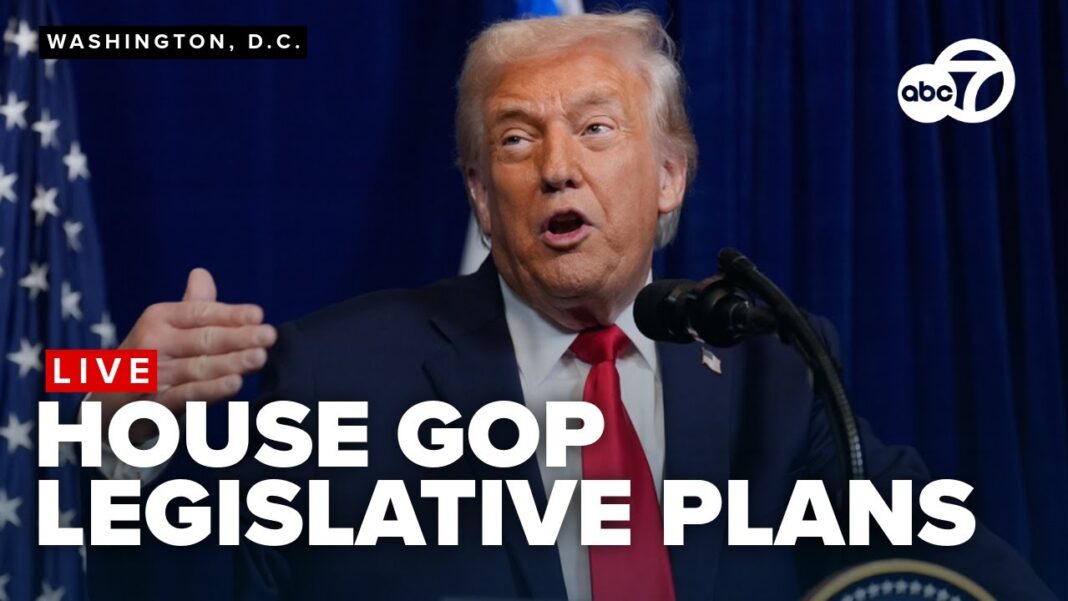
In a blunt and characteristically unsparing address to House Republicans this week, President Donald Trump delivered a message that was at once a rallying cry and a warning shot. If Republicans fail to secure victory in the 2026 midterm elections, he said, Democrats will seize the opportunity to impeach him—again. The remark, delivered during a closed-door retreat for GOP lawmakers in Washington, underscored how deeply the next election cycle is entwined with the fate of Trump’s presidency and the survival of his legislative agenda.
According to a report on Tuesday at Reuters, Trump did not cloak his warning in abstraction or political euphemism. “You gotta win the midterms,” he told lawmakers. “’Cause, if we don’t win the midterms, it’s just gonna be—I mean, they’ll find a reason to impeach me. I’ll get impeached.” The statement, stark and unapologetic, set the tone for a speech that oscillated between confidence and concern, triumphalism and grievance.
As Reuters reported, Trump framed the 2026 midterms not merely as a routine contest for congressional seats but as a referendum on his presidency itself. All 435 seats in the House of Representatives and one-third of the Senate will be on the ballot in November 2026, making the elections a pivotal test of Republican cohesion and voter enthusiasm.
Trump’s argument was simple but sweeping: without Republican control of at least one chamber of Congress, his administration would face relentless investigations, legislative paralysis, and—most ominously—another impeachment drive from a Democratic-controlled House. Given Trump’s history, the threat carried weight. He remains the only president in U.S. history to have been impeached twice.
The Reuters report noted that Trump repeatedly invoked those earlier impeachments, which occurred during his first term from 2017 to 2021. In both cases, the Democratic-led House accused him of abuses of power—first over his dealings with Ukraine, and later in connection with the events leading up to the January 6, 2021, attack on the U.S. Capitol. In both cases, the Republican-controlled Senate voted to acquit him.
For Trump, those episodes are not closed chapters but living proof, he argues, of what awaits if Democrats regain congressional dominance.
Beyond the impeachment warning, Trump used the retreat to exhort Republicans to close ranks and present a unified front across a wide range of policy issues. Reuters reported that the president urged lawmakers to fight “in a more unified fashion” on matters including gender politics, healthcare reform, election integrity, and economic policy.
At the heart of his appeal was an insistence that Republicans must do a better job of selling his agenda to a public increasingly anxious about the cost of living. Inflation, housing affordability, healthcare expenses, and energy prices all loom large in voter sentiment, and Trump warned that internal party divisions could squander an opportunity to capitalize on widespread frustration.
“Sell it,” Trump implored, according to the Reuters report, arguing that Republican lawmakers must actively communicate the benefits of his policies rather than assume voters will intuitively grasp them.
Despite projecting confidence about an “epic win” in 2026, Trump also acknowledged the formidable headwinds facing the party in power. As the Reuters report detailed, he openly mused about the long-standing political pattern in which the president’s party tends to lose ground in midterm elections.
“They say that when you win the presidency, you lose the midterm,” Trump said during the speech, delivered at the Kennedy Center, the Washington performing arts complex that has recently been renamed to include a reference to Trump. “I wish you could explain to me what the hell’s going on with the mind of the public.”
The remark captured a familiar tension in Trump’s political worldview: a simultaneous belief in his own electoral magnetism and a deep suspicion of the electorate’s consistency. It also reflected an awareness that structural forces—historical trends, voter fatigue, and shifting coalitions—may be as consequential as charisma or messaging.
The Reuters report observed that Trump’s acknowledgment of these risks was notable, given his frequent tendency to dismiss unfavorable outcomes as anomalies or conspiracies.
Trump’s relationship with the current House of Representatives has thus far been marked by remarkable deference from Republican lawmakers. According to the information provided in the Reuters report, House Republicans have largely ceded authority over spending and other core congressional prerogatives to the Trump administration, allowing the White House to exert outsized influence over legislative priorities.
Yet that dynamic may not be entirely stable. Reuters reported that signs of independence have begun to emerge, including a potential House vote this week to override a veto Trump issued last month canceling water infrastructure projects in Colorado and Utah. While it remains unclear whether the override effort will secure the two-thirds majority required, the very fact that such a vote is being contemplated suggests a subtle recalibration of power.
For Trump, such moments of dissent underscore the stakes of the midterms. A narrower Republican majority—or worse, a Democratic takeover—would not only embolden opposition lawmakers but also encourage wavering Republicans to assert themselves more forcefully.
Central to Trump’s warning was his assertion that impeachment has become a routine political weapon rather than an extraordinary constitutional remedy. Trump portrayed potential future impeachment efforts not as responses to misconduct but as pretextual exercises driven by partisan animus.
“They’ll find a reason,” he said, implying that the mere existence of Democratic control would be sufficient to trigger proceedings. This framing reflects a broader Republican critique of impeachment as an increasingly normalized tool of political warfare—a view that has gained traction among conservative voters following Trump’s two impeachments.
Democrats, for their part, have historically argued that impeachment is a solemn constitutional duty, not a partisan gambit. But Trump’s rhetoric suggests he sees little daylight between the two.
As the Reuters report emphasized, the implications of the 2026 midterms extend far beyond Trump’s personal fortunes. His legislative agenda—encompassing tax policy, deregulation, immigration enforcement, and healthcare—depends heavily on congressional alignment. A hostile House or Senate could stall nominations, block funding, and launch investigations that consume the administration’s bandwidth.
Moreover, Trump’s warning signals a presidency increasingly defined by defensive calculation. Rather than treating the midterms as a secondary contest, he has elevated them to existential importance, tying their outcome directly to his ability to govern without constant legal and political siege.
Trump’s strategy—mobilizing supporters by framing elections as battles for survival—is hardly new. Yet, the explicit linkage of midterm losses to impeachment adds a sharper edge to the message. It transforms voter turnout from a matter of policy preference into a perceived necessity for preserving the presidency itself.
Whether this approach will galvanize Republican voters or fatigue them remains an open question. Political analysts cited by Reuters have noted that fear-based appeals can be powerful motivators, but they can also deepen polarization and harden opposition.
With more than a year until voters head to the polls, Trump’s remarks mark an early attempt to define the narrative of the 2026 midterms. By casting the elections as a shield against impeachment, he has raised the stakes for Republican lawmakers and voters alike.
As the Reuters report indicated, the coming months will reveal whether Trump’s warning becomes a self-fulfilling prophecy or a rallying cry that defies historical precedent. What is clear is that, for Trump, the next midterm election is not merely about congressional arithmetic. It is about power, legitimacy, and the continued viability of his presidency in a deeply divided America
