



|
Getting your Trinity Audio player ready...
|
By: Fern Sidman
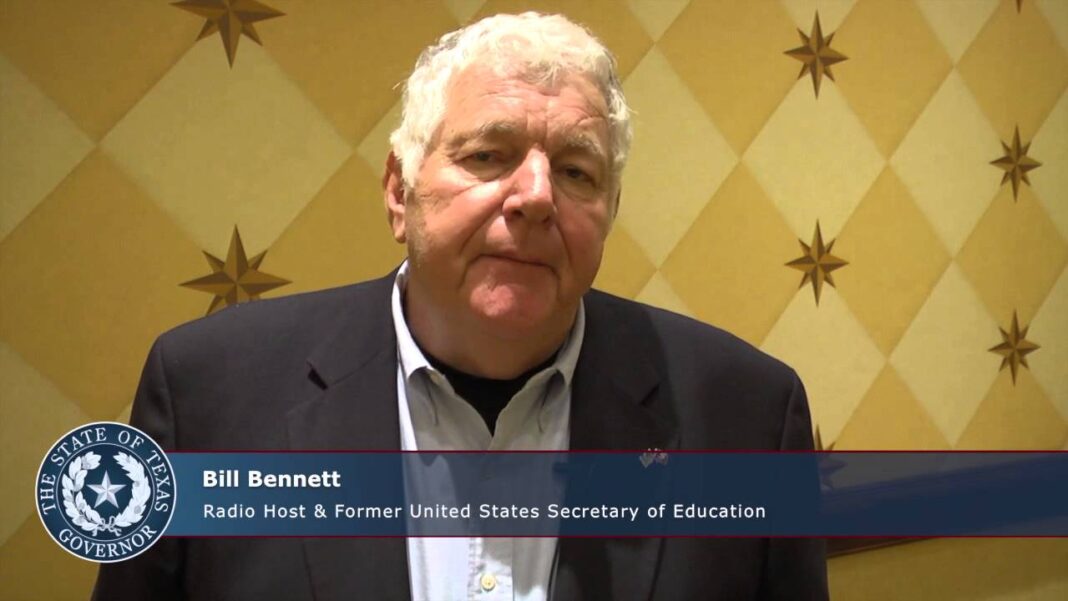
Former U.S. Education Secretary William J. Bennett, a longtime conservative intellectual who served under Presidents Ronald Reagan and George H.W. Bush, is now receiving $30,000 per month from the Qatari government to serve as a senior education adviser, according to a federal filing submitted earlier this month. The development, reported by the Jewish News Syndicate (JNS) on Thursday, has sparked intense concern among scholars and policy analysts, particularly given Qatar’s well-documented links to extremist networks and its expansive financial footprint in American higher education.
According to Bennett’s July 3 filing under the Foreign Agents Registration Act (FARA) of 1938, he began working with the Qatar Embassy in Washington at the end of June for a seven-month term. The documents state that Bennett’s responsibilities will include public advocacy aimed at countering the perception that Qatar’s education initiatives support radical Islamist ideologies, including those aligned with the Muslim Brotherhood. The filing notes that Bennett will conduct outreach to U.S. political officeholders and participate in public communications designed to “dispel contrary notions.”
The Jewish News Syndicate sought comment from Bennett directly, though he has not publicly addressed the matter as of this writing. Bennett, a prominent figure in education reform and conservative commentary for decades, had built a reputation as a vocal critic of political extremism and a staunch advocate for civic virtue and moral education — a reputation now at the center of debate following his Qatari engagement.
Qatar has long been known to exert significant influence in U.S. academic institutions, especially through philanthropic donations and partnerships with elite universities. According to data cited by JNS, Charles Small, president of the Institute for the Study of Global Antisemitism and Policy (ISGAP), warned that Bennett’s new role fits into a broader strategy by Qatar to embed its interests within American educational and political ecosystems.
“Qatar is obviously buying influence in higher education and cultural institutions and now on both sides of the aisle in Washington,” Small told JNS. “It’s a national security threat, because the Qataris follow the ideology of the Muslim Brotherhood, which is committed to the fragmenting of American society using antisemitism.”
Small, who has extensively studied foreign interference in academic environments, characterized the Bennett development as “unfortunate,” noting the former secretary’s “stellar reputation” in education policy. But he warned that Qatar’s affiliations — including support for Hamas, continued engagement with the Taliban, and strong ties to the Iranian Revolutionary Guard Corps — raise profound concerns when considering its influence over American institutions.
As reported by JNS, ISGAP has documented tens of billions of dollars in Qatari investment across U.S. higher education, including $10 billion to Cornell University and $1.3 billion to Texas A&M University. These arrangements have not merely been financial but often involve complex contracts granting intellectual property rights to Qatari stakeholders.
According to Small, the Texas A&M arrangement alone gave Qatar IP rights over 502 research projects, including 58 with dual-use military implications and 13 involving dual-use nuclear research. Such implications have alarmed national security experts, as they suggest that Qatar may gain access to sensitive technologies and scientific breakthroughs developed in the United States.
“This goes far beyond the typical university donor relationship,” Small emphasized in his remarks to JNS. “We are talking about potential exposure of military and nuclear-related intellectual property to a regime that maintains ties with America’s adversaries.”
The Foreign Agents Registration Act requires individuals engaged in lobbying or public relations on behalf of foreign governments to disclose the nature and scope of their work. In Bennett’s filing, he acknowledges that he will be engaged in public and political messaging to present Qatar’s education initiatives in a positive light and to challenge public narratives that associate Qatari educational outreach with radical Islamism.
The disclosure also notes Bennett’s potential involvement in shaping public discourse in U.S. policy circles — a prospect that analysts say could be damaging, given the country he is representing. As JNS reported, this raises new ethical and strategic questions about how former senior officials may lend their reputations and networks to foreign governments that do not align with U.S. national interests.
“This is a dangerous game,” Small said, according to JNS. “When a country with Qatar’s affiliations and ideological agenda can pay high-profile Americans to essentially launder its image, it creates an atmosphere where genuine threats to democratic society are papered over.”
A key element of criticism surrounding Bennett’s Qatari ties stems from the Gulf nation’s ideological alignment with the Muslim Brotherhood, a transnational Islamist organization with a long history of antisemitic rhetoric and political subversion. According to the information provided in the JNS report, ISGAP and other think tanks have repeatedly identified Qatar as the single largest state sponsor of Brotherhood-affiliated institutions, both within the Arab world and across Western democracies.
Qatar’s continued hosting of Hamas leadership in Doha, its support for radical clerics, and its state-owned media network Al Jazeera’s editorial line, all contribute to concerns that the country’s investments in Western institutions are part of a broader ideological campaign.
While Qatar publicly denies support for terrorism, analysts argue that its funding patterns and diplomatic relationships suggest a more complicated reality — one that should not be obscured by public relations campaigns, regardless of who leads them.
The Bennett filing has prompted renewed calls for tighter oversight of foreign funding in U.S. academia and more rigorous ethical standards for former government officials. The optics of a former education secretary — once charged with protecting the integrity of American education — now being paid to defend the interests of a controversial foreign power is certain to provoke continued scrutiny.
As the JNS report pointed out, Bennett’s case is just the latest example of a growing pattern: former high-level officials entering into lucrative consulting or advocacy arrangements with regimes that critics say are pursuing long-term influence operations in American civic life.
Whether these relationships are viewed as legitimate global engagement or ethically compromised lobbying remains a matter of debate. But the facts disclosed in the FARA filing are clear: Bennett will be paid $30,000 per month to help shape how U.S. policymakers and the broader public perceive a government widely accused of supporting groups and ideologies hostile to Western values.

Kick him out. Send him to Qatar. He can live nicely on his Social Security there and learn Shariah, while he is at it. Congress must act.