



|
Getting your Trinity Audio player ready...
|
Tucker Carlson’s Reckless Conspiracies Target Chabad as Jewish Leaders Warn of Dangerous Consequences
By: Fern Sidman
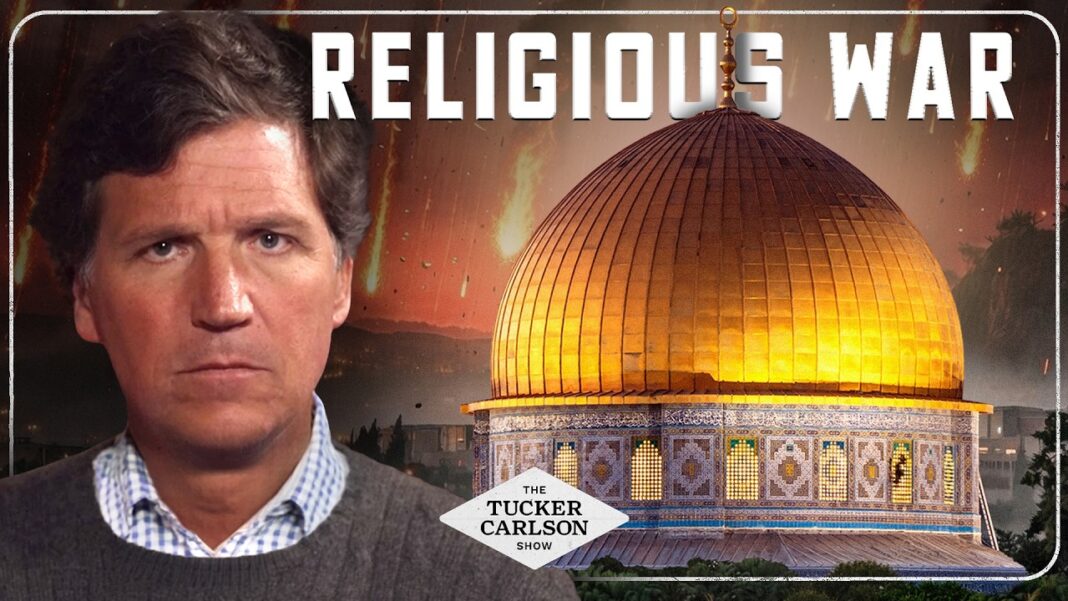
In his latest foray into the most egregious forms of anti-Semitic rhetoric, far-right podcaster Tucker Carlson has turned his attention toward one of the most visible and benevolent Jewish movements in the world — the Chabad-Lubavitch community — deploying sweeping conspiratorial language that is not only false but dangerously irresponsible. According to a report on Thursday by Jewish Insider, Carlson used a recent episode of his program to accuse Chabad of seeking to ignite a “religious war” amid the ongoing U.S. and Israeli strikes on Iran, invoking apocalyptic imagery and theological distortions that have alarmed Jewish leaders across the political spectrum.
Carlson’s remarks, delivered late Wednesday night, painted an ominous and factually unfounded portrait of Jewish intentions in the Middle East. He claimed that Jews view the war against Iran as an opportunity to feud with Islam and even to target Christianity. Among his most incendiary assertions was the suggestion that Jews seek to destroy the al-Aqsa Mosque and the Dome of the Rock in Jerusalem in order to rebuild the Third Temple — a claim long circulated in extremist circles but repeatedly rejected by mainstream Jewish authorities and the Israeli government.
Carlsin’s shocking and inflammatory rhetoric above
The Jewish Insider report detailed how Carlson singled out the Chabad movement, alleging that its goal is the rebuilding of the Temple and that such aspirations place Jews at odds with Christians. “Christians have a way of dying disproportionately in these wars, which tells you something about their real motives,” Carlson said, implying ulterior designs behind Jewish theological beliefs. He went on to argue that rebuilding the Temple — destroyed by the Romans in the first century — is “totally anathema to Christianity,” as though this eschatological divergence were evidence of malevolent intent.
The claims reflect a profound mischaracterization of Jewish theology and contemporary Jewish life. While it is true that Orthodox Jews incorporate into their daily prayers a hope for the eventual rebuilding of the Temple in the Messianic era, this aspiration is understood as a divine, not human-engineered, event. As the Jewish Insider reported, no mainstream Jewish denomination advocates for the destruction of Muslim holy sites to hasten that outcome. Israeli policy itself strictly forbids Jewish prayer on the Temple Mount, underscoring the sensitivity and complexity of the issue.
Rabbi Mordechai Lightstone, Chabad’s social media director, responded directly to Carlson’s insinuations. In comments cited by Jewish Insider, Lightstone emphasized that belief in the Messianic era and the rebuilding of the Temple is a foundational element of Jewish faith — one of the 13 Principles articulated by Maimonides — but that it is accompanied by a vision of universal peace and goodwill. “Acts of destruction or the subjugation of other nations are an anathema to a time when good will flow in abundance,” Lightstone wrote. The Messianic vision, he stressed, envisions a world where “the occupation of the entire world, Jew and non-Jew alike, will be to know the divine.”
The recent accusation by Tucker Carlson claiming that @Chabad @Lubavitch is somehow behind the war in Iran is not merely bizarre. It is a repackaging of one of the oldest antisemitic tropes in history.
When Tucker says “Chabad,” his intention is obvious. Chabad is the largest,… pic.twitter.com/j9ghRxuOqa
— Rabbi S Litvin (@BluegrassRabbi) March 5, 2026
Critics of Carlson’s rhetoric argue that his framing does more than misinform; it feeds into centuries-old tropes that cast Jews as clandestine architects of global conflict. The Jewish Insider report noted that Carlson’s language echoes conspiracy theories that have historically fueled antisemitic violence. By suggesting that Jews harbor secret designs to dismantle Islamic holy sites or manipulate geopolitical conflicts for religious ends, he taps into narratives that have repeatedly proven dangerous.
The reaction to Carlson’s comments was swift and pointed. Punchbowl News founder Jack Sherman dismissed the accusations as “so absurd” that they defy comprehension. “If you know anything about Chabad,” Sherman wrote, as quoted by Jewish Insider, “they have one mission: encouraging Jewish people to practice Judaism.” Karol Markowicz, a columnist for the New York Post, similarly criticized Carlson for targeting “the warmest, kindest, most welcoming organization ever that does nonstop charity work.”
Those descriptions align with the lived experience of millions who have encountered Chabad’s global network of emissaries, known as shluchim. For decades, Chabad has operated thousands of centers worldwide, offering educational programs, holiday services, youth initiatives, and social support to Jews of all backgrounds. Its emissaries often serve in remote or underserved communities, providing pastoral care, food assistance, and cultural programming. Jewish Insider has frequently chronicled Chabad’s role in disaster relief efforts, from mobilizing volunteers after hurricanes and wildfires to distributing meals during the COVID-19 pandemic.
In the United States alone, Chabad institutions have become fixtures in cities and suburbs, college campuses, and rural towns. Their mission is not political agitation but spiritual engagement — encouraging Jewish observance, strengthening communal bonds, and extending hospitality. It is precisely this visible presence and reputation for warmth that makes Carlson’s allegations so jarring to those familiar with the movement.
Beyond reputational harm, there are tangible security concerns. The Jewish Insider reported that Carlson’s rhetoric has sparked fears about the physical safety of Chabad sites. In January, a man repeatedly drove his car into Chabad’s Brooklyn headquarters in what authorities described as a deliberate act. The NYPD has since announced increased patrols at Jewish locations amid rising tensions following the Iran strikes. Against this backdrop, inflammatory language from a media figure with millions of followers carries potential consequences.
Security experts note that conspiracy theories often function as accelerants. When influential voices amplify claims that a minority group is orchestrating war or seeking to destroy sacred sites, fringe actors may interpret such narratives as justification for violence. The Jewish Insider’s coverage underscores the anxiety within Jewish communities that Carlson’s comments could embolden extremists.
The broader pattern of Carlson’s commentary has also drawn scrutiny. Critics have long accused him of indulging in conspiratorial thinking that frames global events as orchestrated by hidden elites. In this instance, the Jewish Insider highlighted how his claims about Chabad fit within a worldview that casts Jews as central actors in a cosmic struggle, rather than as participants in a pluralistic society.
What distinguishes this episode is the specificity of the target. Chabad is not a shadowy organization operating behind closed doors; it is a visible, accessible, and service-oriented movement. Its public activities are transparent and community-focused. To suggest that it is maneuvering to provoke a religious war represents not merely hyperbole but a distortion untethered from observable reality.
At a time when antisemitic incidents have surged across the United States and Europe, the stakes of public discourse are particularly high. The Jewish Insider has documented numerous episodes in which rhetoric online translated into harassment or vandalism offline. The conflation of theological concepts with political conspiracies risks deepening misunderstandings and fostering suspicion.
Religious scholars emphasize that eschatological beliefs are common across traditions. Christianity, Islam, and Judaism all contain visions of a future era of redemption. Interpreting such beliefs as evidence of present-day aggression reflects either profound ignorance or deliberate provocation. Carlson’s insistence that rebuilding the Temple is inherently antagonistic to Christianity ignores centuries of interfaith dialogue and the reality that most Jewish communities approach Messianic hope as a spiritual, not geopolitical, aspiration.
In responding to the controversy, Jewish leaders have urged clarity and calm. They stress that Chabad’s mission is rooted in outreach and kindness, not confrontation. The movement’s global presence — from soup kitchens to educational seminars — stands in stark contrast to the apocalyptic narrative Carlson advances.
As the Jewish Insider continues to report on the fallout, the episode serves as a cautionary tale about the power of rhetoric in an era of heightened polarization. Public figures wield influence that extends beyond their immediate audiences. When that influence is used to amplify unfounded conspiracies about religious communities, the consequences can ripple outward in unpredictable and troubling ways.
For Chabad’s emissaries and volunteers, the work continues: lighting Shabbat candles with college students, delivering food to families in need, organizing holiday celebrations that bring neighbors together. In that quotidian devotion to service lies a quiet rebuttal to Carlson’s narrative — a lived demonstration that faith, when practiced with humility and compassion, builds bridges rather than kindles war.
