



|
Getting your Trinity Audio player ready...
|
By: Abe Wertenheim
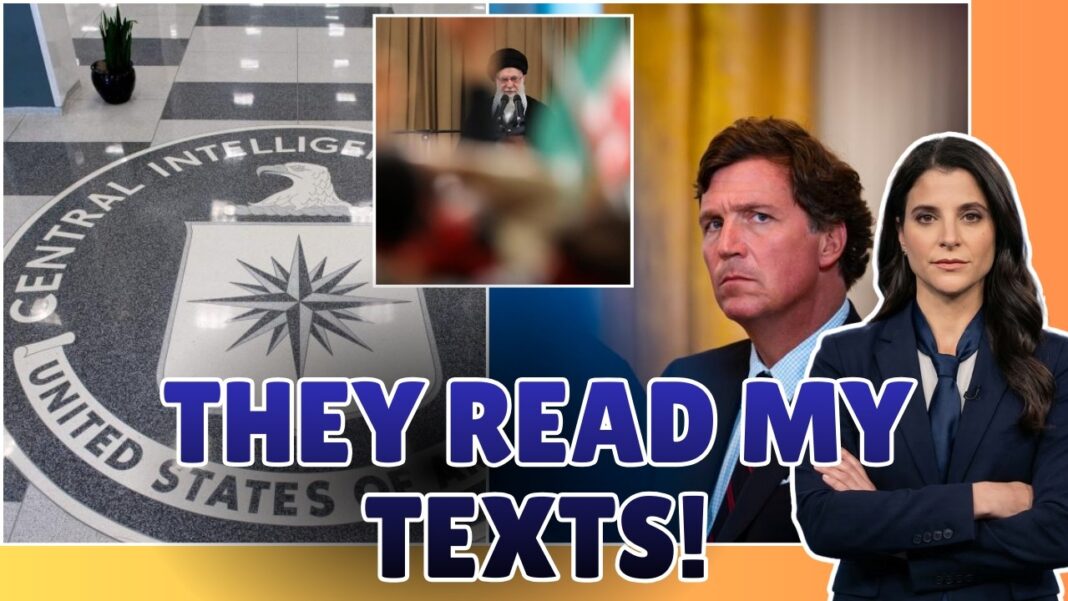
Amid the intensifying geopolitical tensions surrounding the United States–Israel conflict with Iran, conservative commentator Tucker Carlson has ignited a new political firestorm by alleging that the Central Intelligence Agency intercepted his private communications and recommended criminal charges against him for allegedly acting as an unregistered foreign agent for Tehran.
Carlson made the explosive claim in a video posted Saturday evening on the social media platform X, asserting that intelligence officials had accessed his text messages and were now urging the United States Department of Justice to investigate him under the Foreign Agents Registration Act.
The allegations, which have not been independently confirmed by federal authorities, have reverberated across political circles and media outlets. Coverage by The New York Post and other news organizations on Sunday has underscored both the extraordinary nature of Carlson’s accusations and the broader debate they have triggered about surveillance, free speech, and dissent during wartime.
In the video message, Carlson claimed that federal intelligence agencies had monitored his communications with contacts in Iran prior to the outbreak of hostilities between the United States, Israel, and the Islamic Republic.
“The CIA is preparing some kind of criminal referral against me,” Carlson said, according to remarks highlighted by The New York Post. “A crime report to the Department of Justice on the basis of a supposed crime I committed.”
Carlson suggested that the alleged offense involved his communications with individuals inside Iran during the tense weeks preceding the war. “What’s that crime? Well, talking to people in Iran before the war,” he said. “They read my texts.”
When you discover the CIA has been reading your texts in order to frame you for a crime. pic.twitter.com/XgoluHw8EG
— Tucker Carlson (@TuckerCarlson) March 14, 2026
Carlson’s claims, if substantiated, would raise profound questions about the monitoring of American citizens and journalists by intelligence agencies—particularly in the context of an ongoing international conflict. However, as The New York Post noted in its coverage, no official confirmation of such surveillance or referral has been publicly announced by either the CIA or the Department of Justice.
Carlson suggested that prosecutors could attempt to charge him under the Foreign Agents Registration Act (FARA), a law enacted in 1938 to counter covert propaganda campaigns conducted by foreign governments. The statute requires individuals who receive payment from foreign governments for lobbying, advocacy, or political influence operations within the United States to register with the Justice Department. Failure to do so can result in criminal prosecution.
According to the report cited by The New York Post, Carlson categorically rejected any suggestion that he had acted on behalf of the Iranian government. “I’m not an agent of a foreign power,” he said in his video statement. “Unlike a lot of people commenting on U.S. politics and global affairs, I have only one loyalty, and that’s the United States.” Carlson further insisted that he has never received financial compensation from any foreign government. “I’ve never taken money from another country,” he said. “Don’t need it, don’t want it.”
Carlson defended his communications with Iranian sources by arguing that journalists and commentators must speak with individuals across political and national boundaries in order to understand world events.
“It’s my job to talk to everybody all the time and try to figure out what’s happening around the world,” Carlson said, according to The New York Post. “I’m an American. I can talk to anybody.”
This defense echoes longstanding arguments made by journalists and foreign correspondents who frequently engage with officials and sources in adversarial states as part of their reporting. Critics, however, have questioned whether Carlson’s activities crossed the line from journalism into political advocacy, particularly given his public commentary on U.S. policy toward Iran.
Carlson’s allegations come at a time when the United States is deeply engaged in a military confrontation with Iran. The conflict escalated following the launch of Operation Epic Fury, a joint U.S.–Israeli military campaign targeting Iranian missile facilities, naval assets, and nuclear infrastructure.
Carlson has emerged as one of the most vocal critics of the operation, repeatedly condemning the strikes in public statements and media appearances. In comments highlighted in The New York Post report, Carlson described the killing of Iran’s Supreme Leader Ali Khamenei during the campaign as “absolutely disgusting and evil.” He has also argued that the war is being fought primarily to serve Israeli interests rather than American ones. Such remarks have drawn sharp criticism from officials in Washington.
Carlson’s opposition to the Iran campaign has also placed him at odds with some of his former allies within the conservative movement. Although he was previously regarded as a prominent supporter of Donald Trump, relations between the two men appear to have cooled as the conflict intensified. The New York Post reported that Trump publicly criticized Carlson earlier this year, declaring in a March interview that the commentator had “lost his way.”
“I knew that a long time ago,” Trump reportedly said. “He’s not MAGA.” The comments marked a dramatic shift from Trump’s earlier praise of Carlson as “a very conservative guy” and “a very good guy.”
Before the outbreak of war, Carlson had reportedly met with Trump several times at the White House. According to coverage referenced by The New York Post, the meetings occurred during the weeks leading up to the start of military operations against Iran.
One such meeting reportedly took place on February 23, shortly after Carlson conducted a controversial interview with then-U.S. Ambassador to Israel Mike Huckabee. Observers speculated at the time that Carlson’s White House visit may have included a private discussion about his public criticism of the administration’s Iran policy. However, neither Carlson nor the White House has confirmed the details of those conversations.
Carlson’s engagement with Iranian political figures has drawn scrutiny before. In July 2025, he conducted a widely criticized interview with Iran’s president, Masoud Pezeshkian. During the conversation, Carlson was accused by critics of allowing the Iranian leader to present his government’s narrative without significant challenge.
Marcus Kolga, an expert on foreign disinformation campaigns, told Iran International that the interview represented a propaganda victory for Tehran. “This was a major victory for Iranian information warfare operations,” Kolga said at the time. “Whether intentionally or not, Carlson is acting as a significant conduit and amplifier for Iranian government information operations.”
The New York Post noted that the interview intensified debate over Carlson’s role as both a media commentator and a political influencer.
Carlson suggested in his recent video that the alleged investigation against him may be driven by political disagreements over Israel and U.S. foreign policy. “There are some people who are mad at me for my views about Israel,” he said. Carlson also argued that governments often restrict dissent during wartime. “Countries tend to become more authoritarian in wartime,” he said, according to remarks cited by The New York Post. “There’s much less tolerance for dissent.”
Such claims echo historical debates about civil liberties during periods of national crisis, when governments have sometimes expanded surveillance and security measures.
Carlson’s accusations—whether ultimately proven or disproven—touch on longstanding tensions within American democracy. On one hand, intelligence agencies are tasked with protecting national security, particularly during times of war. On the other hand, the United States has a strong tradition of safeguarding freedom of speech and protecting journalists from government interference.
Legal experts note that the Foreign Agents Registration Act has historically been used to prosecute individuals who secretly lobby or advocate on behalf of foreign governments. However, applying the statute to a media commentator would likely generate intense legal and constitutional debate.
As of now, no federal agency has confirmed Carlson’s claims regarding surveillance or potential charges. The CIA and the Department of Justice have not publicly responded to the allegations. Nonetheless, the controversy has already sparked heated debate across political and media circles.
Coverage by The New York Post has highlighted the broader implications of the dispute, noting that Carlson’s accusations intersect with several of the most contentious issues in American public life: national security, media influence, and the boundaries of dissent during wartime.
Whether Carlson’s claims ultimately prove accurate or unfounded, the episode underscores the extraordinary political tensions surrounding the conflict with Iran. In an era defined by rapid information flows, polarized politics, and global confrontation, the intersection of journalism, intelligence operations, and foreign policy has rarely been more volatile—or more consequential.
