



|
Getting your Trinity Audio player ready...
|
Trump’s Popular Vote Victory Signals a “Revenge” for the Working Class, Says CNN’s Scott Jennings
Edited by: Fern Sidman
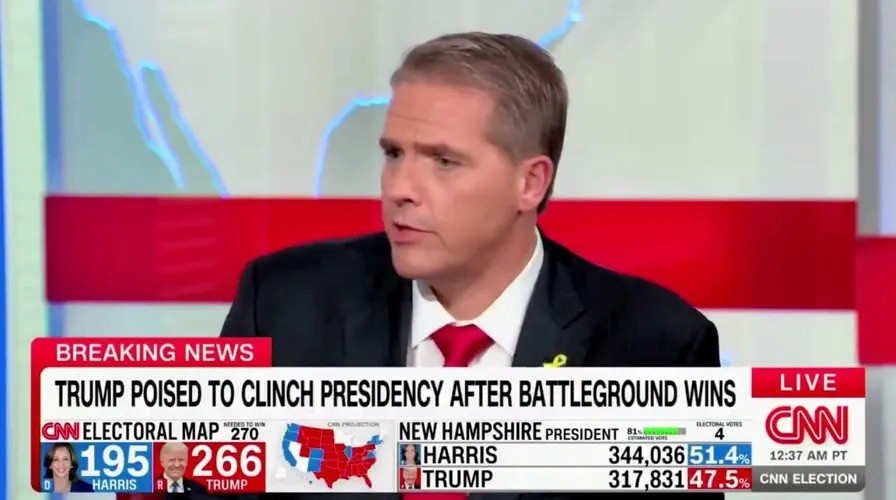
In a compelling analysis of the recent election results, CNN Senior Political Commentator Scott Jennings shed light on the historic significance of President Trump’s victory in the national popular vote. Jennings highlighted that this achievement marks a profound shift in American politics, one that transcends mere electoral success. According to a report on the Vois Es Nais web site, Jennings views this outcome as emblematic of a broader societal awakening, as the voice of the working-class American who has felt silenced, overlooked, and disparaged by the political establishment is now resounding across the nation.
Scott Jennings👌addresses THE
ongoing existential CRISIS of the #Democrat party, and rest of the
CNN 📺 panel AGREE WITH HIM.– WHAT are we?
– WHO are we?
– WHAT do we STAND for?#Trump’s LANDSLIDE victory just
DESTROYED the Democrat party
as we KNOW it. 🤡🇺🇸💥 KARMA https://t.co/1jB5CBWetg pic.twitter.com/DF1PwceUPH— Agent TruthTeller🕵️♀️ (@AgentTruthTell3) November 7, 2024
Jennings interprets Trump’s popular vote win as more than a victory for a single candidate; he sees it as a watershed moment that illustrates the rising influence of everyday Americans who feel alienated by traditional power structures. The Vois Es Nais report indicated that, for Jennings, this election is a form of “revenge” for those citizens who have long been dismissed as inconsequential by the political elite. Trump’s popularity among working-class voters, Jennings argues, is rooted in a deep-seated frustration with a system they view as fundamentally rigged against them, with policies that seem to cater more to wealthy elites and coastal intellectuals than to ordinary, hardworking individuals.
A consistent theme in Jennings’s analysis, as noted by Vois Es Nais, is the backlash against the derogatory labels often applied to Trump supporters. Many in this demographic feel that they have been unfairly stereotyped as “garbage” or even “Nazis” by their critics, which has only deepened their resentment toward the political and media establishment. According to Jennings, these labels ignore the nuanced concerns of millions of Americans who are simply seeking respect, opportunity, and a chance to be heard. By casting aside these reductive stereotypes, Jennings argues, analysts and politicians alike can gain a clearer understanding of the motivations driving a significant segment of the electorate.
The Vois Es Nais report also highlighted that Jennings’s point that Trump’s appeal to the working class resonates is because he acknowledges the struggles and frustrations of Americans who feel crushed under the weight of economic disparity, eroding job opportunities, and a lack of representation in Washington. This election, according to Jennings, illustrates that the voice of the “forgotten” American is now impossible to ignore. Trump’s popular vote win represents a validation of these voices—a demonstration of the power of a demographic that feels marginalized by globalization, stagnant wages, and an economy that increasingly seems to benefit the few at the expense of the many.
Jennings’s commentary also calls attention to the broader cultural divides that have come to define contemporary American politics. According to the report at Vois Es Nais, he observes that this election has brought the frustrations of rural and working-class Americans to the forefront, highlighting a clear schism between them and the coastal urban elites who often dominate political discourse. For Jennings, the popular vote victory signals a seismic shift: a challenge to the dominance of elite-driven narratives that, in his view, have too often ignored the lived experiences and concerns of working Americans.
At the heart of Jennings’s analysis is a call for a more inclusive and empathetic political approach. As reported by Vois Es Nais, he argues that the political elite would do well to listen to the concerns of this pivotal voter base rather than dismissing them. The election has shown, Jennings believes, that millions of Americans are tired of being patronized, tired of feeling invisible, and ready to demand a seat at the table. This shift, he suggests, is not merely a reaction to economic hardship but a response to years of cultural condescension, where the values and priorities of the working class have often been sidelined in favor of those espoused by the elite.
In Jennings’s view, this election serves as a wake-up call to political leaders across the spectrum: the voice of the working class is powerful and cannot be relegated to the sidelines. Vois Es Nais reported that Jennings’s analysis offers a roadmap for understanding this significant political shift—one that underscores the importance of respect, inclusion, and genuine representation for all Americans, not just those at the top. Trump’s victory in the popular vote is, in Jennings’s eyes, a signal that these Americans have taken back control of their narrative, determined to shape the future of their country on their own terms.
For Jennings, the takeaway from this election is clear: the working-class American is no longer content with a passive role in the nation’s political discourse. Their “revenge,” as he terms it, is not about vengeance but about a demand for recognition and a rejection of the labels and stereotypes that have too often defined them. Through this lens, Trump’s popular vote victory is not merely a political triumph but a profound moment of cultural validation for millions of Americans who feel their voices are finally being heard.
