



|
Getting your Trinity Audio player ready...
|
By: Fern Sidman – Jewish Voice News
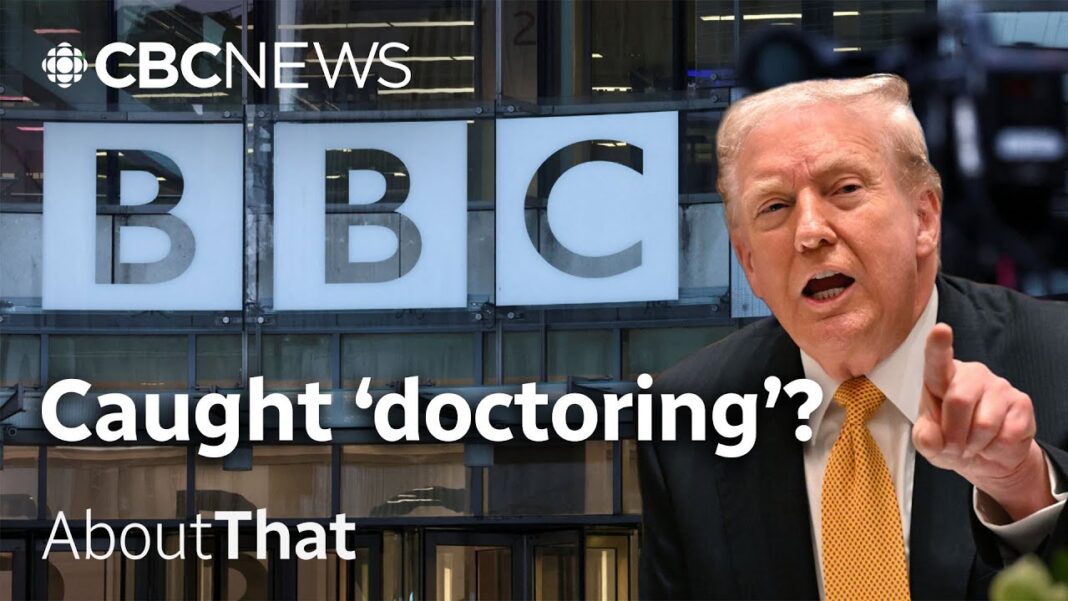
In an escalating international media controversy that has shaken one of the world’s most respected news institutions, President Trump announced on Tuesday that he intends to sue the British Broadcasting Corporation (BBC) over what he described as “a deliberate and dishonest manipulation” of his January 6, 2021, speech — an act he claims “defrauded the public” and “distorted history.”
As Israel National News reported on Wednesday, Trump’s remarks came during a televised interview with Fox News host Laura Ingraham, where he stated unequivocally that he felt “an obligation” to pursue legal action. “Well, I think I have an obligation to do it,” Trump said, speaking with characteristic resolve. “They defrauded the public, and they’ve admitted it… This is within one of our great allies, you know. This is supposedly our great ally, BBC. The government has a chunk of that one, I guess. But that’s a pretty sad event.”
The BBC scandal, which has dominated headlines across Europe and the United States, centers on the discovery that the network edited key segments of Trump’s January 6 speech, omitting passages in which he explicitly urged his supporters to “act peacefully and patriotically.” Instead, the edited version — broadcast to millions — made it appear as though Trump’s remarks were continuous and incendiary, delivered without pause or moderation.
As the Israel National News report detailed, the revelations triggered an immediate public and political outcry, culminating in the resignations of BBC Director-General Tim Davie and Deborah Turness, the network’s CEO of News and Current Affairs. Both officials stepped down on Sunday amid mounting pressure following the publication of internal reports and leaked communications showing that senior producers were aware of the edits but allowed the altered version to air.
In the wake of the resignations, the BBC issued a terse statement acknowledging that it had received a formal letter from Trump’s legal team threatening litigation and would “respond in due course.”
Trump, who has frequently criticized global media outlets for what he perceives as coordinated efforts to undermine him, described the BBC’s conduct as “beyond journalistic failure — an act of fraud.” Speaking to Ingraham, he accused the network of intentionally attempting to “influence the course of a presidential election” through misinformation.
“They actually changed my January 6th speech,” Trump said, as quoted by Israel National News, “which was a beautiful speech — a very calming speech. And they made it sound radical. And they actually changed it. It was very dishonest.”
The president reiterated his frustration in a post on his Truth Social platform, writing: “These are very dishonest people who tried to step on the scales of a Presidential Election. On top of everything else, they are from a foreign country, one that many consider our Number One Ally. What a terrible thing for Democracy!”
Trump’s emphasis on the foreign nature of the BBC has drawn attention to the potential diplomatic implications of his lawsuit. As the Israel National News report observed, the BBC operates under a royal charter and receives funding through the British government’s television licensing system — effectively giving it quasi-public status. For Trump, this fact raises deeper questions about whether a foreign, state-linked broadcaster sought to interfere in American political discourse.
At the heart of the controversy lies the omitted section of Trump’s speech delivered near the White House on January 6, 2021. The full transcript, available from the National Archives, shows Trump telling the crowd: “I know that everyone here will soon be marching over to the Capitol building to peacefully and patriotically make your voices heard.”
However, in the version aired by the BBC, this passage was entirely removed, and the network edited together segments separated by more than 40 minutes — presenting them as a single, continuous statement.
According to the information provided in the Israel National News report, this manipulation “created a misleading impression that Trump had directly incited violence without qualification or pause.” Analysts have described the BBC’s edits as one of the most damaging ethical breaches in its modern history, comparable in scope to the infamous 1995 Diana interview scandal that similarly rocked the broadcaster’s reputation.
The BBC’s internal review, led by communications strategist Michael Prescott, reportedly concluded that editorial judgment had been compromised by political bias within senior ranks. The review identified patterns of “emotive framing” and “narrative-driven editing” in multiple reports concerning U.S. politics and the Israeli–Palestinian conflict.
As the Israel National News report highlighted, Prescott’s report also criticized the BBC’s Arabic-language service for disseminating “anti-Israel bias and unverified claims” during last year’s Gaza conflict — findings that had already drawn strong condemnation from the Embassy of Israel in the UK.
The embassy stated that the network had “consistently failed to uphold accuracy, impartiality, and integrity,” noting that “its reporting has too often provided a platform for antisemitic and extremist narratives.” The embassy added that the resignation of Davie and Turness should mark “a turning point” for the network to “restore public trust through transparency and reform.”
In this broader context, the Trump speech scandal appears to have been the final blow to the embattled broadcaster’s leadership — a culmination of years of criticism regarding its handling of Israel-related stories, transatlantic politics, and coverage of populist movements.
From a legal standpoint, Trump’s case against the BBC — should he proceed — would likely test international media law and defamation standards. Experts told Israel National News that the case could hinge on whether Trump’s team can demonstrate intentional malice or reckless disregard for the truth, the same threshold used in U.S. libel law under New York Times Co. v. Sullivan.
However, the situation is complicated by jurisdictional boundaries. The BBC is based in the United Kingdom, where defamation law traditionally favors plaintiffs. “In Britain, Trump would not have to prove malice — only that the edits materially damaged his reputation,” one London-based legal scholar explained to Israel National News. “That gives him a potentially stronger case than he might have in the U.S.”
Diplomatically, the timing is delicate. With the Trump administration back in power, the White House is seeking to reinforce its “special relationship” with London while also holding international media organizations accountable for perceived bias. Some British officials, speaking anonymously to Israel National News, have voiced concern that a prolonged legal battle could “strain bilateral goodwill at a sensitive moment.”
Beyond the immediate legal ramifications, the case shines a spotlight on the enduring tension between media freedom and media accountability — a theme that has dominated both American and European discourse since the rise of digital misinformation.
Trump’s insistence that the BBC’s conduct “was very dishonest” taps into a broader public skepticism toward mainstream media institutions, which he has long accused of colluding against conservative voices. As the Israel National News report observed, “the BBC controversy has reignited global debate about the role of publicly funded broadcasters and whether their editorial independence has been compromised by political ideology.”
Critics argue that the BBC’s editing of Trump’s speech is not an isolated incident but part of a pattern in which narratives are shaped to align with institutional biases. Supporters of the network, meanwhile, contend that while mistakes were made, the corporation remains a vital bastion of free journalism in an era of partisanship and polarization.
As of Tuesday evening, the BBC had not issued a formal apology to Trump or the American public, though insiders told Israel National News that “senior editorial figures are bracing for litigation.”
Trump, for his part, appears determined to press forward. “They tried to alter the truth,” he said during his Fox News interview. “And when you alter the truth, you’re not just lying — you’re rewriting history. I won’t let that stand.”
For many observers, the outcome of this dispute may reverberate far beyond Trump or the BBC itself. As the Israel National News report noted, “This confrontation between a sitting American president and the world’s most storied broadcaster is not merely a legal battle. It is a referendum on truth — on whether journalism still has the courage to confront its own errors and rediscover its moral compass.”
In a media landscape increasingly defined by mistrust, distortion, and ideological polarization, that reckoning may be long overdue.